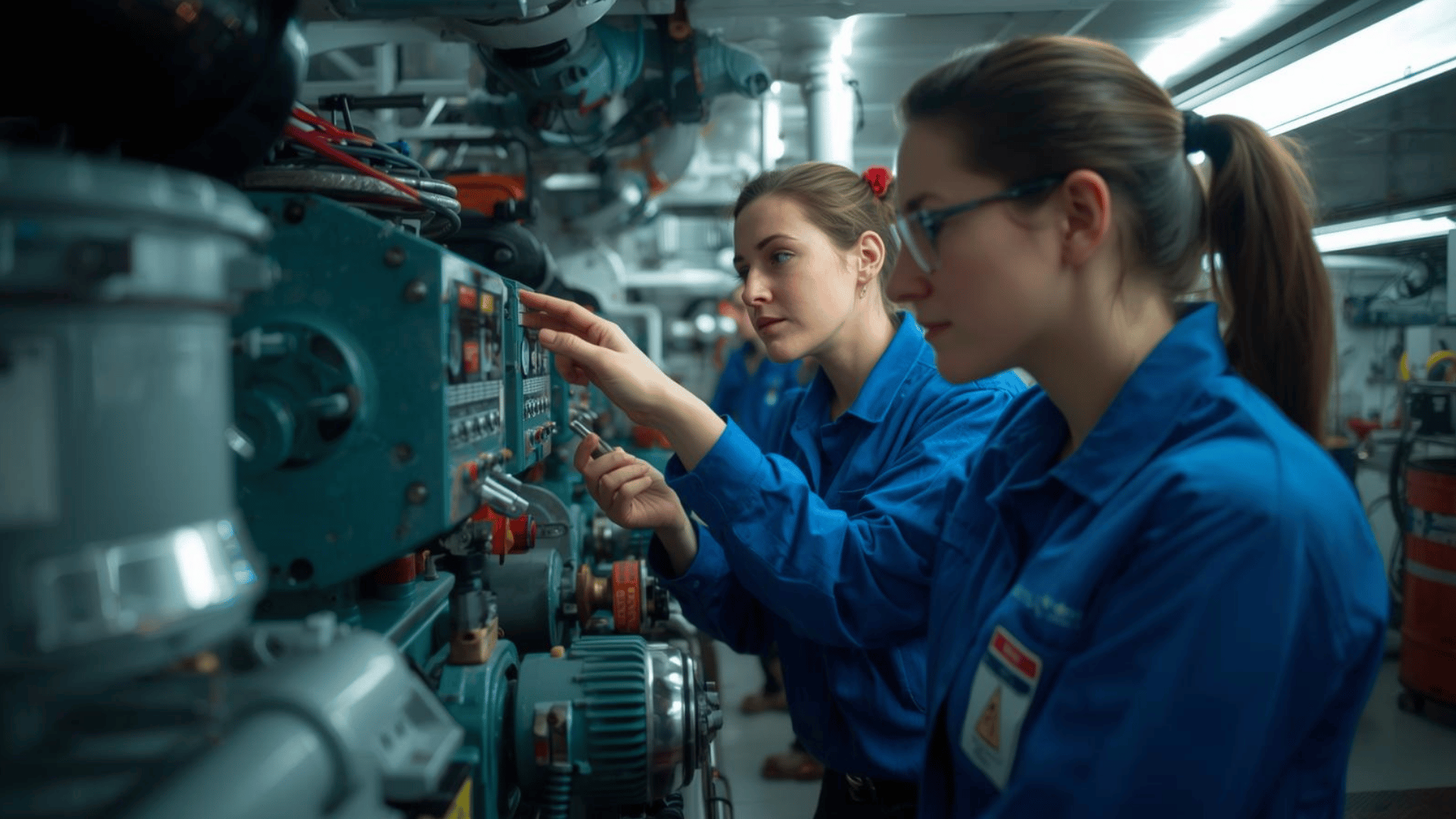
The emergency generator is the last line of electrical defence on any ship. When the main generators fail — through engine breakdown, fuel contamination, blackout, or fire in the machinery space — the emergency generator must start automatically, pick up its designated loads, and sustain them without interruption. It powers navigation lights, radio communications, fire detection systems, emergency bilge pumps, steering gear, and watertight door controls. A failure to start when needed is not an inconvenience; it is a genuine threat to the vessel and everyone on board.
Because the emergency generator spends most of its service life in standby mode, it is paradoxically more vulnerable to maintenance neglect than equipment that runs continuously. A continuously running engine gives constant feedback — noise, temperature, pressure readings, exhaust colour. A standby engine gives nothing until the moment it is needed. That is precisely why structured, scheduled maintenance is not optional for emergency generators: it is the only mechanism that reveals developing problems before a real emergency exposes them.
Regulatory Background: What SOLAS Requires
Before examining individual maintenance points, it helps to understand what the emergency generator is required to do under SOLAS Chapter II-1.
The emergency generator must be located above the uppermost continuous deck and in a compartment completely separate from the main machinery space. It must be capable of starting automatically and supplying power within 45 seconds of a main power failure. The generator set must be self-contained — its own starting system, its own fuel supply, its own cooling arrangement — so that a casualty in the engine room cannot disable it simultaneously.
Required operating duration under full emergency load:
| Vessel Type | Minimum Operating Duration |
|---|---|
| Cargo ships | 3 hours |
| Passenger ships | 36 hours |
The emergency generator’s fuel tank must hold enough fuel for the required duration at full load, with the fuel service tank located in the emergency generator room or an adjacent space, not in the main engine room.
These are minimum statutory requirements. Maintaining the generator to these standards in actual service requires the maintenance programme described below.
1. Engine Sump Oil — Regular Level Checks and Scheduled Changes
Because the emergency generator operates in auto-start mode for most of its life, the engine may sit unattended for weeks between weekly test runs. Oil level checks cannot wait for the engine to run — they must be performed as a standalone routine inspection regardless of whether the engine has been operated.
Check the sump dipstick at a minimum of once per week. The oil condition during these checks provides useful information beyond just the level. If the oil appears dark, carries visible carbon or soot particles, or shows signs of water contamination (milky appearance or foam on the dipstick), this indicates a problem that requires immediate investigation — not simply a top-up.
Oil change intervals depend on the engine manufacturer’s specification, the engine design, and the oil grade in use. The typical interval is 250 to 500 running hours. However, this interval must be halved when the fuel in use contains more than 0.5% to 1% sulphur content. High-sulphur combustion produces sulphuric acid compounds in the exhaust, some of which blow past piston rings and contaminate the sump oil. Oil degraded by acid attack loses its protective film strength and accelerates bearing wear.
On emergency generators that accumulate running hours slowly due to infrequent use, a calendar-based oil change — regardless of hours — should also be considered. Oil degrades over time even without running, as oxidation, moisture absorption, and additive depletion occur during storage.
2. Air Cleaner and Filter Maintenance
Every diesel engine requires a clean, unrestricted supply of combustion air. The emergency generator draws its air through a filter, which may be one of two types:
An oil bath air cleaner uses a reservoir of oil through which intake air passes. Larger particles are trapped in the oil. These require periodic draining and refilling with fresh oil — never allow the oil level to fall below the marked minimum or the filtration effect is lost.
A dry type air cleaner uses a paper or fabric cartridge element that physically captures dust and particles. These are more common on modern units. The cartridge becomes progressively more restrictive as it loads with particulate, and must be cleaned or replaced on schedule. The typical replacement interval is one year or after five to seven cleaning cycles — whichever comes first. Beyond this point, the cartridge material degrades and cleaning no longer restores adequate airflow.
A clogged air filter causes the engine to run rich, produces black exhaust smoke, raises exhaust temperatures, and reduces power output. In an emergency start scenario, a restricted air supply may prevent the engine from reaching rated speed or from sustaining load — exactly when full performance is most critical.
3. Fuel System and Filter Maintenance
Fuel quality and fuel system cleanliness are fundamental to reliable starting. Emergency generators typically run on marine diesel oil (MDO) or marine gas oil (MGO), but even clean distillate fuel picks up water and sediment during storage in the day tank.
The water separator, where fitted, prevents water from reaching the injection system. Check the water separator’s collection bowl at every maintenance visit and drain it completely if any water is present. Water in diesel fuel causes injector corrosion, incomplete combustion, and — in cold conditions — ice crystal formation that can block fuel lines entirely.
Fuel feed pump filters and main fuel filters must be cleaned or have their elements renewed at the intervals stated in the manufacturer’s manual, or sooner if there is any sign of restricted flow. Blocked fuel filters are among the most common causes of emergency generator failure to start or failure to sustain load.
If the day tank has not been used recently, drain a small quantity from its lowest point and inspect for water separation or sediment before the next test run.
4. Lube Oil Filter and Centrifugal Filter Maintenance
The lubrication system typically includes several filtering stages: a full-flow lube oil filter, a centrifugal filter, and a bypass filter. Each serves a different function and requires separate attention.
The full-flow lube oil filter handles all oil flowing to the bearings and must be clean to maintain adequate oil pressure. Replace the filter element at the manufacturer’s specified interval — typically coinciding with oil changes — or immediately if a pressure differential alarm activates.
The centrifugal filter, where fitted, uses rotational force to separate very fine particles from the oil. It should be opened, cleaned, and inspected at the intervals stated in the maintenance manual. The sludge accumulation pattern inside the centrifuge bowl also gives useful information about engine condition — an unusually large accumulation of metallic particles suggests abnormal internal wear.
Bypass filters should be inspected and replaced per maker instructions. Neglecting any stage of the oil filtration system allows contaminants to circulate through bearings and cause accelerated wear.
5. Valve Clearance Inspection and Adjustment
The inlet and exhaust valves of the diesel engine operate through a mechanical linkage — rocker arms actuated by the camshaft — and the clearance between the rocker arm and the valve stem tip must be within the manufacturer’s specified range. This clearance is known as tappet clearance.
Incorrect tappet clearance has direct consequences for engine performance. Too little clearance prevents valves from seating fully, causing compression loss and hot gas blowby past the valve seat. Too much clearance reduces the duration of valve opening, cutting air intake and exhaust scavenging efficiency.
Tappet clearance must always be checked and adjusted on a cold engine. On a warm engine, thermal expansion of components gives false readings. Check the clearances at the running hours specified in the maintenance section of the generator manual — typically at major inspection intervals — and record the measured values against the specified values for both inlet and exhaust on each cylinder. Any cylinder showing significant deviation should be adjusted immediately.
6. Battery Maintenance and Charging System Verification
Most emergency generators use electric start as the primary or sole starting method. The starting battery is therefore a critical component in the chain between a blackout occurring and the emergency generator coming online within the mandatory 45-second window.
Key battery maintenance tasks:
- Electrolyte level — check at regular intervals by inserting a level stick or examining the transparent level indicator if fitted. Top up with distilled water only. Never use tap water, which contains minerals that degrade battery performance.
- Specific gravity — measure with a hydrometer to confirm that the battery is holding a full charge. A battery that reads correct voltage on a voltmeter but has degraded plates will show acceptable open-circuit voltage while being unable to deliver the cranking current needed to start the engine.
- Terminal condition — inspect terminals for corrosion and clean with a wire brush if required. Apply terminal grease or petroleum jelly after cleaning to inhibit future corrosion.
- Charging system — verify that the automatic trickle charger is maintaining battery charge continuously. Emergency generator batteries must be charged from both the main switchboard and the emergency switchboard, so that the battery remains charged regardless of which power source is available. Confirm that both charging circuits are functional.
SOLAS requires that the emergency generator starting system be capable of at least six starts within 30 minutes, and at least two starts within the first 10 minutes. A degraded battery that cannot deliver this performance will fail this requirement — and potentially fail to start the generator when it matters.
7. Cooling Water System Inspection
The emergency generator’s cooling system — whether fresh water cooled with a heat exchanger, raw water cooled, or air cooled — must be in sound condition for the engine to run at normal operating temperature throughout its required duty period.
Inspect the cooling water pump for shaft seal leaks, bearing condition, and impeller wear at the intervals specified by the manufacturer. A failing pump seal that drips slowly when the engine is running may not be visible during a weekly test run, but will rapidly worsen under sustained load.
Check coolant condition in fresh water cooled systems. The antifreeze and corrosion inhibitor concentrations in the coolant degrade over time and must be maintained within the recommended range. Depleted corrosion inhibitor allows internal corrosion of the cooling passages, which produces scale and ferrous particles that accelerate wear in the pump and passages.
In the emergency generator room — which is typically outside the main engine room and may be subject to different temperature conditions — pay particular attention to the risk of freezing in cold-water trades. The cooling system must be protected against freezing or the engine must be kept warm enough to prevent it.
8. Weekly Testing and Comprehensive Operational Checks
No maintenance programme is complete without regular operational testing. For emergency generators, the standard is weekly testing under load — not just a no-load run, but an actual test that confirms the generator will pick up and sustain its designated emergency loads.
A complete weekly test covers:
- Starting — confirm the generator starts automatically and comes on load within 45 seconds. Manual starting should also be tested periodically.
- Voltage and frequency — verify that output voltage and frequency stabilise within normal limits within seconds of the engine reaching operating speed.
- Load acceptance — transfer emergency loads to the generator and confirm stable operation.
- Running parameters — monitor exhaust temperature, lube oil pressure, cooling water temperature, and fuel consumption rate during the test run. Compare against baseline values.
- Physical inspection during run — check for fuel, oil, and coolant leaks; check for unusual vibrations; listen for abnormal noises from the engine, alternator, or auxiliaries.
- Post-run checks — record all parameters in the planned maintenance system log. Note any observations that require follow-up.
- V-belt condition (where fitted) — inspect drive belts for cracking, fraying, or glazing. Check belt tension by pressing the belt at the midpoint between pulleys; acceptable deflection is 10–15 mm depending on the manufacturer. A belt that fails during an emergency start will disable the alternator drive and render the generator useless.
Maintenance Schedule Summary
| Maintenance Task | Interval |
|---|---|
| Sump oil level check | Weekly |
| Weekly operational test under load | Weekly |
| Battery electrolyte and terminal check | Monthly |
| Charging circuit verification | Monthly |
| Water separator drain | Monthly |
| Air filter inspection and cleaning | Per maker (typically 3–6 months) |
| Dry cartridge replacement | Annual or after 5–7 cleanings |
| Fuel filter replacement | Per maker or on condition |
| Lube oil filter replacement | At oil change |
| Centrifugal filter cleaning | Per maker |
| Sump oil change | 250–500 hours or calendar-based |
| Tappet clearance check | Per maker major interval |
| Cooling water quality check | 3–6 months |
| Cooling pump inspection | Annual |
| Full alarm and shutdown test | Per SMS schedule |
An emergency generator that receives disciplined, scheduled maintenance to the points above will start reliably when it is needed. One that is run weekly for five minutes with no further attention is a liability. The distinction between these two situations is entirely in the hands of the engineering team responsible for the vessel’s maintenance management system.
Happy Boating!
Share 8 Important Points To Note For Maintenance Of Emergency Generators On Ship with your friends and leave a comment below with your thoughts.
Read Blow-Down Procedure for Marine Boilers until we meet in the next article.