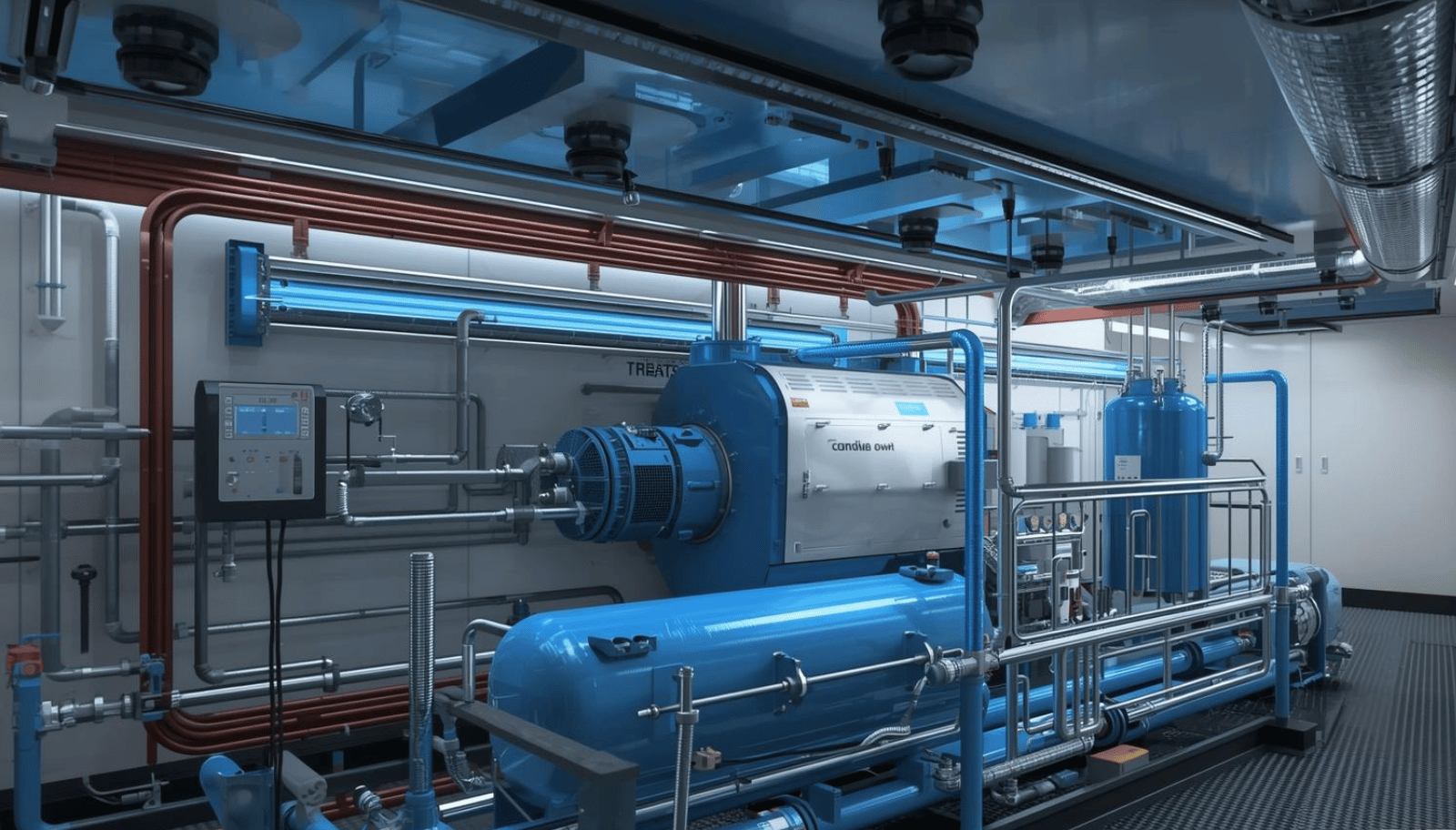
Every time a ship takes on ballast water to maintain stability when traveling without cargo, it draws in a living community from the local ocean — bacteria, algae, larvae, small invertebrates, and fish eggs. When that water is discharged thousands of miles away in a different port, those organisms enter a new marine environment where they have no natural predators. The ecological consequences have been severe in documented cases worldwide: native species displaced, fisheries damaged, and coastal ecosystems permanently altered.
The IMO’s International Convention for the Control and Management of Ships’ Ballast Water and Sediments made ballast water treatment mandatory for commercial vessels. Ships must now treat ballast water to defined biological standards before discharge — a requirement that has driven the development of a diverse range of treatment technologies, each with different operating principles, space requirements, and cost profiles.
This article explains how ballast water treatment systems work, what technologies are available, how they compare, and what a typical shipboard installation looks like.
Why ballast water requires treatment
A large vessel can carry between 1,000 and 100,000 tonnes of ballast water depending on ship size. This water is pumped in at loading ports and discharged at destination ports, often on the opposite side of the world. The organisms it carries — some microscopic, some visible — survive the voyage in sufficient numbers to establish populations in new environments. Invasive species introduced through ballast water have caused collapses in native shellfish populations, algal blooms, and displacement of indigenous marine communities.
The IMO D-2 standard, which most ships must now meet, specifies the maximum allowable concentrations of living organisms in discharged ballast water. Achieving this standard requires active treatment, not simply managing where water is exchanged.
Treatment technology categories
No single technology meets IMO D-2 standards across all organism size categories on its own. Most shipboard systems combine a physical separation stage with a disinfection stage. The selection of which combination to use depends on the ship type, available space and power, ballast water flow rates, trading routes (salinity, temperature, turbidity variations), and capital and operating cost constraints.—
Stage 1: Physical separation / filtration
Physical separation is almost always the first stage in a shipboard ballast water treatment system. Its role is to remove larger organisms, sediments, and suspended solids before the water reaches the disinfection stage. Reducing the biological and particulate load at this point increases the effectiveness of downstream treatment and protects UV lamps or electrodes from fouling.
Screen and disc filtration
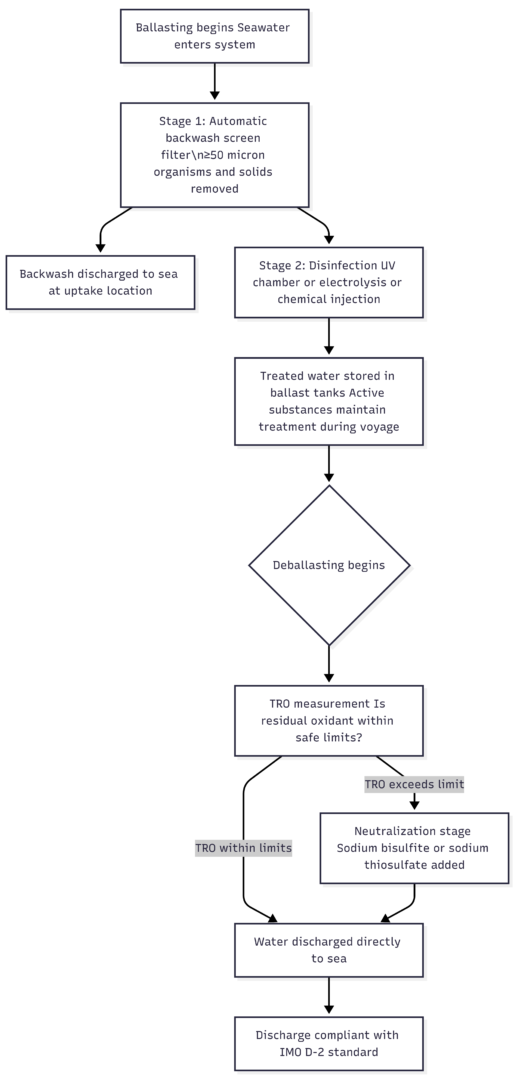
Automatic self-cleaning screen filters are the most widely used physical separation technology. They consist of fine mesh screens — typically rated to remove particles of 50 microns and above — through which ballast water passes during uptake. When the differential pressure across the screen rises as the screen loads with debris, an automatic backwash cycle is triggered. Backwash water, containing the concentrated filtered solids and organisms, is discharged back overboard at the uptake location.
Screen filtration is environmentally clean — it requires no chemicals — and reliably removes the majority of larger organisms. Its limitation is that organisms smaller than the mesh size pass through, which is why screens alone cannot meet IMO D-2 standards without a secondary disinfection stage.
Hydrocyclone
A hydrocyclone uses centrifugal force generated by high-velocity water rotation to separate denser suspended solids from the water stream. Because it has no moving parts, it is mechanically simple to install and maintain. Its limitation mirrors that of screens: performance depends on particle mass and density, so smaller, less dense organisms — including most bacteria and algae — are not effectively removed.
Coagulation and flocculation
For ships dealing with high-turbidity water in coastal or estuarine ports, coagulation is used as a pre-treatment ahead of filtration. A coagulant chemical is added to the ballast water, causing fine suspended particles to aggregate into larger flocs that settle faster and are captured more easily by filters. Some systems add magnetic powder as the coagulant, then use magnetic discs to extract the resulting magnetic flocs from the water. The trade-off with coagulation-based approaches is the additional tank volume required for the flocculation process and the need to carry and manage coagulant chemicals.
Media filters
Compressible media filters — typically using crumb rubber or similar materials — offer finer filtration than screens and are better suited to shipboard use than conventional granular media systems because of their smaller footprint and lower bulk density. They can capture smaller particles that pass through screen filters.
Stage 2: Disinfection
After physical separation, the water still contains microorganisms — bacteria, viruses, and small organisms that passed through the filter — in concentrations that exceed IMO D-2 discharge standards. Disinfection is the stage that kills or permanently inactivates these organisms.
UV radiation
UV treatment is the most widely adopted disinfection method in current BWTS installations. High-intensity UV lamps — typically amalgam UV lamps — are arranged around a stainless steel treatment chamber through which ballast water flows during uptake. Ultraviolet light at wavelengths around 254 nm penetrates cell walls and disrupts the DNA structure of microorganisms. Organisms whose DNA has been damaged cannot replicate and are effectively neutralized, even if they remain physically present in the water.
UV treatment produces no chemical byproducts, requires no neutralization before discharge, and has a well-established safety record. Its limitation is sensitivity to water turbidity — high levels of suspended solids absorb UV energy and reduce penetration depth, which is why pre-filtration is critical in turbid water conditions. UV dose must be maintained above the minimum effective level across the full range of ballast water flow rates.
Electrolysis and electrochlorination
Electrolysis-based systems pass an electrical current through seawater to generate sodium hypochlorite and other oxidizing compounds directly from the chloride ions in the ballast water. These generated oxidants — referred to collectively as Total Residual Oxidant (TRO) — kill microorganisms by attacking cell membranes and disrupting metabolic functions. Because the oxidants are generated in-situ from the seawater itself, no chemical storage is needed during the voyage.
Before discharge, TRO levels in the treated ballast water must be measured. If TRO exceeds safe discharge thresholds, a neutralizing agent — typically sodium thiosulfate or sodium bisulfite — is injected to break down the residual oxidants before the water is released. Electrolysis systems work best in saline water; performance drops significantly in low-salinity or fresh water due to insufficient chloride ion concentration.
Chemical injection — oxidizing biocides
Oxidizing biocides including chlorine, chlorine dioxide, ozone, peracetic acid, and hydrogen peroxide are established disinfectants used across water treatment industries. In ballast water systems, these chemicals are introduced at the ballasting stage to kill organisms in the intake stream or within the tanks.
Chlorination involves dissolving chlorine in water to destroy microorganisms. Ozonation generates ozone gas using an ozone generator and bubbles it into the ballast water, where it decomposes and reacts with organic matter to kill organisms. Both are effective across a broad biological spectrum. Both produce residual oxidants that require monitoring and neutralization before discharge.
Non-oxidizing biocides — which work by interfering with organism reproduction, neural function, or metabolism rather than destroying cell structures — have seen limited adoption because many tend to produce toxic metabolic byproducts. Research continues to identify non-oxidizing compounds that are both effective and environmentally safe after discharge.
Deoxygenation
Deoxygenation removes the oxygen that aerobic organisms need to survive. Nitrogen or another inert gas is injected into the headspace above the water in sealed ballast tanks, displacing oxygen and reducing dissolved oxygen concentration to levels that cannot sustain aerobic life. Organisms asphyxiate and die over a period of approximately two to four days.
Deoxygenation produces no chemical byproducts and is inherently clean after the organisms die. Its constraint is transit time — the treatment requires the water to remain in tanks for two to four days, making it unsuitable for vessels on short coastal or feeder routes. It also requires that ballast tanks be effectively sealed against atmospheric oxygen ingress, which eliminates its applicability on many older vessels. Ships already equipped with inert gas systems can integrate deoxygenation without significant additional space requirements.
Heat treatment
Thermal treatment heats ballast water to temperatures lethal to marine organisms. On some installations, the ballast water serves a dual purpose as engine cooling medium, absorbing heat from the main engine cooling circuit and reaching disinfection temperatures in the process. While thermally effective, this approach increases the time organisms remain viable in the tanks and can accelerate internal corrosion due to elevated temperatures. It is less commonly installed than UV or electrolytic systems.
Cavitation and ultrasonic treatment
High-energy ultrasound generates pressure waves in the water that create and collapse microscopic bubbles. The implosion of these bubbles produces intense local pressure and temperature spikes that rupture cell walls and destroy microorganisms. Ultrasonic or cavitation treatment is generally used as a supplementary stage within combination systems rather than as a standalone disinfection method.
Electric pulse and plasma treatment
Electric pulse systems use metal electrodes in the ballast water to generate very high power density energy pulses that kill organisms directly. Plasma treatment uses a high-energy discharge to generate a plasma arc in the water. Both technologies are at advanced development and early commercial deployment stages and are not yet in widespread fleet use.
How a complete BWTS operates: the three-phase process
Selecting a BWTS: key decision factors
The market offers over 60 IMO and USCG type-approved systems. Selecting the right one for a specific vessel requires evaluating several parameters in combination.
| Selection factor | Considerations |
|---|---|
| Ballast water flow rate | System must handle peak flow rates for the vessel’s ballast pumps |
| Trading route salinity | Electrolysis systems need saline water; poor performance in low-salinity estuaries |
| Water turbidity | High-turbidity ports reduce UV effectiveness; pre-filtration specification must match |
| Available space | UV systems are compact; ozone and chemical injection need additional equipment space |
| Power supply | UV and electrolysis draw significant electrical power; shipboard capacity must support this |
| Transit time | Deoxygenation requires ≥4 days in tanks; unsuitable for short-voyage trades |
| Chemical storage | Injection systems require carrying and managing biocide and neutralizing agent stocks |
| Retrofit vs newbuild | Retrofit installations face more constraints on pipework routing, space, and integration |
| USCG vs IMO approval | US waters require USCG type-approval in addition to IMO; not all systems hold both |
Regulatory framework
The IMO Ballast Water Management Convention establishes the D-2 standard that defines maximum permissible concentrations of living organisms in discharged ballast water. Compliance requires not just a type-approved system but an approved Ballast Water Management Plan and properly maintained records in a Ballast Water Record Book.
The US Coast Guard applies additional requirements through 33 CFR Part 151 for vessels operating in US waters, including its own type-approval process, which uses different biological efficacy testing protocols from IMO. Ships operating on transatlantic or transpacific routes to the US must hold USCG-type-approved equipment in addition to IMO compliance.
Port State Control inspections check ballast water record books, system operational logs, and TRO test results where applicable. Non-compliance findings can result in detention, operational restrictions, and fines.
Maintenance of the treatment system — lamp replacement schedules on UV systems, electrode condition on electrolytic systems, filter element integrity, calibration of TRO sensors — is part of the compliance picture. A type-approved system that is poorly maintained and operating outside its design parameters does not provide compliant treatment regardless of its certification status.
The shift from open ocean ballast water exchange (the previous management approach) to shipboard treatment has been one of the most significant technical compliance challenges in modern commercial shipping. It has also driven genuine innovation in marine water treatment technology, with new system types continuing to enter the approval pipeline as regulations tighten and shipowners seek more efficient, lower-footprint solutions.
Happy Boating!
Share How Ballast Water Treatment System Works? with your friends and leave a comment below with your thoughts.
Read Compressed Air Line On Ships – A General Overview until we meet in the next article.