
Discover your personalized daily water intake with our calculator. Input age, weight, height, activity level, and climate for optimal hydration.
Water is the cornerstone of human health, making up 60–70% of our body weight and playing a critical role in nearly every bodily function. From regulating body temperature to supporting cognitive performance, adequate hydration is essential for maintaining physical and mental well-being. Yet, determining how much water you need daily can be complex, as it depends on factors like age, weight, height, activity level, climate, and health conditions. This comprehensive guide introduces a Daily Water Intake Calculator to provide personalized hydration recommendations and explores the science behind why staying hydrated matters.
Why Hydration Matters
Water is vital for life. The human body relies on it for:
- Nutrient Transport: Water carries essential nutrients and oxygen to cells, ensuring organs function efficiently.
- Temperature Regulation: It helps maintain body temperature through sweating and respiration.
- Waste Removal: Water flushes toxins and waste through urine and supports kidney function.
- Joint Lubrication: It cushions joints, reducing friction and wear.
- Brain Function: Even mild dehydration can impair concentration, memory, and mood.
- Metabolic Processes: Water facilitates chemical reactions critical for energy production and digestion.
The Harvard Medical School notes that water also prevents constipation, normalizes blood pressure, and protects organs and tissues. Without adequate hydration, the body struggles to maintain homeostasis, leading to issues like fatigue, headaches, and even severe conditions like kidney stones or heatstroke.
How Much Water Do You Need?
There’s no universal answer to how much water you should drink daily. The National Academies of Sciences recommends 3.7 liters (125 ounces) for men and 2.7 liters (91 ounces) for women, including water from all sources (beverages and food). However, individual needs vary based on:
- Body Weight: Heavier individuals require more water to support metabolic processes.
- Activity Level: Exercise increases water loss through sweat, necessitating higher intake.
- Climate: Hot or humid environments increase fluid loss, while cold climates may increase energy expenditure.
- Health Conditions: Pregnancy, lactation, or illnesses like diabetes may require adjustments.
- Age: Children and older adults have different hydration needs due to body composition and thirst sensitivity.
The general guideline of “8 glasses a day” (about 2 liters) is a starting point but may not suffice for everyone. Our Daily Water Intake Calculator refines this estimate by factoring in personal variables.
Using the Daily Water Intake Calculator
Our calculator estimates your daily water needs based on a formula that ties water intake to energy expenditure (Total Daily Energy Expenditure, or TDEE). This approach, rooted in clinical practice, suggests 1 ml of water per kcal of energy expended, offering a more precise estimate than weight-based methods alone.
Step-by-Step Guide to Using the Calculator
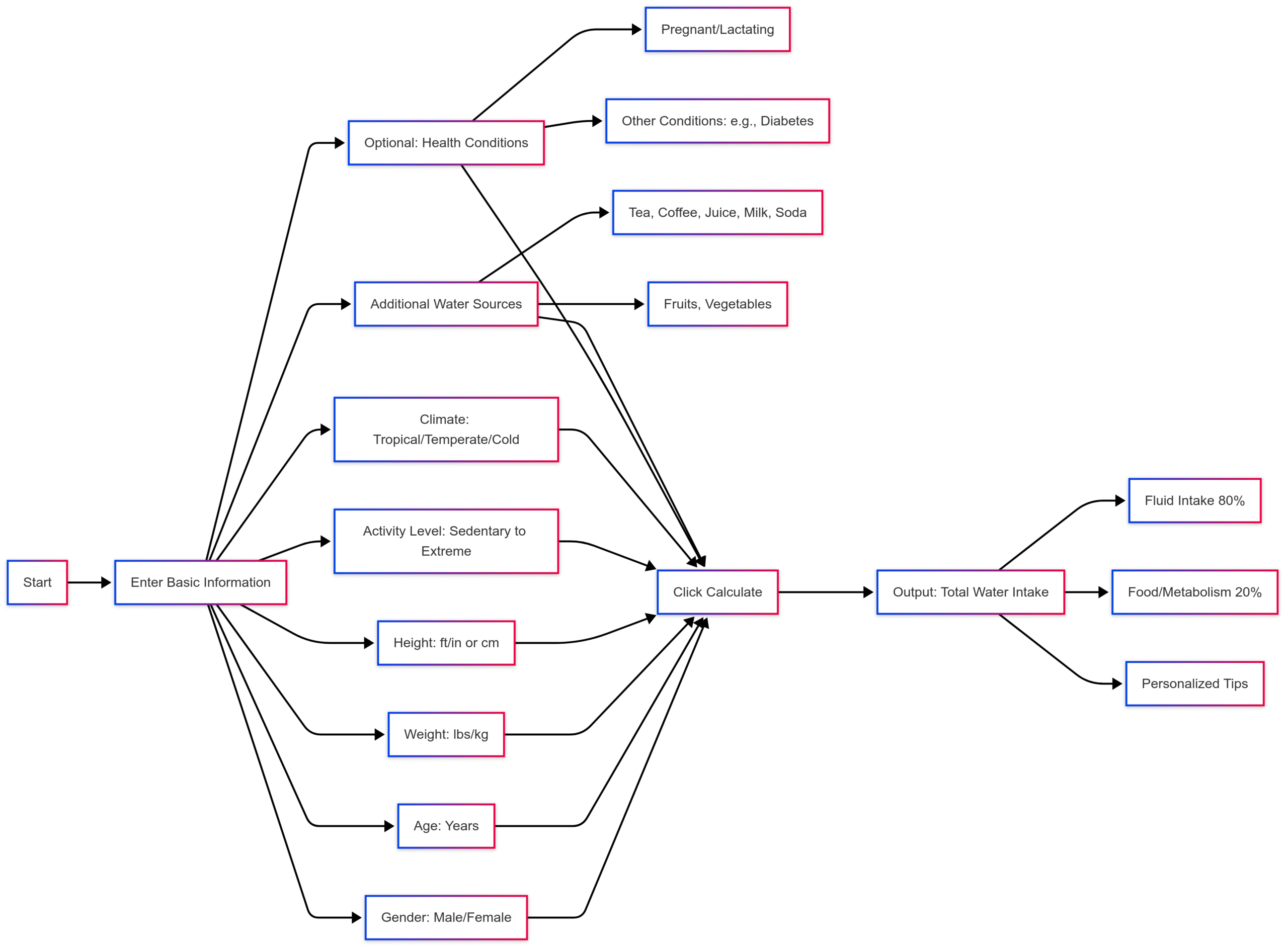
Enter Basic Information:
- Gender: Select Male or Female, as men typically have higher water needs due to greater muscle mass.
- Age: Input your age in years, as hydration needs vary across life stages.
- Weight: Enter your weight in pounds or kilograms.
- Height: Provide your height in feet and inches or centimeters.
- Activity Level: Choose from:
- Sedentary (little or no exercise)
- Light (exercise 1–3 times/week)
- Moderate (exercise 3–5 times/week)
- High (exercise 6–7 times/week)
- Extreme (very heavy exercise or physically demanding job)
- Climate: Select Tropical, Temperate, or Cold to account for environmental fluid loss.
Optional Information:
- Health Conditions: Indicate if you’re pregnant, lactating, or have conditions like diabetes.
- Additional Water Sources: Select beverages (tea, coffee, juice, milk, soda) or foods (fruits, vegetables) you regularly consume, as these contribute to total water intake.
Calculate:
- Click “Calculate” to receive your personalized recommendation in liters, milliliters, cups, and ounces, including how much should come from fluids versus food.
Example Calculation
For a 30-year-old male, 180 lbs, 5’10”, with moderate activity in a temperate climate:
- Base Formula: Weight (lbs) × 0.5 = 180 × 0.5 = 90 ounces (total water).
- Fluid Portion: Approximately 80% of total water, or 72 ounces (9 cups).
- Adjustments: Moderate activity adds ~12 ounces per 30 minutes of exercise. If he exercises for 1 hour, add 24 ounces, totaling 96 ounces (12 cups).
For a 25-year-old female, 140 lbs, 5’4”, lightly active in a tropical climate:
- Base Formula: Weight (lbs) × 0.45 = 140 × 0.45 = 63 ounces.
- Fluid Portion: ~50.4 ounces (6.3 cups).
- Adjustments: Tropical climate adds ~10%, so 63 × 1.1 = 69.3 ounces (8.7 cups).
The calculator outputs both total water intake (including food) and fluid intake, ensuring you know exactly how much to drink.
General Water Intake Recommendations
The European Food Safety Authority (EFSA) and U.S. Institute of Medicine (IOM) provide population-wide guidelines, which our calculator personalizes. Below is a table summarizing their recommendations:
| Age Group | EFSA Total (L/day) | EFSA Fluid (L/day) | IOM Total (L/day) | IOM Fluid (L/day) |
|---|---|---|---|---|
| 0–6 months | 0.68 (milk) | 0.68 (milk) | 0.70 | 0.70 |
| 6–12 months | 0.80–1.00 | 0.64–0.80 | 0.80 | 0.80 |
| 1–3 years | 1.10–1.30 | 0.88–1.00 | 1.30 | 0.90 |
| 4–8 years | 1.60 | 1.20 | 1.70 | 1.20 |
| 9–13 years (Boys) | 2.10 | 1.60 | 2.40 | 1.80 |
| 9–13 years (Girls) | 1.90 | 1.50 | 2.10 | 1.60 |
| 14+ years (Men) | 2.50 | 2.00 | 3.30 | 2.60 |
| 14+ years (Women) | 2.00 | 1.60 | 2.30 | 1.80 |
| Pregnant Women | 2.30 | 1.84 | 2.60 | 1.90 |
| Lactating Women | 2.60 | 2.10 | 3.40 | 2.80 |
Note: 1 liter ≈ 4 standard glasses (8 ounces each).
Sources of Water
Water enters the body through:
- Beverages: Plain water, tea, coffee, juice, milk, and soda. Contrary to myth, caffeinated drinks like coffee contribute to hydration, though their diuretic effect is minimal.
- Food: Fruits (e.g., watermelon, oranges), vegetables (e.g., lettuce, cucumbers), and dishes like soups have high water content.
- Metabolic Processes: The body produces small amounts of water during metabolism.
Our calculator estimates that ~80% of your water intake should come from fluids, with the rest from food and metabolism. For example, if your total need is 80 ounces, you’d aim to drink ~64 ounces (8 cups) of fluids.
Water Content in Foods
The following table, based on Altman (1961), shows the water content of common foods:
| Water Percentage | Food Items |
|---|---|
| 100% | Water |
| 90–99% | Fat-free milk, cantaloupe, strawberries, watermelon, lettuce, cabbage, celery, spinach, pickles, squash (cooked) |
| 80–89% | Fruit juice, yogurt, apples, grapes, oranges, carrots, broccoli (cooked), pears, pineapple |
| 70–79% | Bananas, avocados, cottage cheese, ricotta cheese, baked potato, corn (cooked), shrimp |
| 60–69% | Pasta, legumes, salmon, ice cream, chicken breast |
| 50–59% | Ground beef, hot dogs, feta cheese, tenderloin steak (cooked) |
| 40–49% | Pizza |
| 30–39% | Cheddar cheese, bagels, bread |
| 20–29% | Pepperoni sausage, cake, biscuits |
| 10–19% | Butter, margarine, raisins |
| 1–9% | Walnuts, peanuts (dry roasted), chocolate chip cookies, crackers, cereals, pretzels, peanut butter |
| 0% | Oils, sugars |
Incorporating water-rich foods like watermelon (92% water) or cucumbers (95% water) can significantly boost hydration.
Why Frequent Water Intake Is Necessary
The body constantly loses water through:
- Urine: Eliminates waste and toxins.
- Sweat: Regulates temperature, especially during exercise or in hot climates.
- Respiration: Water vapor is exhaled with each breath.
- Gastrointestinal Processes: Digestion and waste elimination require water.
Thirst signals dehydration has already begun (1–2% body water loss). Drinking water regularly, rather than waiting for thirst, prevents dehydration and supports optimal function.
Adjustments for Special Conditions
Climate
- Tropical Climates: Increase intake by ~10–20% due to higher sweat loss. For example, a 70-ounce requirement may rise to 77–84 ounces.
- Cold Climates: May increase energy expenditure, slightly raising water needs.
- Temperate Climates: Baseline for most calculations.
Activity Level
Add 12 ounces of water per 30 minutes of exercise. For example, a 1-hour workout adds 24 ounces to your daily need.
Pregnancy and Lactation
- Pregnant Women: Need an additional 0.3–0.4 liters (10–13 ounces) daily.
- Lactating Women: Require 0.6–1.1 liters (20–37 ounces) more to support milk production.
Health Conditions
Conditions like diabetes or kidney issues may alter water needs. Consult a physician for personalized advice.
Benefits of Optimal Hydration
Staying hydrated offers numerous health benefits, backed by scientific research:
Kidney Health
Adequate water intake supports kidney function by diluting urine, reducing the risk of kidney stones. A study cited by Popkin et al. (2010) found that higher urine volume decreases stone recurrence.
Sports Performance
Dehydration as low as 2% body weight loss impairs endurance, increases fatigue, and reduces motivation. Athletes losing 6–10% body weight in sweat during events like marathons face significant performance declines. Rehydration reverses these effects and reduces oxidative stress.
Cognitive Performance
Mild dehydration (1–2% body water loss) impairs concentration, memory, and critical thinking. Riebl and Davy (2013) suggest that even slight dehydration acts as a physiological stressor, diverting attention from cognitive tasks.
Headache Prevention
A 2012 study by Spigt et al. found that increased water intake may reduce headache frequency, though further research is needed due to methodological limitations.
Type II Diabetes
Low water intake is linked to hyperglycemia. A study showed that three days of low water intake in diabetic individuals impaired blood glucose response, mediated by cortisol.
Heart Health
Water intake reduces heart rate and increases blood pressure within 15–20 minutes, lasting up to an hour. It also prevents vasovagal reactions in blood donors.
Weight Management
Drinking 1.5 liters above the recommended intake before meals led to weight loss, reduced BMI, and appetite suppression in a 2014 study of overweight women. Replacing sugary drinks with water reduces energy intake by ~8%, aiding weight control.
Constipation
While inadequate hydration contributes to constipation, increasing water intake is most effective in hypohydrated individuals. In hydrated people, extra water has minimal impact.
Bronchopulmonary Health
Low fluid intake is linked to exercise-induced asthma. Increasing water intake can mitigate symptoms.
Skin Health
Drinking more water improves skin thickness and density in those with low initial intake but doesn’t directly enhance complexion or reduce wrinkles.
Risks of Over-Hydration
Excessive water intake (10–15 liters daily for several days) can lead to water intoxication, causing symptoms like confusion, nausea, and, in severe cases, seizures or coma. Healthy kidneys can process large amounts of water, but over-hydration risks are higher in those with kidney issues.
Water Intake Across a Lifetime
Assuming an average daily intake of 3 liters:
- Monthly: 90 liters (3,043 ounces).
- Yearly: 1,095 liters (37,026 ounces).
- Lifetime (80 years): 87,600 liters (2,962,106 ounces).
These figures highlight the immense role water plays over a lifetime.
Water Usage Beyond Drinking
Daily activities like showering and washing also consume significant water:
- Showering: ~100 liters (10 liters/minute for 10 minutes).
- Bathing: ~150 liters per bath.
- Hand/Face Washing: ~5 liters daily.
Estimated Usage:
- Daily: 110 liters (3,720 ounces).
- Monthly: 3,300 liters (111,586 ounces).
- Yearly: 40,150 liters (1,357,632 ounces).
Fascinating Water Facts
- The human body is 60–70% water, with lungs at 83% and bones at 31%.
- Drinking water before meals may reduce appetite and protect the stomach lining.
- A 22–30% loss of body water can be fatal.
- Camels conserve water efficiently, surviving weeks without drinking, while elephants consume up to 200 liters daily.
Chart: Daily Water Intake Workflow
Below is a flowchart illustrating how to use the Daily Water Intake Calculator:
FAQs
How much water should I drink daily?
How does weight affect water needs?
Can drinking water help with weight loss?
What are dehydration symptoms?
How much water do children need?
Is over-hydration dangerous?
Conclusion
Staying hydrated is essential for physical and mental health, yet individual water needs vary widely. Our Daily Water Intake Calculator offers a personalized, evidence-based estimate to help you achieve optimal hydration. By factoring in your weight, activity level, climate, and health conditions, it ensures you drink the right amount of water daily. Pair this with water-rich foods and regular sipping to maintain energy, support organ function, and enhance overall well-being. Use the calculator today to take control of your hydration and unlock the benefits of a well-hydrated body.
Disclaimer: This calculator provides estimates for informational purposes. Consult a healthcare provider for personalized hydration advice.
Happy Boating!
Share Daily Water Intake Calculator with your friends and leave a comment below with your thoughts.
Read Volvo Penta 30 vs. Mercruiser 30: Marine Power Duel until we meet in the next article.