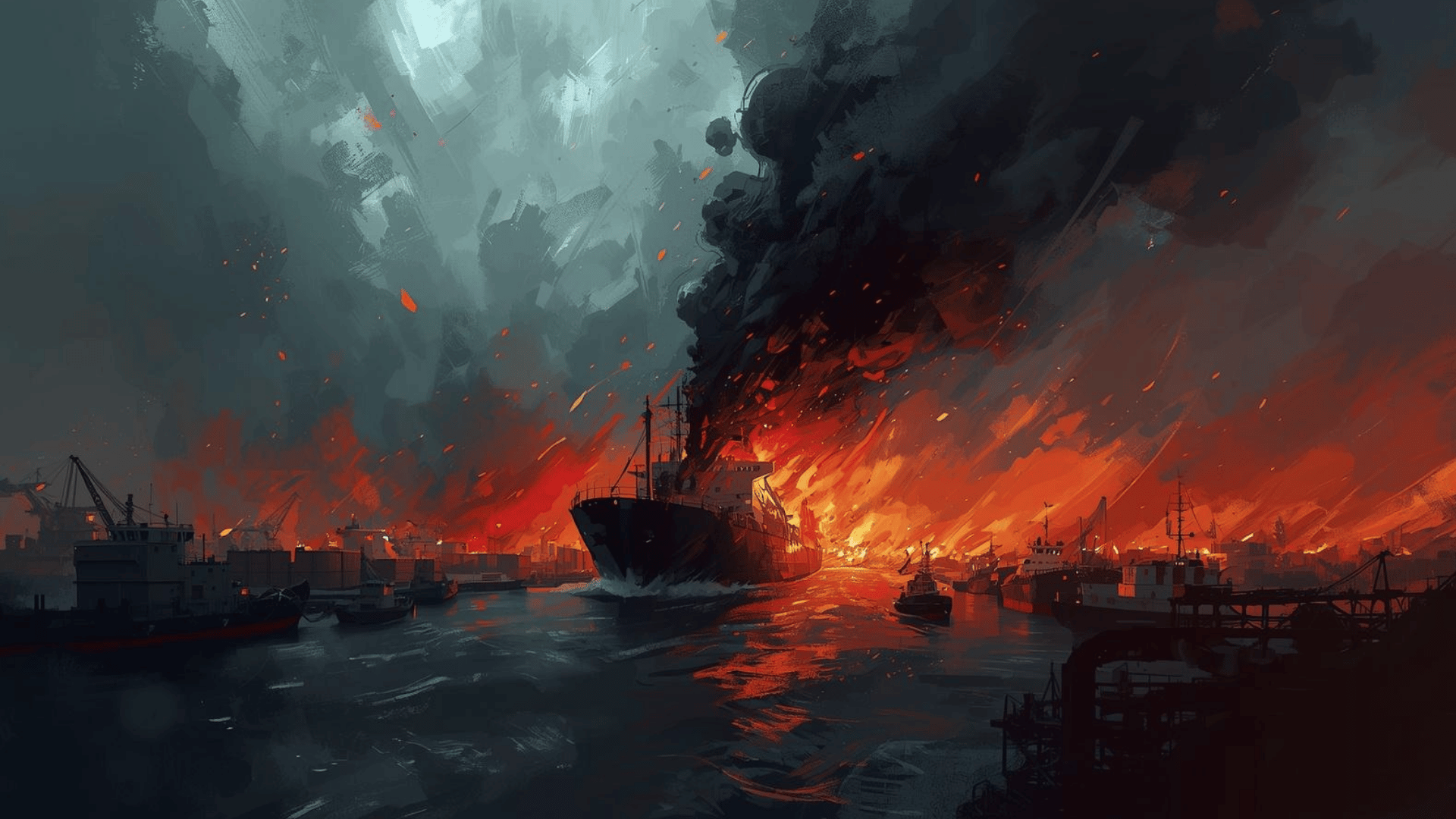
Black smoke coming from a ship’s funnel at port is one of the most operationally disruptive situations an engineer officer can face. Port authorities take it seriously, cargo operations get suspended, and the ship risks detention under MARPOL Annex VI. The pressure on the engine room team to identify and eliminate the source quickly is enormous — and every minute of delay translates directly into financial and reputational cost for the shipowner.
This guide covers the complete troubleshooting process: how to identify the source machinery, what checks to run on each system, and how to address every common root cause.
Why Black Smoke Is a Serious Issue at Port
Black smoke is visible evidence of incomplete combustion. Chemically, it consists of fine unburned carbon particles suspended in exhaust gas — produced when fuel is not fully oxidised during the combustion cycle. This happens when either the air supply is insufficient, the fuel is not properly prepared or injected, or the combustion chamber conditions are wrong.
At sea, brief episodes of black smoke are managed more quietly. At port, the consequences are immediate:
- Port workers can and do halt cargo operations on environmental grounds
- Port State Control inspectors may board the vessel for inspection
- MARPOL Annex VI sets binding emission standards — black smoke from a vessel in port constitutes a potential violation
- Demurrage costs accumulate if cargo operations are stopped
- Reputational damage to the operator can affect future port relationships
Beyond the regulatory dimension, black smoke also signals poor fuel efficiency, increased fuel consumption, and potential engine damage if the underlying cause is not corrected promptly.
Identifying the Source: First Response
A ship’s funnel is not a single exhaust pipe. It integrates multiple exhaust trunks from different machinery systems into one external enclosure. At port, the machinery most likely producing exhaust through the funnel is the generator engine, the auxiliary boiler, and the inert gas generator (IGG). Identifying which trunk is producing the smoke is the essential first step before any troubleshooting can begin.
The correct sequence for initial identification is shown below:
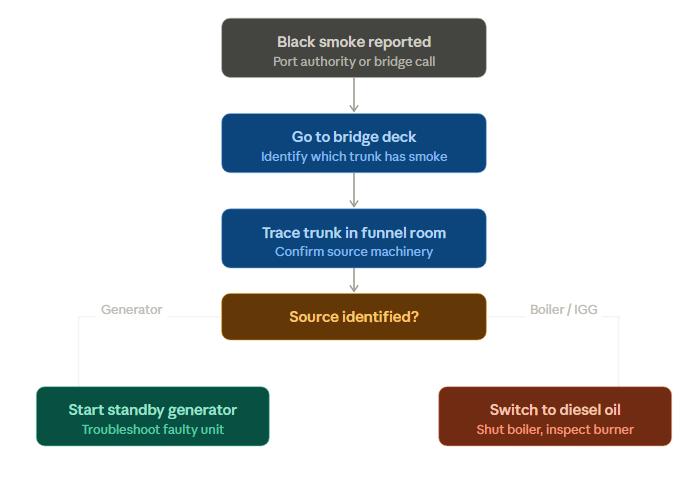
Once the source machinery has been confirmed, troubleshooting follows a different path depending on whether the culprit is a generator, a boiler, or an inert gas generator.
Troubleshooting Marine Generators
Generators are the most common source of black smoke at port. Port electrical load is substantially lower than sea-going load, and generators that are underloaded or poorly set up are susceptible to incomplete combustion.
Electrical Load Management
The first check is the ship’s total electrical load against the generating capacity currently online. At port, if two generators are running to share a relatively small load, both may be operating at 30–40% capacity. At such low loads, turbocharger speed drops, air delivery to the cylinders falls, and combustion suffers. The correct response is to stop one generator entirely and consolidate the full load onto a single unit running at 70–80% capacity. This raises turbocharger RPM, improves air delivery, and restores combustion quality.
Turbocharger System Checks
The turbocharger is the primary source of air supply to the combustion chambers. Any degradation in turbocharger performance reduces oxygen availability and produces black smoke.
The air mesh filter on the turbocharger blower inlet is a common culprit. A partially blocked filter restricts airflow before it even reaches the compressor. Clean or replace the filter and verify that airflow is restored.
The turbocharger turbine and compressor blades can become fouled with carbon deposits or damaged by debris ingestion. Fouled turbine blades reduce the energy extracted from exhaust gases, lowering shaft speed and compressor output. Water washing the turbine while running is the first corrective measure — if this does not restore RPM, the turbocharger requires opening and mechanical cleaning at the next available opportunity.
The nozzle ring directs exhaust gas onto the turbine blades. If soiled or eroded, it reduces turbine efficiency directly. This also requires internal inspection.
Valve Timing and Mechanical Condition
Tappet clearances on the rocker arms affect the timing of inlet valve opening and closing. If tappet clearances are outside specification, the inlet valve may open late or close early, reducing the volume of charge air entering the cylinder. Verify and adjust tappet clearances against manufacturer specifications.
The air supply duct from the engine room blower to the generator space must also be checked. If the duct damper is partially closed or the blower serving that side of the engine room is not running, the generator will be starved of combustion air regardless of turbocharger condition.
Fuel System and Unit Temperature Analysis
Monitoring exhaust temperatures across all cylinder units provides one of the most useful diagnostic pictures. The average temperature difference between individual units should not exceed 50°C. A single unit running significantly hotter than the rest indicates a problem specific to that unit — most commonly a faulty fuel injector or fuel pump delivering too much fuel, or delivering it poorly atomised.
If all units show abnormal temperatures simultaneously, the problem is systemic — fuel viscosity, fuel pump timing, or fuel injection system components should be inspected across the board.
Troubleshooting the Auxiliary Boiler
When the boiler is confirmed as the source, the troubleshooting focus shifts to the combustion air-fuel system within the boiler itself.
Air-Fuel Ratio
The burner’s air-fuel ratio setting is the most common cause of boiler-generated black smoke. An overly rich mixture — too much fuel relative to available air — produces visible black smoke from the funnel. Check and adjust the air-fuel ratio in accordance with the boiler manufacturer’s manual. Many boilers have a simple air register adjustment that controls the swirl and distribution of combustion air around the burner.
Burner Nozzle Condition
A dripping burner nozzle is a classic cause of after-burning and black smoke. If the nozzle continues to pass fuel after the burner has shut off, or dribbles fuel at the edges of the spray pattern, incomplete combustion occurs. Stop the boiler, open the burner door, and inspect the nozzle for dripping, blockage, or wear. Blocked spray holes cause an irregular spray pattern and poor atomisation. A worn nozzle with enlarged holes allows excessive fuel flow. Both conditions require nozzle replacement.
Fuel Oil Temperature
Heavy fuel oil must be heated to a specific temperature to achieve the viscosity required for proper atomisation through the burner nozzle. If the fuel temperature is too low, the oil arrives at the nozzle too viscous, the spray pattern is coarse, and large fuel droplets fail to burn completely. Ensure that the HFO heating system is maintaining temperature to the value specified in the burner manual — typically in the range that achieves a viscosity of 13–15 centistokes at the injection point.
Atomiser Condition
The atomiser breaks the fuel into a fine mist before ignition. A worn or partially blocked atomiser produces uneven fuel distribution and large droplets in parts of the flame, leading to localised rich zones and unburned carbon. Inspect and clean or replace the atomiser as part of any boiler black smoke investigation.
Air Distribution Components
The swirler plate and air distribution register control how combustion air wraps around the fuel spray. Damage or incorrect positioning of these components disrupts the mixing of fuel and air, producing uneven combustion and black smoke. Inspect and adjust according to the manufacturer’s instructions.
Troubleshooting the Inert Gas Generator
The IGG burns fuel in a controlled oxygen-deficient environment to produce inert gas for cargo tanks. When operating in port during cargo discharge, the IGG can generate black smoke if its combustion settings drift or its components are not properly maintained. The same air-fuel ratio logic applies — check burner settings, fuel temperature, and atomiser condition as with the boiler.
Root Causes Summary Table
| System | Root Cause | Corrective Action |
|---|---|---|
| Generator | Low electrical load, two units sharing | Stop one unit, consolidate load to 70–80% on one generator |
| Generator | Blocked turbocharger air filter | Clean or replace air mesh filter |
| Generator | Fouled turbocharger turbine / compressor | Water wash turbine; overhaul if ineffective |
| Generator | Incorrect tappet clearances | Adjust to manufacturer specification |
| Generator | Engine room blower not supplying air | Check damper position and blower operation |
| Generator | Single unit high exhaust temperature | Inspect and test fuel injector and fuel pump for that unit |
| Generator | All units at abnormal temperature | Check fuel viscosity, pump timing, injection system |
| Boiler | Incorrect air-fuel ratio | Adjust burner air register to correct setting |
| Boiler | Dripping or worn burner nozzle | Stop boiler, inspect, replace nozzle |
| Boiler | Low fuel oil temperature | Raise HFO temperature to achieve correct viscosity |
| Boiler | Worn or blocked atomiser | Clean or replace atomiser unit |
| Boiler | Faulty swirler or air register | Inspect and adjust air distribution components |
| IGG | Combustion air-fuel imbalance | Check and adjust burner settings per manual |
| Any | Fuel grade change | Verify turndown ratio compatibility; adjust burner settings |
MARPOL Annex VI: The Regulatory Context
MARPOL Annex VI establishes international standards for air pollution from ships, including limits on visible exhaust emissions. Black smoke from a ship’s funnel in port is taken as evidence of combustion that fails to meet these standards. Port State Control officers who observe or are notified of black smoke emissions are entitled to board the vessel, examine the engine room logs and maintenance records, and issue deficiency notices. In serious or repeat cases, ships can be detained.
Compliance is not merely a matter of good engineering practice — it is a legal requirement under international maritime law. Every port authority in the world now takes funnel emissions seriously, and some ports have additional local regulations that go beyond MARPOL minima.
Additional Scenarios That Can Cause Black Smoke at Port
Beyond direct machinery faults, two common operational scenarios can generate black smoke that may be misidentified as a mechanical problem.
Boiler soot blowing is the periodic process of cleaning combustion deposits from boiler tubes using steam or air jets. During soot blowing, a burst of dark smoke is normal and expected. Many ships schedule soot blowing at night to minimise visibility. If black smoke appears briefly during boiler soot blowing and then clears, no troubleshooting is required — but port authorities should be notified in advance where possible.
Sudden load changes on the ship’s electrical system — such as starting cargo cranes, refrigeration compressors, or other large consumers simultaneously — can cause a temporary surge in generator load beyond the turbocharger’s ability to instantaneously increase air supply. This produces a short burst of black smoke that clears within seconds as turbocharger speed catches up. If the smoke is brief and coincides with a known load event, it does not indicate a persistent fault but may warrant load management review to soften the transient.
Preventing Black Smoke at Port: Maintenance Priorities
The most reliable way to avoid black smoke at port is systematic preventive maintenance of the three key machinery systems before the ship arrives in port. The following checks should be part of every pre-port routine:
Turbocharger air filter condition should be inspected and cleaned before entering port if the interval since last cleaning is approaching its limit. A clean filter costs minutes; a black smoke episode in port costs hours.
Fuel injectors should be pressure-tested at their scheduled interval without exception. Worn injectors that might be tolerated at sea become visible emission sources in port when load conditions change.
Boiler burner nozzles and atomisers should be inspected and cleaned at every port call where the boiler will remain in service. Burner condition degrades gradually, and the degradation becomes obvious only when operating conditions change.
Fuel oil heating systems should be verified to be maintaining temperature before arrival. Cold HFO arriving at the burner nozzle is one of the most avoidable causes of combustion problems.
A ship that arrives at port with well-maintained combustion systems, correctly loaded generators, and properly set boiler burners will not produce black smoke. The engineering behind clean funnel emissions is not advanced — it is disciplined routine maintenance applied consistently.
Happy Boating!
Share Types of Valves Used on Ships: Gate Valve with your friends and leave a comment below with your thoughts.
Read Top 14 Maritime Institutes Providing Dynamic Positioning (DP) Courses in Asia until we meet in the next article.