
What are SSB Radios?
Single Sideband (SSB) radio is one of the most powerful long-range communication tools available to mariners, offshore sailors, and emergency operators. While VHF radios are standard for coastal waters, SSB unlocks truly global communication — often reaching thousands of miles without subscription fees, satellites, or cellular infrastructure.
If you’re planning a bluewater passage or simply want to understand how ships stay connected across oceans, this guide covers everything you need to know.
What Is SSB Radio?
SSB stands for Single Sideband — a specific type of amplitude modulation (AM) used to transmit voice and data over high-frequency (HF) shortwave radio waves. Unlike conventional AM radio, which broadcasts the carrier signal plus two mirrored sidebands, SSB suppresses the carrier and transmits only one sideband. This makes the signal narrower, more efficient, and significantly more powerful over long distances.
A standard AM signal spans roughly 6 kHz of bandwidth across two redundant sidebands. SSB uses less than half that bandwidth — typically around 3 kHz — to carry the same voice information. The practical benefit: more power is concentrated in a narrower band, giving SSB signals far greater reach than FM or standard AM at equivalent output power.
SSB operates in the High Frequency (HF) spectrum between 3 MHz and 30 MHz. At these frequencies, radio waves refract off the ionosphere — the electrically charged upper layer of the atmosphere — and bounce back to earth hundreds or thousands of miles away. This “sky wave” propagation is what allows SSB to achieve ranges that are simply impossible for VHF, which is limited to line-of-sight distances of 25–50 nautical miles.
On ships and offshore vessels, SSB radio is part of the Global Maritime Distress and Safety System (GMDSS), established under SOLAS (Safety of Life at Sea). It is used by ocean-going yachts, commercial vessels, naval forces, and amateur (ham) radio operators worldwide.
SSB vs. VHF: Key Differences
Understanding the difference between SSB and VHF clarifies when and why SSB is necessary.
| Feature | VHF Radio | SSB (HF) Radio |
|---|---|---|
| Frequency Range | 156–174 MHz | 2–30 MHz |
| Typical Range | 25–50 nautical miles | 400–4,000+ nautical miles |
| Propagation | Line-of-sight | Ionospheric sky wave |
| DSC Capability | Yes (Channel 70) | Yes (on marine SSB models) |
| Data Transfer (Email/GRIB) | No | Yes (via Pactor modem) |
| Subscription Required | No | No |
| Licence Required | Short Range Certificate (SRC) | Long Range Certificate (LRC) or GOC |
| Primary Use | Coastal, harbour, short range | Offshore, bluewater, global |
Both VHF and HF SSB radios can share the same MMSI number, so purchasing an SSB system does not require a separate MMSI application.
How SSB Radio Propagation Works
The range of an SSB signal depends on frequency and time of day. Higher frequencies generally achieve greater daytime range, while lower frequencies perform better at night due to changes in ionospheric density. The following table provides a practical guide:
| Frequency Band | Daylight Range | Night Range |
|---|---|---|
| 2 MHz | ~200 NM | ~500 NM |
| 4 MHz | ~400 NM | ~800 NM |
| 6 MHz | ~600 NM | ~1,200 NM |
| 8 MHz | ~800 NM | ~1,600 NM |
| 12 MHz | ~1,200 NM | ~2,400 NM |
| 16 MHz | ~1,600 NM | Fade out |
A useful rule of thumb for daytime use: assume approximately 100 nautical miles of range per MHz of frequency used.
One important phenomenon to be aware of is the dead zone — an area close to a transmitting station where sky wave signals skip over without being received. For short-range communication, VHF or MF remains more appropriate.
Amateur Radio vs. Marine SSB: Which to Choose?
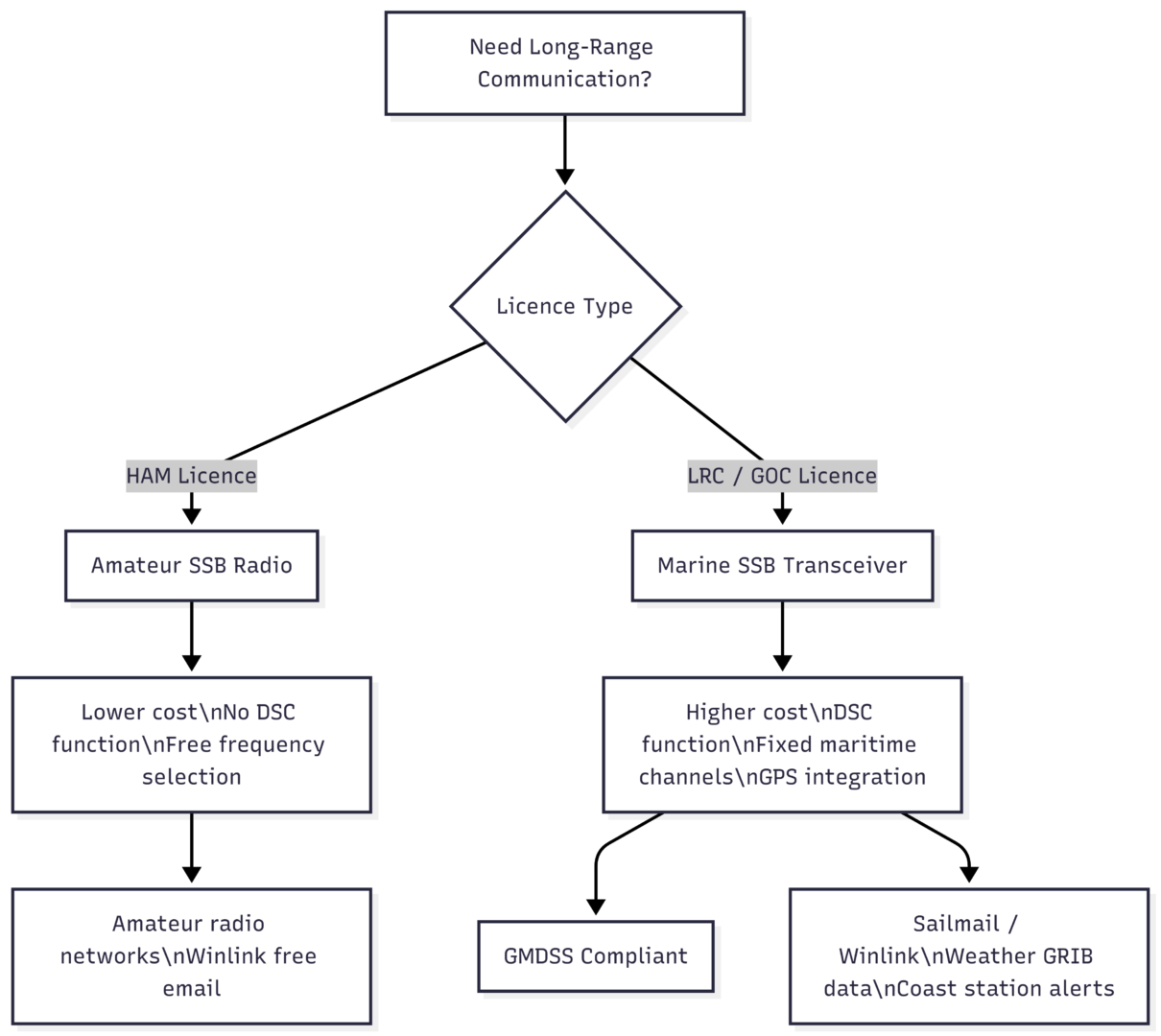
SSB radios come in two main categories: amateur (ham) radio equipment and purpose-built marine SSB transceivers. The right choice depends primarily on your radio licence.
SSB Amateur Radio Equipment
Amateur radio systems are generally cheaper to purchase and cover frequencies in the bands: 1.8 / 3.5 / 5 / 7 / 10 / 14 / 18 / 21 / 24 / 28 MHz. However, the amateur radio certificate (HAM licence) is significantly more complex to obtain than a marine radio licence, involving detailed study of electrotechnical principles and operating procedures.
Amateur SSB gear does not include a DSC (Digital Selective Calling) function, which limits its usefulness for maritime distress situations.
Marine SSB Transceivers
Marine SSB radios are purpose-built for shipboard use. They operate on fixed maritime channels in the 2 / 4 / 6 / 8 / 12 / 16 / 18 / 22 / 25 MHz bands and include features specifically designed for ocean use:
- DSC (Digital Selective Calling): Enables automatic distress alerts and selective calling without the need to monitor all channels continuously. Incoming DSC data is displayed and stored for later recall.
- GPS integration: Displays the vessel’s current position when connected to a GPS source.
- Remote control unit and splash-proof display
- 150W transmitting power (typical for premium models)
- Separate second receiver on higher-end units
The key marine SSB models available include:
| Model | Features | Price (approx.) |
|---|---|---|
| ICOM IC-M803 | HF Transceiver, DSC Class E | ~€1,950 |
| ICOM IC-M804 | EU Approval, 12V, HF Transceiver | ~€3,700 |
SSB Sideband Selection: Upper vs. Lower
SSB operates on either the upper sideband (USB) or the lower sideband (LSB), depending on frequency:
- Upper Sideband (USB): Used on bands above 10 MHz (30-meter band and higher), including all VHF and UHF bands.
- Lower Sideband (LSB): Used on bands below 10 MHz.
The convention is consistent across amateur and marine radio operations worldwide. Misalignment between transmit and receive sidebands results in severely distorted, unintelligible audio — so knowing which sideband to use is fundamental operating knowledge.
SSB Installation: What You Need to Know
The performance of an SSB system is almost entirely determined by the quality of installation. A premium transceiver poorly installed will be outperformed by a modest radio correctly set up. There are four critical installation factors.
1. Antenna Grounding
SSB antennas are asymmetric — they require an effective ground plane to function. On ships, the sea itself provides an excellent ground, but it must be connected properly to the antenna tuner.
- Metal hulls: Use a DC blocker (such as a DCF-47) to prevent DC voltage reaching the hull. Capacitive coupling through antifouling paint still exists, so electrolysis protection is essential.
- GRP and wooden hulls: Bronze grounding plates (Dynaplates), minimum 300 × 80 × 13 mm, mounted below the waterline and connected exclusively to the SSB tuner, provide reliable grounding. Never paint over grounding plates — algae and marine growth must be cleaned every 6 months with a wire brush.
- SSB Ground Paint: A silver-plated copper coating applied below the waterline (approximately 3 m²) acts as a maintenance-free capacitive ground. It can be painted over with standard boat paint. Note: this method does not provide lightning protection.
- KISS-SSB Grounding System: A 300 cm hose containing resonance wires connected to the tuner’s grounding terminal. Keep it well away from live cables.
2. Antenna Tuner
Because SSB operates across 2–30 MHz, a single antenna cannot maintain resonance across the entire range. An automatic antenna tuner electronically adjusts the antenna’s effective length to bring it into resonance on any operating frequency. The tuner must be mounted as close as possible to the antenna feed point — not next to the radio.
Reliable backstay antenna lengths: 7.0 m to 13.5 m (maximum 17 m). The antenna length is measured from the tuner output, including the feedline to the backstay.
| Component | Recommended Model | Price (approx.) |
|---|---|---|
| Automatic Antenna Tuner | ICOM AT-140 | ~€635 |
| Automatic Antenna Tuner | ICOM AT-141 | ~€433 |
| Copper Foil (grounding) | 0.2 × 60 mm | ~€9 |
3. Cable Quality
Every poor connection degrades SSB performance. Key rules:
- Use low-attenuation coaxial cable between the radio and tuner.
- Use GTO-15 UV-resistant high-voltage cable between the tuner output and antenna (never coaxial cable for this section — coaxial shielding prevents signal radiation).
- Solder PL plugs cleanly, ensuring no contact between conductor and shielding.
- Use a backstay clamp with maximum contact surface area for a reliable, waterproof connection to the insulated backstay.
4. Component Spacing
The high-voltage feedline between the tuner and antenna radiates signal. Maintain adequate distance from metallic structures. Use standoffs to keep the GTO-15 cable away from uninsulated backstay sections — contact will cause significant power loss. On metal hull yachts, route cables through large deck insulators, not bare metal penetrations.
Data Transfer via SSB: Email and Weather at Sea
One of SSB radio’s most valuable capabilities for offshore sailors is the ability to receive weather data and exchange email without satellite service. This is achieved through a Pactor modem connected between the SSB transceiver and a laptop.
The Pactor modem converts digital data to shortwave-compatible signals and exchanges information with shore-based HF radio stations, which relay data to and from the internet.
Typical data capabilities via Pactor:
- Receive weather GRIB files (wind, wave height, air pressure, routing data)
- Receive and send email (attachments up to ~50 KB)
- Receive weather faxes and Navtex messages
- No separate Navtex receiver required
| Pactor Modem Model | Standard | Notes |
|---|---|---|
| SCS DR-7400 | Pactor 4 (P4 Dragon) | Fast, current standard |
| SCS DR-7800 | Pactor 4 + built-in display | Premium, significantly higher cost |
| PTCIIIusb | Pactor 3 | Slower, largely discontinued |
Data Service Providers
| Provider | Network | Cost | Max Usage |
|---|---|---|---|
| Winlink / RMS Express | Amateur radio (HAM licence required) | Free | 30 min/day |
| Sailmail | HF Marine Bands (LRC/GOC) | USD $275/year | 90 min/week |
Key SSB Frequencies and Radio Nets
For sailors in the Atlantic and European waters, several regular SSB radio nets provide weather, safety information, and vessel-to-vessel communication:
- Pre-ARC Radio Net: 8,297 kHz (J3E/USB) — daily sailboat communication net, also has a Facebook group for shore-based listeners
- Trans-Atlantic Radio Net: 12,350 kHz — daily in winter/spring at 2130 UTC
- Chris Parker’s Weather Net: 8,137 kHz and 12,350 kHz — daily at 2200 UTC, well known among Caribbean and transatlantic sailors
- Med Net: 6,516 kHz (check-in), then 8,131 kHz and 12,359 kHz — Mediterranean region, spring through autumn, Monday to Saturday
- SSCA Net (KPK): 8,104 kHz — daily at 1215 UTC
- German Weather Service (DWD): 5,905 kHz and 6,180 kHz in AM
The Where & When Propagation Tool is a useful software utility that calculates which frequency and time will yield the best signal path between two geographic positions.
DSC: Digital Selective Calling on SSB
Modern marine SSB transceivers include DSC, which dramatically improves both safety and convenience. DSC allows:
- Automated distress alerting: A single button press sends your MMSI, GPS position, and distress nature to all vessels and coast stations simultaneously — something a satellite phone cannot do.
- Selective calling: Call a specific vessel by MMSI without broadcasting to all traffic.
- Data logging: All received DSC calls are stored in memory for later review.
A DSC function on SSB requires a dedicated DSC antenna (such as the AA-35 active/DSC antenna) separate from the main HF antenna.
Why SSB Outperforms Satellite Phones for Maritime Safety
A common misconception is that a satellite phone can replace SSB for offshore use. In a distress situation, this comparison is critical:
- An SSB distress call (via DSC or voice) alerts all vessels within range and relevant coast stations simultaneously
- A satellite phone reaches only one number at a time
- SSB has no ongoing subscription cost for basic voice and safety communications
- SSB with Pactor provides weather and email service at a fraction of satellite data costs
- SSB is GMDSS-compliant for vessels operating beyond coastal waters under SOLAS
Summary
SSB radio is the backbone of long-range maritime communication, offering global reach, built-in safety systems, and cost-free intership calling. For any vessel venturing beyond VHF range, a properly installed SSB system — comprising a quality transceiver, automatic antenna tuner, correct grounding, and optionally a Pactor modem — provides capabilities no other single communication system can match at equivalent cost. Understanding the technology, installation requirements, and operational procedures is what separates a functional system from one that underperforms when it matters most.
Happy Boating!
Share What are SSB Radios? with your friends and leave a comment below with your thoughts.
Read Why Boilers Are Used On Ships? until we meet in the next article.