How to Become a Marine Engineer: The Complete Guide for Aspiring Experts
Marine engineering stands as a cornerstone of global trade and transportation, powering the vessels that carry goods across oceans. If you’re drawn to a career that combines technical expertise with adventure on the high seas, this profession offers unparalleled opportunities.
Marine engineers ensure ships function efficiently, safely, and compliantly, managing everything from propulsion systems to electrical networks. This comprehensive guide outlines the precise steps to enter the field, required qualifications, training options, and career progression. Whether you’re a student with a science background or a professional seeking a shift, you’ll find actionable insights to launch your journey.
What is a Marine Engineer?
A marine engineer designs, operates, maintains, and repairs the mechanical and technical systems aboard ships. This includes main engines, auxiliary machinery, boilers, generators, fuel systems, and pollution control equipment. Their role is critical for vessel safety, efficiency, and environmental compliance during voyages across international waters.
Marine engineers work in high-stakes environments, often at sea for extended periods. They collaborate with deck officers, crew, and shore-based teams to troubleshoot issues, perform routine maintenance, and ensure adherence to regulations like those from the International Maritime Organization (IMO). The profession demands a blend of theoretical knowledge and practical skills, making it ideal for those who thrive in dynamic, problem-solving settings.
Beyond ships, marine engineers may work on offshore platforms, submarines, or in shipyards, applying their expertise to design and innovation. The field evolves with technology, incorporating advancements in automation, renewable energy sources for vessels, and digital monitoring systems.
Why Marine Engineering is a Strong Career Choice
Marine engineering provides job security due to the perpetual demand driven by global shipping, which handles over 90% of world trade. Skilled professionals are always needed to keep fleets operational.
Salaries are competitive, with entry-level positions often starting at $60,000 annually, rising to $150,000 or more for chief engineers, plus benefits like housing allowances and travel perks. The role offers international exposure, allowing engineers to visit diverse ports and cultures.
Career progression is structured and rapid for dedicated individuals. Starting as a cadet, one can advance to senior roles with increasing responsibility and pay. The field’s variety prevents monotony, with opportunities in research, consulting, or management ashore.
Challenges include long absences from home and demanding conditions, but the rewards—financial stability, skill development, and global impact—make it worthwhile.
Educational Requirements
A solid foundation in science and mathematics is essential. High school students should focus on physics, chemistry, calculus, and algebra to build analytical skills.
The primary pathway is a bachelor’s degree in marine engineering, mechanical engineering, or a related field. These programs typically last four years and cover thermodynamics, fluid mechanics, materials science, electrical engineering, and naval architecture. Coursework includes lab sessions simulating ship environments.
Some countries require specific entry qualifications, such as 4-5 GCSEs or A-levels in STEM subjects. For those without a degree, equivalent vocational training or apprenticeships can suffice, but a degree accelerates entry.
Post-graduation, specialized maritime courses are mandatory. These align with IMO’s Standards of Training, Certification, and Watchkeeping (STCW) convention, ensuring global recognition.
Choosing the Right Maritime Training Institute
Selecting an accredited institute is crucial for quality education and employability. Look for programs approved by maritime authorities and offering hands-on training.
The School of Marine Education (SME) excels in this regard. Partnered with South Shields Marine School in the UK, SME delivers globally recognized courses. Their curriculum emphasizes practical skills, from engine operations to safety protocols.
SME offers flexible options, including short courses for skill enhancement. Their affiliation provides access to UK-based training, exposing students to advanced facilities and international standards. This partnership facilitates pathways to study abroad, boosting resumes with prestigious credentials.
Other reputable institutes include maritime academies in the US, Singapore, or Australia, but SME stands out for its comprehensive support, from enrollment to job placement.
Obtaining Required Certifications and Licenses
Certifications validate competence and are legally required for sea-going roles. The progression typically follows STCW guidelines.
- Entry-level: Officer of the Watch (OOW) certification allows basic watchkeeping duties.
- Next: Engine Officer of the Watch (EOOW), focusing on engine room operations.
- Intermediate: Second Engineer, assisting in oversight and maintenance.
- Advanced: Chief Engineer, the pinnacle, managing all technical aspects.
To obtain these, complete approved training, pass exams, and log sea time. SME tailors programs to prepare for these, including mock exams and practical drills.
Additional mandates include medical fitness certificates, basic safety training (firefighting, survival), and security awareness. Renewal every five years involves refresher courses.
Here’s a table summarizing key certifications:
| Certification Level | Description | Requirements | Approximate Cost |
|---|---|---|---|
| Officer of the Watch (OOW) | Entry-level for deck or engine watch. | Bachelor’s degree + basic training + exams. | $5,000 – $10,000 (including courses) |
| Engine Officer of the Watch (EOOW) | Specific to engine operations. | OOW + specialized modules + sea time. | $3,000 – $7,000 |
| Second Engineer | Assists chief; handles crew and maintenance. | EOOW + 12-18 months experience + advanced exams. | $4,000 – $8,000 |
| Chief Engineer | Oversees all machinery and compliance. | Second Engineer + further sea time + leadership training. | $5,000 – $12,000 |
Costs vary by location and institute; SME provides guidance on financing.
Gaining Practical Experience
Theory alone isn’t enough; hands-on experience is vital. Most programs require 12-18 months of sea time as a cadet or trainee.
During this phase, you’ll shadow experienced engineers, learning to operate diesel engines, electrical systems, and pumps. SME integrates practical training through simulators and onboard placements.
Short courses cover specifics like welding, hydraulics, or automation. This exposure builds confidence in real-world scenarios, from routine checks to emergencies.
Internships with shipping companies enhance networks and provide references. Aim for diverse vessels—tankers, containers, or cruise ships—to broaden expertise.
Career Path and Ranks
The marine engineering hierarchy is clear, with ranks reflecting experience and responsibility.
- Start as an Engineering Cadet/Trainee: Combine studies with sea time.
- Progress to Fourth Engineer: Handle daily machinery operations.
- Then Third Engineer: Oversee specific systems like boilers.
- Second Engineer: Manage the engine room team.
- Culminate as Chief Engineer: Lead all technical operations.
For visualization, here’s a flowchart of the career progression:
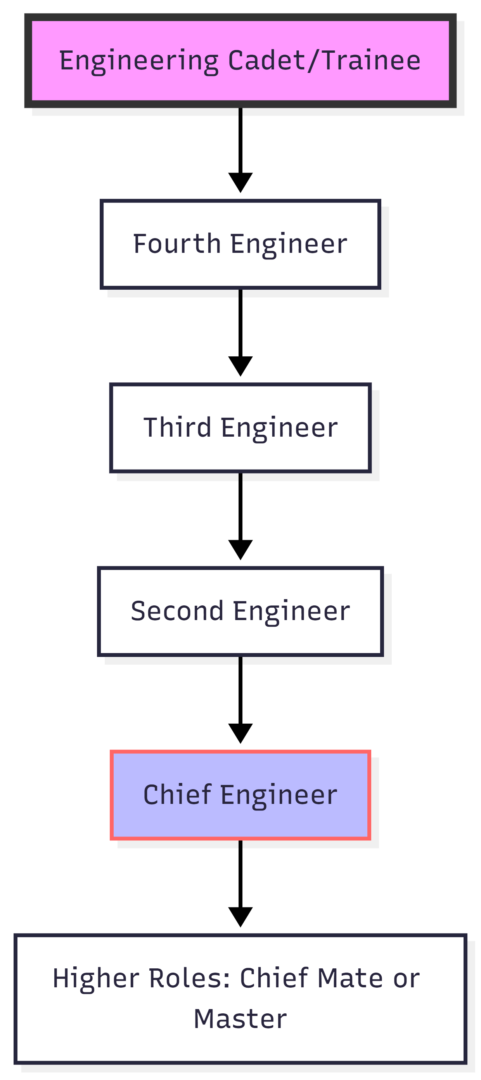
This path typically takes 5-10 years, depending on dedication and opportunities.
Table of ranks and duties:
| Rank | Key Duties | Required Experience | Salary Range (Annual) |
|---|---|---|---|
| Engineering Cadet | Assist in watches, learn basics. | None; training phase. | $20,000 – $40,000 |
| Fourth Engineer | Monitor engines, perform maintenance. | 12 months sea time. | $50,000 – $70,000 |
| Third Engineer | Manage auxiliaries like generators. | 18-24 months. | $70,000 – $90,000 |
| Second Engineer | Lead shifts, inventory management. | 3-5 years. | $90,000 – $120,000 |
| Chief Engineer | Overall responsibility, compliance. | 5+ years. | $120,000 – $160,000+ |
Key Responsibilities of Marine Engineers
Marine engineers maintain vessel integrity through diverse tasks.
- Engine Maintenance: Oversee main propulsion, generators, and fuel systems for optimal performance.
- Safety and Compliance: Operate equipment under MARPOL (pollution prevention) and ensure IMO standards.
- Troubleshooting: Diagnose and repair faults, from leaks to electrical failures, often under time pressure.
- Administrative Oversight: Log operations, order spares, and coordinate with ports.
These duties scale with rank, emphasizing leadership in seniors.
Essential Qualifications and Skills
Beyond certifications, success requires:
- Analytical aptitude for problem-solving.
- Mechanical skills for hands-on repairs.
- Physical fitness, passing medical exams.
- Adaptability to multicultural, high-pressure teams.
Soft skills like communication aid in reporting and training crew.
Detailed Duties by Rank
5th or Junior Engineer (MEO in the Making)
As a junior, focus on learning. Duties include assisting in watchkeeping, basic maintenance, and familiarizing with systems.
Handle emergencies: For emergency maneuvering, monitor engine responses. In blackout situations, restart generators swiftly. Address uptake fires by isolating exhausts. Respond to oil mist detectors by venting and inspecting. Manage flooding by activating pumps. Extinguish scavenge fires via fuel cutoffs.
Courses: Basic STCW, safety modules. Certificates: Medical fitness.
Duties of 4th Engineer (First Responsibility)
The first qualified role involves independent watches. Monitor fuel transfers, lubrication, and cooling systems.
Emergencies mirror juniors but with more autonomy: Execute emergency steering via manual overrides. In blackouts, prioritize critical loads. Combat uptake fires with CO2 systems. Isolate oil mist alarms. Contain flooding with bilge systems. Quench scavenge fires promptly.
Art of Troubleshooting: Develop systematic diagnostics, using tools like multimeters and pressure gauges.
Role as 3rd Engineer (Gaining Experience)
Oversee specific machinery, like boilers or purifiers. Conduct overhauls and inspections.
Emergencies: Lead initial responses, coordinating with team. Enhance skills in emergency maneuvering for precise control. Manage steering gear failures. Restore power in blackouts. Suppress uptake fires efficiently. Calibrate oil mist detectors. Direct flooding containment. Control scavenge fires to prevent escalation.
Role of 2nd Engineer (Engine Room Manager)
As manager, supervise crew, plan maintenance, and ensure inventories.
Emergencies: Oversee all responses. In maneuvering, liaise with bridge. Handle steering emergencies decisively. Coordinate blackout recoveries. Direct fire teams for uptakes. Investigate mist detector triggers. Lead flooding repairs. Implement scavenge fire protocols.
Tricks and Trade: Optimize fuel efficiency, use predictive maintenance software.
Role of Chief Engineer (Overall In-Charge)
The leader manages budgets, compliance, and innovations.
Emergencies: Ultimate authority. Strategize maneuvering in crises. Oversee steering system integrity. Plan blackout drills. Enforce fire safety. Audit mist detectors. Supervise flooding damage control. Prevent scavenge fires through design reviews.
Handling Port State Control: Prepare documentation for inspections. Manage paperwork for logs, certifications.
Handling Emergency Situations
Emergencies test marine engineers’ mettle. Common scenarios:
- Emergency Maneuvering: Adjust propulsion for sudden changes, ensuring engine reliability.
- Emergency Steering: Switch to backups if primary fails.
- Blackout Situation: Restore power sequentially, starting with essentials.
- Uptake Fire: Isolate and extinguish using fixed systems.
- Oil Mist Detector: Alarm indicates crankcase issues; ventilate and inspect.
- Flooding in Engine Room: Activate bilges, seal compartments.
- Scavenge Fire: Cut fuel, increase airflow to cool.
Training at institutes like SME includes simulations for these.
Career Advancement and Growth Opportunities
Advancement hinges on experience, exams, and performance. From OOW to chief, then potentially to ashore roles like surveyor or consultant.
SME offers tailored guidance: Career planning, certification prep, and networking. Their short courses update skills in emerging tech like LNG propulsion or electrification.
International opportunities abound, with visas supported by institutes. Financial aid via loans is available.
Support Services for Aspiring Engineers
Institutes like SME ease transitions. They provide:
- NOE (Notice of Eligibility) application help.
- UK visa support.
- Loan counseling.
- Accommodation arrangements.
This holistic approach ensures focus on learning.
Taking the First Step
Embark on your marine engineering career with the right education and training. Institutes like SME, partnered with South Shields Marine School, offer the tools for success. From cadet to chief, the path is rewarding, demanding expertise and resilience.
In summary, marine engineering merges engineering prowess with maritime adventure. Follow these steps—education, certification, experience—and you’ll navigate toward a fulfilling profession.
Happy Boating!
Share How to Become a Marine Engineer: The Complete Guide for Aspiring Experts with your friends and leave a comment below with your thoughts.
Read Mitsubishi launches training ship for maritime education and research until we meet in the next article.