Working of Marine Boilers Explained
Marine boilers are critical systems on ships, generating steam for propulsion, power, heating, and auxiliary functions. They harness heat from engine exhaust to boil water under high pressure, producing steam that drives turbines, pumps, and heating systems. This article explores their working principles, construction, types, components, and maintenance, providing a comprehensive guide for understanding these essential maritime engineering elements.
Purpose and Applications of Marine Boilers
Marine boilers produce steam essential for various shipboard operations. Steam powers propulsion in steam-driven vessels by driving turbines or engines. It generates electricity through turbine-connected generators, supplying power for lighting, navigation, and equipment.
Heating is another key function. Steam maintains fuel viscosity in tankers, preventing solidification for smooth pumping. In cold climates, it prevents freezing in seawater lines, ballast systems, and freshwater reserves. It also supports crew comfort via hot water, galley heating, cabins, and air conditioning.
For cargo handling, steam heats heavy fuels or chemicals on tankers, ensuring optimal viscosity for transfer. Auxiliary systems like pumps, compressors, winches, and motors rely on steam for operation.
On tankers, boilers provide constant heat to cargo tanks, keeping fuels at low viscosity levels. Passenger ships and cold-weather vessels demand larger boilers for high steam consumption.
Principle of Marine Boilers: Waste Heat Recovery
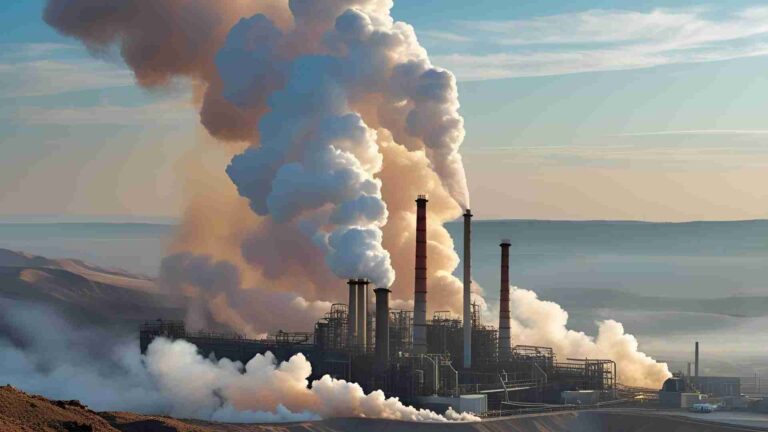
Marine boilers operate on waste heat recovery, tapping exhaust gases from main and auxiliary engines. These gases, at 350-400°C, contain significant thermal energy.
The process involves directing exhaust through tubes in a water-filled chamber. Heat transfers to water, boiling it into steam. Efficiency depends on gas flow rate, density, specific heat, and temperature gradients.
Heat transfer occurs via conduction (through tube surfaces), convection (within water), and radiation (from high-energy gases). Steam is routed for use, then condenses and recycles via feeder pumps.
When engines are off, auxiliary burners heat the system like a stove. This exhaust gas recovery mimics connecting a car’s exhaust to a water heater, but scaled for ships with safety controls.
Here’s a flowchart illustrating the basic working cycle:
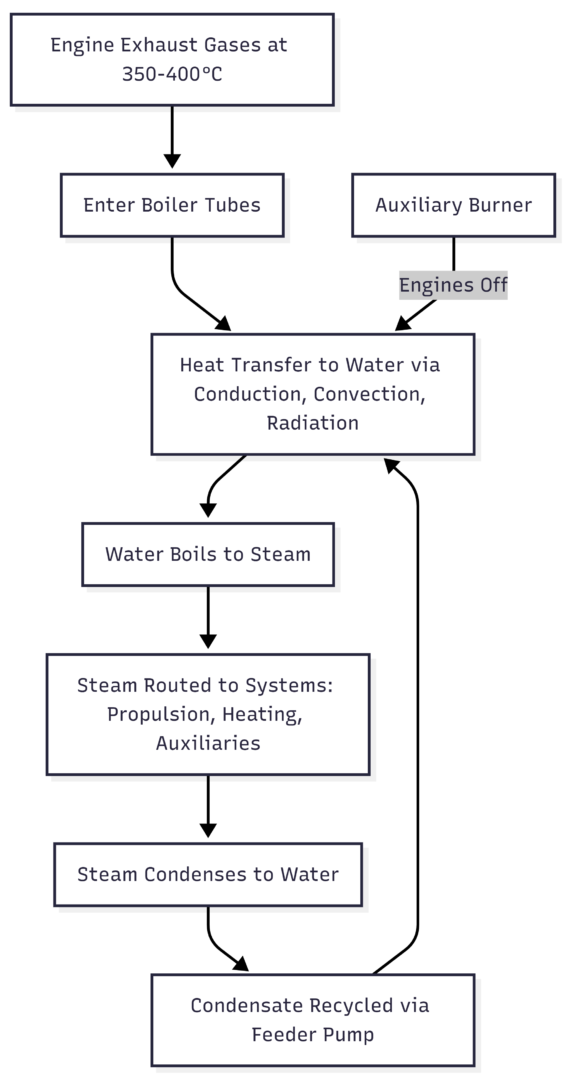
This cycle ensures efficient energy use, reducing fuel needs.
Construction of Marine Boilers
Boilers are cylindrical or dome-shaped vessels, sized by ship type and steam demand. Tankers, cold-climate vessels, and passenger ships feature complex, multiple-unit designs.
Core construction includes a drum or shell for water, tubes for heat exchange, inlets/outlets, pumps, valves, gauges, and fittings. Materials have evolved from iron to high-grade steels like carbon steel, creep-resistant alloys, ferritic stainless steels, and high-tensile steels for strength, durability, and corrosion resistance.
Construction follows strict codes, with destructive and non-destructive testing to detect faults, preventing explosions from high-pressure leaks.
Types of Marine Boilers
Marine boilers fall into two main categories: fire tube (smoke tube) and water tube.
Fire Tube Boilers
In fire tube boilers, hot gases flow through tubes surrounded by water. They operate at 10-15 bar, handling large water volumes for high steam needs. Design is simple, suitable for auxiliary roles.
Disadvantages include inefficiency, lower pressure, and explosion risk from hot water contacting the shell. Maintenance is high.
Features include a hemispherical furnace for heat distribution, connected by an ogee ring. Gases pass through fire tubes for conduction-based heat transfer. Composite versions use oil or exhaust gas.
Advantages: Compact, dual-heat source, easy maintenance with manholes and handholes.
Water Tube Boilers
Water tube boilers reverse this: water flows through tubes surrounded by hot gases. Evaporation is faster, efficiency higher (85-90%), and safer as hot water isn’t in shell contact.
They handle pressures over 100 bar, producing superheated steam. Ideal for high-demand vessels.
Disadvantages: Higher cost, complex operation, continuous pumping increasing electrical load.
The Foster Wheeler ESD-type exemplifies this: It features steam and water drums, generating tubes, headers, downcomers, burner, baffles, superheater, attemperator, and economizer. Circulation is natural convection; feedwater flows down, heats, rises as steam-water mix, separates in the steam drum.
Comparison of Water Tube vs. Fire Tube Boilers
The following table compares key specifications:
| Aspect | Water Tube Boilers | Fire Tube Boilers |
|---|---|---|
| Operation | Water in tubes, gases outside | Gases in tubes, water outside |
| Pressure Range | 60-150 bar | 10-25 bar |
| Steam Production Rate | 10,000-500,000 kg/h | 500-20,000 kg/h |
| Efficiency | 85-90% | 75-80% |
| Start-up Time | 30-60 minutes | 15-30 minutes |
| Steam Quality | Superheated, dry | Saturated, often wet |
| Load Response | Slower (2-5 minutes), steady under fluctuations | Rapid (30-90 seconds), more fluctuations |
| Safety | Distributed pressure, lower explosion risk | Single vessel, higher risk if dry-fired |
| Maintenance | Specialized, tube replacement without shutdown | Basic, full shutdown for tubes |
| Space/Weight | Taller, narrower; 1.2-1.8 kg steam/kg boiler | Longer, lower; 2.5-3.5 kg steam/kg boiler |
| Applications | Main propulsion, high-power needs | Auxiliary, heating, backups |
| Fuel Efficiency Boost | 5-15% better via economizers | Limited heat recovery |
| Failure Modes | Tube leaks, deposits, pump failures | Tube sheet cracks, corrosion, impingement |
Water tube boilers dominate modern vessels for efficiency, while fire tube suit simpler auxiliary needs.
Advantages of Water Tube:
- Superior efficiency with economizers.
- High-pressure capability for turbines.
- Modular for expansion.
- Safer with distributed pressure.
Disadvantages: Complex, sensitive to water quality, taller profile.
Advantages of Fire Tube:
- Simple operation, quick start.
- Compact horizontal layout.
- Tolerant of water impurities.
Disadvantages: Lower pressure/efficiency, higher risks, full shutdown for repairs.
Selection depends on needs: water tube for high performance, fire tube for reliability in auxiliary roles.
Essential Components of Marine Boilers
Boilers feature key components for operation, safety, and efficiency.
- Water Gauge (Sight Glass): Transparent tube for visual water level monitoring, preventing dry firing.
- Safety Valve: Releases excess pressure; at least two per boiler, set to lift at 3% above working pressure. Includes easing gear.
- Main Steam Stop Valve: Isolates boiler from main line; SDNR type prevents backflow.
- Auxiliary Stop Valve: Controls flow to auxiliaries; also SDNR.
- Main Feed Check Valve: Regulates feedwater; SDNR to prevent backflow.
- Blow Down Valve: Removes impurities; two in series for safety.
- Air Vent: Releases air during filling, prevents vacuum on cooling.
- Salinometer Valve: Samples water for chemical testing.
- Pressure Gauge Cock: Connects to gauge for monitoring.
- Soot Blowers: Clean tubes with steam/air.
Additional components include burners, baffles, superheater (dries steam), attemperator (cools superheated steam), and economizer (preheats feedwater).
Economizer and Superheater
Economizer: In exhaust path, preheats feedwater by 50-100°C using 250-400°C gases, boosting efficiency by 5-15%. Forced circulation ensures flow; reduces fuel use.
Superheater: Heats saturated steam by 50-150°C for dry, high-energy output, improving turbine efficiency by 15-20%. Alloy steel construction.
Together, they enhance efficiency by 20-30%.
Marine economizers use forced circulation for reliability at sea, integrating with boilers for steam from exhaust or oil.
Safety Valves in Marine Boilers
Safety valves prevent over-pressurization. Regulations require two per boiler, lifting at 3% above working pressure, not exceeding 10% under max firing.
Features: Precision lips for flow, waste steam piston for quick opening.
Accumulation Test: At max firing with outlets closed, pressure stabilizes within 10%.
Boiler Water Testing and Quality
Water quality prevents scale, corrosion, foaming. Tests include:
- pH (9.5-11.5): Prevents corrosion; daily check.
- Phosphate (20-50 ppm): Forms sludge instead of scale.
- Hydrazine (0.1-0.2 ppm): Removes oxygen.
- Chloride (<300 ppm): Detects seawater contamination.
- Conductivity/TDS (2,000-3,500 ppm): Controls blowdown.
Procedures: Cool samples, daily critical tests, weekly full analysis.
Poor quality causes: Scale reducing efficiency 10-15%, oxygen pitting, acidic corrosion, foaming damaging turbines.
Maintenance involves dosing adjustments, blowdown, investigations.
Boiler Survey Process
- Surveys ensure integrity. Every 30 months for auxiliaries; mains: 30 months first 8 years, annual after.
- Inspections: Remove/test safety valves, measure furnace/tubes, internal checks for cracks/scale.
- Post-survey: Repairs, certificates, limits adjustments.
Conclusion
Marine boilers are vital for steam generation, supporting propulsion, power, heating, and auxiliaries through waste heat recovery. Water tube types offer high efficiency and safety for demanding applications, while fire tube provide simplicity for backups. Key components like safety valves, economizers, and superheaters ensure reliable operation. Regular water testing and surveys maintain safety and efficiency, making boilers indispensable in maritime engineering.
Happy Boating!
Share Working of Marine Boilers Explained with your friends and leave a comment below with your thoughts.
Read How to Become a Marine Engineer: The Complete Guide for Aspiring Experts until we meet in the next article.