What is marine eductor in ships
A marine eductor is one of the most elegantly simple pieces of equipment found aboard a vessel. With no moving parts, no electricity requirement, and no mechanical complexity, it performs critical pumping operations across tankers, cargo ships, naval vessels, and cruise liners. Understanding what an eductor is, how it works, and where it’s used is essential knowledge for any marine engineer or seafarer.
What Is a Marine Eductor?
A marine eductor — also called a liquid jet pump — is a device that moves fluid using the Venturi effect and Bernoulli’s principle. It uses a high-pressure motive fluid (typically seawater) to create a vacuum inside a mixing chamber, which draws in a secondary fluid such as bilge water, sludge, or ballast water. The two fluids mix and are then discharged together.
Unlike centrifugal or reciprocating pumps, an eductor has zero moving parts. This makes it exceptionally reliable, low-maintenance, and suitable for use in hazardous environments where mechanical pumps pose a risk.
Working Principle of a Marine Eductor
The eductor operates entirely on Bernoulli’s principle, which states:
When the velocity of a fluid increases, its pressure decreases — and vice versa.
This is expressed by the equation:
½ρv² + p = constant
Where:
- v = velocity of the fluid
- p = pressure of the fluid
- ρ = density of the fluid
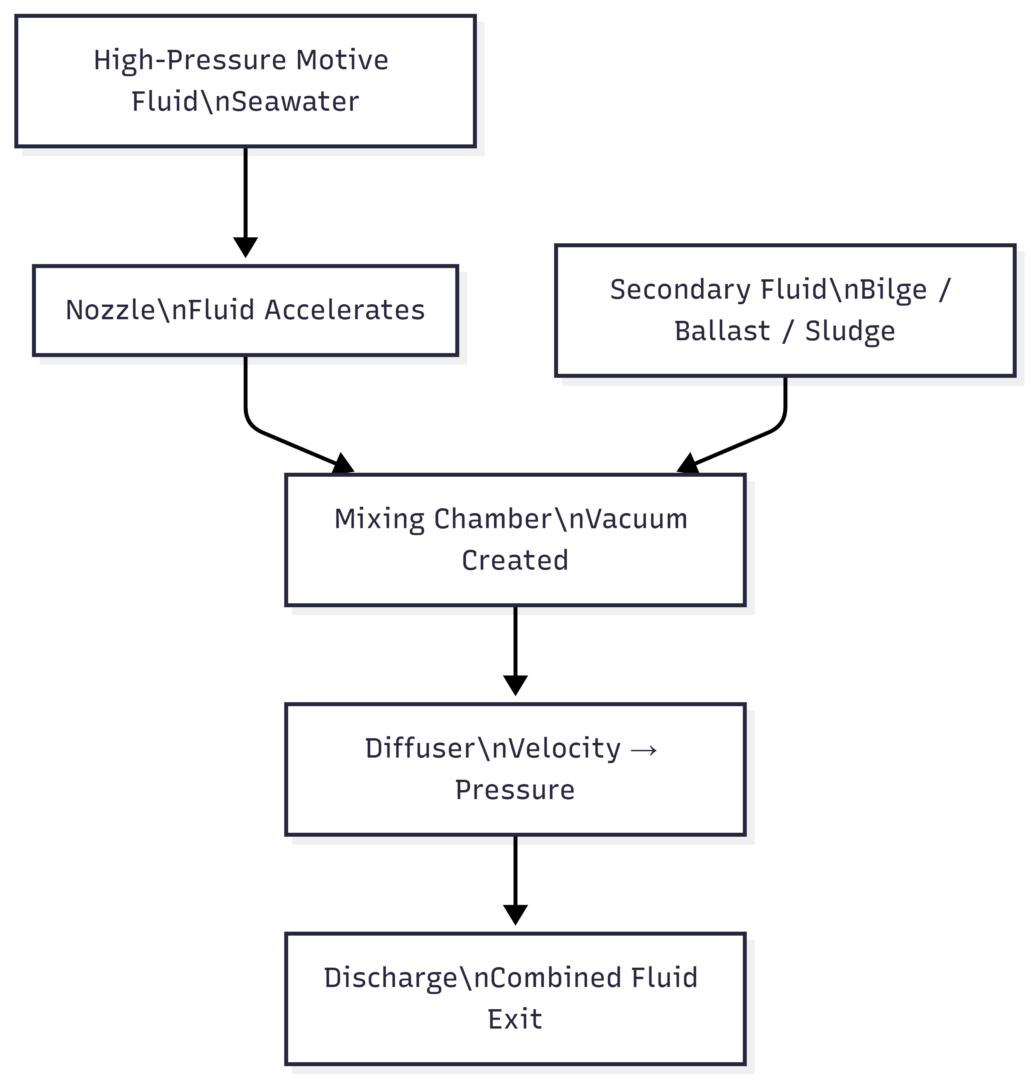
In practice, the eductor forces motive fluid (seawater) through a narrow nozzle. As the fluid accelerates through the nozzle, its pressure drops dramatically, creating a low-pressure zone (vacuum) in the suction chamber. This vacuum pulls in the secondary fluid. Both fluids then enter a mixing chamber, exchange momentum, and pass through a diffuser where velocity converts back into pressure — allowing the mixed fluid to be discharged.
The flow relationship is governed by the continuity equation:
A₁V₁ = A₂V₂
Since A₂ (nozzle) < A₁ (inlet), V₂ > V₁, therefore P₂ < P₁ — creating suction.
Flow: How a Marine Eductor Works
Key Components of a Marine Eductor
| Part No. | Component | Function | Common Material |
|---|---|---|---|
| 1 | Body | Houses all internal components | Cast iron / SS304 / Bronze |
| 2 | Nozzle | Accelerates motive fluid to create vacuum | Stainless Steel (SS304) |
| 3 | Suction Chamber | Where vacuum draws in secondary fluid | Cast iron / Bronze |
| 4 | Mixing Chamber | Combines motive and suction fluids | Cast iron / SS304 |
| 5 | Diffuser | Converts velocity back to pressure energy | Cast iron / SS304 / Bronze |
| 6 | Discharge Outlet | Expels the mixed fluid | Varies by model |
The nozzle is a smooth, sharply contracted conical tube. One side connects to the driving water inlet pipe; the other inserts into the suction pipe. The diffuser connects the mixing chamber to the discharge pipe, recovering pressure energy from the high-velocity mixed stream.
How to Operate a Marine Eductor: Step-by-Step
Proper operation is critical to prevent backflow and pressure issues, particularly when handling different fluid types such as oil and water.
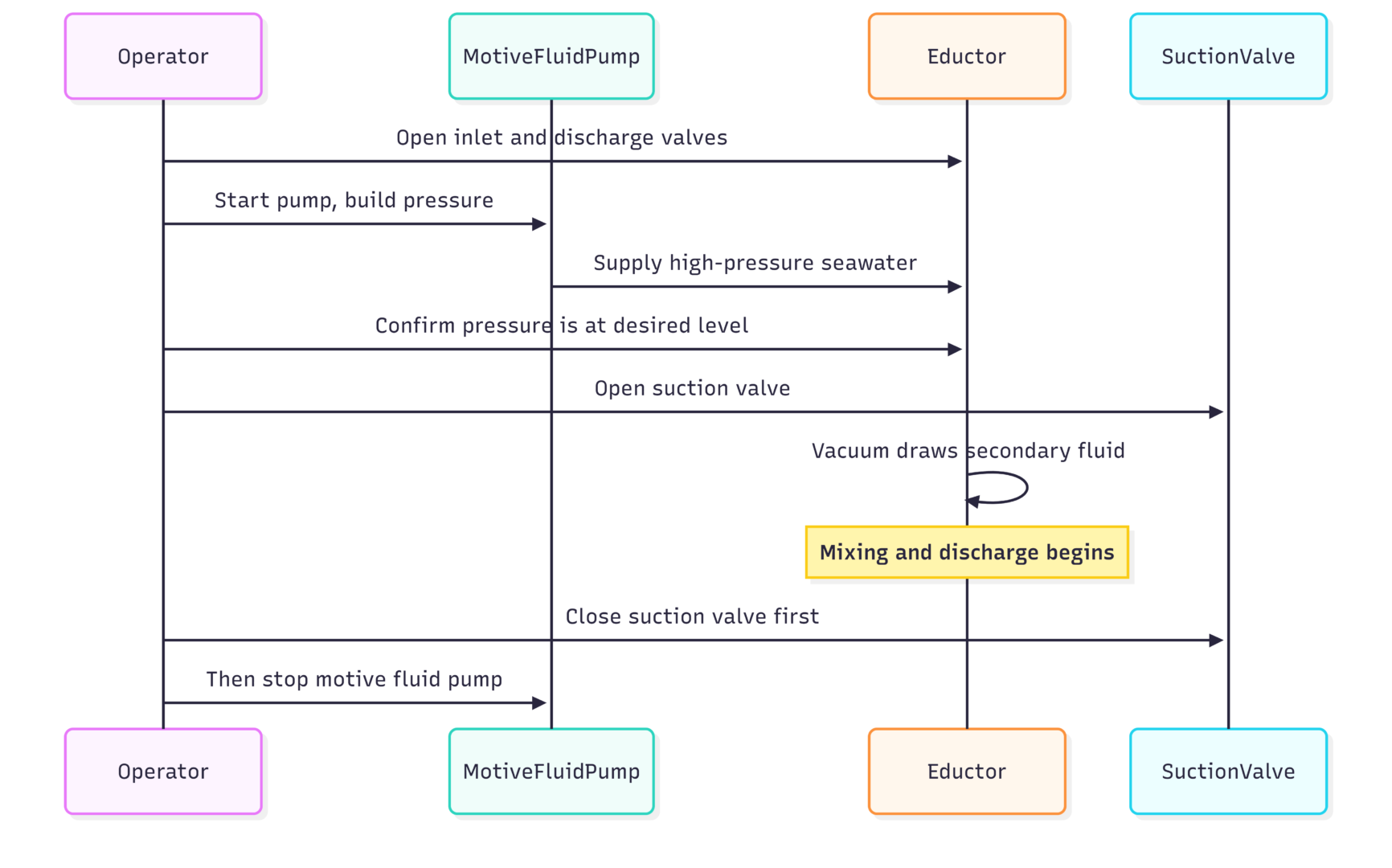
Important: Always open the suction valve after the motive fluid has reached operating pressure. Opening it prematurely causes backflow through the suction line.
Applications of Marine Eductors on Ships
Eductors are used across virtually every ship type due to their reliability in demanding environments.
Primary Uses
| Application | Ship Type | Purpose |
|---|---|---|
| Bilge Pumping | All vessels | Remove accumulated bilge water from engine room |
| Tank Stripping | Tankers | Remove residual cargo oil, chemicals, or sludge |
| Ballast Operations | Bulk carriers, tankers | Transfer seawater ballast between tanks |
| Emergency Dewatering | Naval, cargo | High-capacity flooding response |
| COW Operations | Crude oil tankers | Crude oil washing of cargo tanks |
| Fresh Water Generator | All vessels | Create vacuum for distillation process |
| Vacuum Toilet Systems | Cruise ships, all vessels | Generate vacuum for sanitation systems |
| Fire Fighting | All vessels | Foam pressure delivery in emergencies |
| Deep Well / Sump Draining | Tankers, bulk carriers | Drain areas inaccessible to standard pumps |
Secondary Uses
- Soil stabilization in dredging operations
- Drilling operations for fluid management
- Liquid mixing and agitation in storage tanks
- Priming centrifugal pumps before startup
- Chemical dosing in water treatment systems
Eductor Specifications and Typical Pressure Ranges
| Parameter | Typical Value |
|---|---|
| Motive fluid | Pressurized seawater |
| Motive fluid pressure | 2–7 bar (29–101 psi) |
| Suction lift capacity | Up to 8–10 meters |
| Discharge head | Varies by model and motive pressure |
| Motive fluid velocity | Up to 20 ft/sec (6 m/s) |
| Operating temperature | -10°C to 120°C (model dependent) |
| Body materials | Cast iron, SS304, Bronze (ZCuZn16Si4) |
| Size range | ER-40 to ER-150 (common series) |
Eductor vs. Ejector: Key Differences
Although often confused due to similar appearance and operating principles, eductors and ejectors are distinct devices with fundamentally different applications.
| Feature | Eductor | Ejector |
|---|---|---|
| Motive fluid | Water or liquid | Steam or air |
| Nozzle type | Converging | Converging-diverging |
| Operating velocity | ~20 ft/sec (6 m/s) | Up to 2,000 ft/sec (610 m/s) |
| Suction head | Larger | Smaller |
| Bore size limit | No limit | Limited to 0.5–0.55× discharge diameter |
| Noise level | Silent | Louder |
| Compression ratio | High | Lower |
| Primary use on ships | Bilge, ballast, cargo stripping | Steam-powered vacuum systems |
Advantages of Marine Eductors Over Conventional Pumps
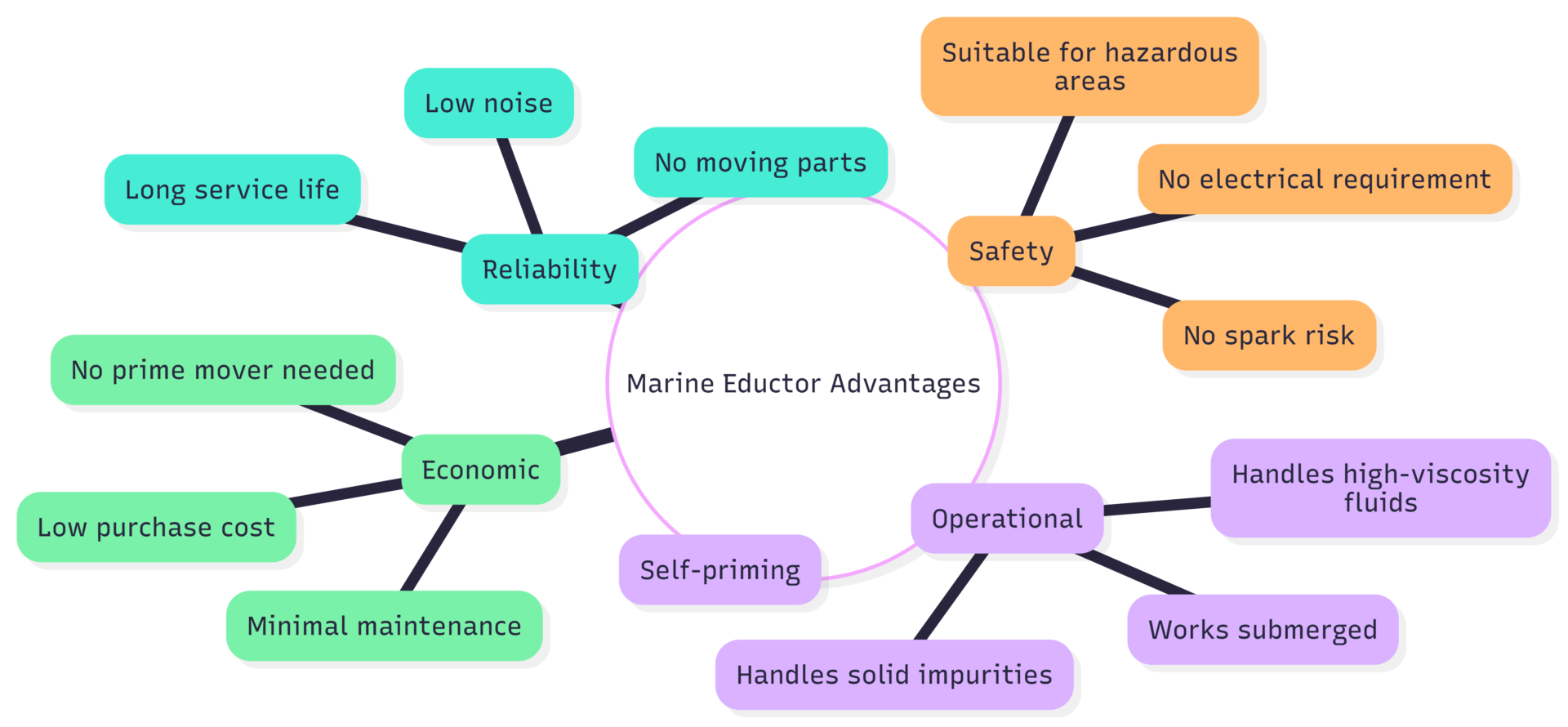
The eductor’s most significant advantage over mechanical pumps is its ability to handle fluid containing solid contaminants — material that would destroy an impeller or seal in a centrifugal pump. This makes it invaluable for sludge removal, tank stripping, and bilge operations where the fluid is rarely clean.
Performance Limitations of Marine Eductors
While highly versatile, eductors have inherent performance constraints that operators must understand.
Suction Capacity vs. Discharge Head: As discharge head increases, suction capacity decreases. There is a direct inverse relationship between the two — the eductor cannot overcome excessive back pressure without reducing its suction volume.
Motive Fluid Pressure: Increasing motive pressure beyond the recommended level does not improve suction — it merely wastes energy. Conversely, pressure below the recommended level significantly reduces suction capacity and risks backflow.
Efficiency: Eductors have comparatively low thermodynamic efficiency versus mechanical pumps. They are chosen for reliability and simplicity rather than energy efficiency.
Common Maintenance Issues and Troubleshooting
| Problem | Likely Cause | Solution |
|---|---|---|
| No suction | Clogged nozzle | Clear nozzle with soft tool (never sharp objects) |
| Reduced suction | Low motive fluid pressure | Check and increase pump pressure |
| Backflow through suction | Suction valve opened too early | Follow correct start-up sequence |
| Poor discharge flow | High back pressure | Increase motive fluid pressure |
| Leakage at body joints | Worn gaskets or O-rings | Replace sealing components |
When clearing a blocked nozzle, always use a soft wooden tool. Metal instruments or sharp objects will damage the nozzle’s smooth conical bore, permanently reducing performance.
Eductor vs. Centrifugal Pump: When to Use Each
| Scenario | Best Choice | Reason |
|---|---|---|
| Bilge stripping with sludge | Eductor | Handles solids without damage |
| High-volume cargo transfer | Centrifugal pump | Higher flow efficiency |
| Emergency flooding response | Eductor | No power required, instant deployment |
| Clean ballast water transfer | Either | Both suitable |
| Hazardous / explosive environment | Eductor | No electrical components |
| Deep tank stripping with low suction head | Eductor | Excellent low-head suction |
Conclusion
The marine eductor is a deceptively simple device that performs complex, critical tasks across every major ship type. Its zero-moving-parts design, ability to handle contaminated and viscous fluids, and suitability for hazardous environments make it irreplaceable in modern marine engineering. From bilge pumping and ballast management to cargo tank stripping and vacuum toilet systems, the eductor quietly powers essential shipboard operations that other pump types cannot reliably handle.
For marine engineers, understanding how to correctly start, operate, and troubleshoot an eductor — and knowing when to select it over a mechanical pump — is fundamental knowledge that directly impacts vessel safety and operational efficiency.
Happy Boating!
Share What is marine eductor in ships with your friends and leave a comment below with your thoughts.
Read Sewage Treatment Plant on Ships Explained until we meet in the next article.