What is Equasis Shipping Database?
The Equasis Shipping Database stands as a cornerstone in the maritime industry, offering a centralized platform for accessing critical safety and operational information on the world’s merchant fleet. Designed to foster transparency and elevate standards, this web-based system consolidates data from diverse sources, enabling stakeholders to make informed decisions about vessels and operators. By providing objective, non-commercial details, Equasis plays a pivotal role in combating substandard shipping practices and enhancing overall maritime safety.
At its core, Equasis—short for Electronic Quality Shipping Information System—serves as an online repository that aggregates and disseminates information related to ship quality, safety records, and management. It addresses a fundamental challenge in the shipping sector: the fragmentation of data across various entities. Before such systems existed, accessing comprehensive details on a vessel’s history, inspections, or ownership required navigating multiple channels, often leading to inefficiencies and oversights. Equasis bridges this gap by creating a unified, accessible hub that benefits a wide array of users, from port authorities and insurers to shipowners and environmental regulators.
The database’s inception stemmed from a collaborative effort between key maritime players, recognizing the need for a neutral platform to share unbiased information. Operated as a non-profit initiative, it emphasizes global cooperation, drawing contributions from maritime authorities worldwide.
This collaborative model ensures that the information remains reliable and up-to-date, reflecting the dynamic nature of the shipping industry. With its focus on promoting high standards, Equasis not only informs but also influences practices, encouraging operators to maintain compliance and invest in safety measures.
In an era where maritime transport handles a significant portion of global trade, the importance of such a database cannot be overstated. Ships traverse international waters, carrying goods worth trillions annually, and any lapse in safety can result in catastrophic environmental, economic, or human consequences. Equasis mitigates these risks by making safety-related data readily available, allowing users to evaluate the performance of ships and companies objectively. This transparency has earned it a reputation as one of the most trusted open sources for verifying vessel compliance and history.
The Purpose of Equasis
The primary objective of Equasis is to enhance maritime safety through the provision of free, objective information. By consolidating scattered data into a single platform, it empowers users to assess the quality of ships and their operators. This evaluation process is crucial for identifying potential risks and promoting best practices across the industry.
One key aim is to eliminate substandard shipping. Substandard vessels, often characterized by poor maintenance, inadequate crew training, or non-compliance with international regulations, pose significant threats to safety and the environment. Equasis counters this by highlighting deficiencies through detailed records, enabling stakeholders to avoid engaging with high-risk operators. For instance, port state control authorities can use the database to prioritize inspections on vessels with problematic histories, thereby preventing accidents and pollution incidents.
Transparency is another cornerstone. In an industry historically plagued by opacity, Equasis democratizes access to information, allowing even small-scale operators or researchers to review data that was once privileged. This openness fosters accountability, as shipowners know their records are publicly scrutinized. It also supports informed decision-making in chartering, insurance, and regulatory contexts. By providing a non-commercial system, Equasis ensures that the data remains impartial, free from biases that might arise in profit-driven databases.
Furthermore, Equasis seeks to build an international database that covers the entire global fleet. This global scope is essential given the international nature of shipping, where vessels operate under various flags and jurisdictions. The system encourages active cooperation from maritime authorities around the world, creating a network that strengthens collective oversight. Through this, it collects and disseminates quality and safety-related information, including accurate ship characteristics and management details.
Equasis also extends its focus to maritime transport companies. Beyond individual vessels, it provides insights into company performance, helping users gauge the reliability of operators. This holistic approach ensures that safety improvements are not limited to hardware but encompass organizational practices as well.
In summary, the purpose of Equasis revolves around reducing risks, promoting cooperation, and centralizing information to drive higher standards in maritime operations.
Data Coverage and Scope
Equasis boasts extensive coverage, encompassing data on over 85,000 ships. This includes all vessels in service above 100 gross tonnage (GT), making it a comprehensive resource for the merchant fleet. The database’s breadth ensures that it captures a wide spectrum of ship types, from container vessels and tankers to bulk carriers and passenger ships.
The scope is not limited to basic identification; it delves into technical, operational, and safety performance records. This depth allows users to track a vessel’s lifecycle, from construction and classification to ongoing inspections and incidents. By including ships of varying sizes and purposes, Equasis addresses the diversity of the maritime sector, where smaller vessels might operate in coastal trades while larger ones handle transoceanic routes.
Geographically, the database is truly global, drawing from international sources to reflect worldwide operations. It covers ships under every flag state, providing a unified view that transcends national boundaries. This universality is vital for an industry where a single vessel might change flags multiple times in its service life.
To illustrate the scale, consider that the merchant fleet represents a massive infrastructure asset, with vessels collectively valued in the hundreds of billions. Equasis’s coverage ensures that stakeholders can monitor this fleet’s health, identifying trends in safety compliance across regions or ship types.
Information Provided in Equasis
The Equasis database offers a rich array of information, structured to provide users with a complete picture of a vessel’s status. Key elements include ship identification details, such as International Maritime Organization (IMO) numbers and Maritime Mobile Service Identity (MMSI) numbers. These unique identifiers serve as the foundation for tracking, ensuring accuracy in queries.
Ownership information is another critical component. Users can access details on the registered owner, beneficial owner, and management company, revealing the corporate structure behind a vessel. This is particularly useful for due diligence in transactions or investigations, as it uncovers potential links to operators with poor reputations.
Flag state data indicates the country under which the ship is registered, which influences applicable regulations and oversight. Equasis highlights flag performance, allowing comparisons between open registries and those with stringent standards.
Classification society records are integral, detailing the society’s role in certifying the vessel’s seaworthiness. These include survey reports, class notations, and any suspensions or withdrawals, providing insights into structural integrity and compliance with international conventions like SOLAS (Safety of Life at Sea).
Port State Control (PSC) inspection results form a core dataset. PSC inspections, conducted by port authorities, assess compliance with safety, environmental, and labor standards. Equasis aggregates results from multiple regimes, showing deficiencies, detentions, and follow-up actions. This historical data helps predict future performance and identify recurring issues.
Additional details encompass operational history, such as voyage records, incident reports, and insurance coverage through Protection and Indemnity (P&I) clubs. Together, these elements enable a multifaceted analysis, from risk assessment to regulatory compliance verification.
To organize this information effectively, Equasis presents it through searchable interfaces, with options for advanced queries. Users can filter by criteria like ship type, age, or inspection outcomes, streamlining research.
Data Sources and Contributors
The robustness of Equasis stems from its diverse data sources, aggregating inputs from over 50 public and private organizations. This collaborative input ensures comprehensiveness and reduces the risk of gaps.
Primary contributors include the International Maritime Organization (IMO), which provides foundational data on ship registrations and standards. Seven Port State Control regimes—such as Paris MoU, Tokyo MoU, and others—supply inspection records, offering regional perspectives on compliance.
The European Maritime Safety Agency (EMSA) hosts and maintains the system, contributing EU-specific data and oversight. P&I clubs, which insure against liabilities, share information on coverage and claims, adding a financial dimension to safety assessments.
Classification societies, responsible for technical certifications, upload survey and class data. Industry associations and data suppliers provide supplementary details on trade and commerce, while companies voluntarily share operational insights.
This multi-source approach enhances reliability, as cross-verification minimizes errors. Data providers update information regularly, with approximately 80% refreshed weekly, ensuring timeliness.
Here’s a table summarizing key data providers and their contributions:
| Data Provider Category | Examples | Key Contributions |
|---|---|---|
| International Organizations | IMO | Ship identification, global standards |
| Port State Control Regimes | Paris MoU, Tokyo MoU, etc. (7 total) | Inspection results, deficiencies, detentions |
| Hosting Agency | EMSA | System maintenance, EU data integration |
| Insurance Entities | P&I Clubs | Coverage details, liability records |
| Classification Bodies | Various societies | Survey reports, class notations |
| Industry Associations | Multiple | Trade data, operational insights |
| Commercial Data Suppliers | Companies sharing commerce info | Voyage and management details |
This table highlights the ecosystem supporting Equasis, illustrating how interconnected inputs create a holistic database.
Accessibility and User Experience
Access to Equasis is free, aligning with its non-commercial ethos. However, users must register to gain entry, a step that ensures accountability and prevents misuse. Registration is straightforward, requiring basic details like email and affiliation, after which users receive login credentials.
Once registered, the platform offers an intuitive web-based interface. Searches can be conducted by ship name, IMO number, or other identifiers, yielding detailed profiles. Advanced features allow for bulk queries or customized reports, catering to professional needs.
The user base is diverse, including maritime authorities, shipbrokers, insurers, journalists, and researchers. This broad accessibility promotes widespread use, amplifying the database’s impact on safety.
Security measures protect sensitive data, with access levels potentially varying based on user type. Overall, the system balances openness with responsible data handling.
Updates and Reliability
To maintain its value, Equasis emphasizes regular updates. Data refreshes occur frequently, with about 80% updated weekly. This cadence reflects the fast-paced maritime environment, where inspections, ownership changes, or incidents can alter a vessel’s status rapidly.
Reliability is upheld through validation processes, where contributors verify submissions before integration. EMSA’s management unit oversees quality control, ensuring consistency across sources.
Users benefit from this timeliness, as outdated information could lead to misguided decisions. Equasis’s commitment to freshness has solidified its status as a dependable resource.
The Main Goals of Equasis
Equasis was established with clear, ambitious goals to transform maritime information sharing. Foremost is reducing substandard shipping by disseminating safety-related data, empowering users to shun non-compliant vessels.
Creating a non-commercial, globally accessible system ensures equity, allowing worldwide participation without financial barriers.
Building an international database for the entire fleet promotes uniformity in oversight, regardless of vessel origin.
Seeking cooperation from maritime authorities fosters a collaborative network, enhancing data quality through shared expertise.
Collecting and disseminating quality information centralizes resources, making scattered data actionable.
Providing accurate ship characteristics and management info supports precise assessments.
Including details on maritime transport companies extends scrutiny to organizational levels.
These goals collectively drive Equasis’s mission, contributing to safer seas.
For a visual representation of data flow in Equasis, consider the following flowchart:
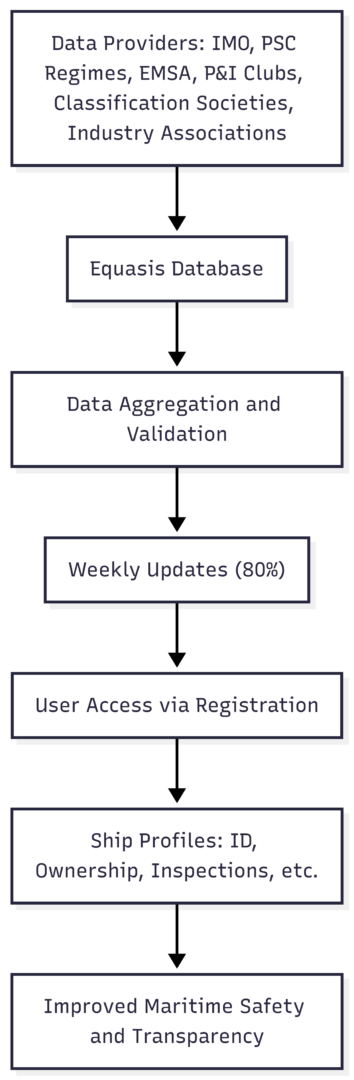
This diagram outlines the process from data input to user benefits, emphasizing the system’s efficiency.
Funding and Sustainability
Equasis’s operations are sustained through contributions from key stakeholders. Primarily, costs are shared by the European Commission and French maritime authorities, reflecting its European roots.
Additional financial support comes from maritime authorities in the United Kingdom, Spain, Singapore, and Japan. This international funding underscores global commitment to the initiative.
As a non-profit, Equasis avoids user fees, relying on these partnerships for development and maintenance. This model ensures long-term viability without compromising accessibility.
Impact on the Maritime Industry
Equasis has profoundly influenced the shipping sector by raising awareness of safety issues. Its data has informed policy decisions, such as targeted inspections or flag state reforms.
Operators use it for self-assessment, identifying areas for improvement to enhance reputations. Insurers leverage records for risk pricing, potentially lowering premiums for compliant vessels.
Environmentally, by highlighting pollution risks, Equasis supports efforts to reduce incidents like oil spills. It also aids in labor standard enforcement, protecting seafarers.
Globally, it has standardized information exchange, facilitating international trade while minimizing risks.
Challenges and Future Directions
Despite successes, Equasis faces challenges like data completeness, as not all entities contribute equally. Ensuring universal participation remains a goal.
Technological advancements could enhance features, such as AI-driven analytics or mobile access.
Future expansions might include real-time tracking integration or expanded environmental data, adapting to evolving regulations like IMO’s decarbonization targets.
Conclusion
Equasis Shipping Database exemplifies how collaborative information sharing can elevate industry standards. By providing free, comprehensive data on the global fleet, it empowers stakeholders to prioritize safety and transparency. As a trusted resource, it continues to play a vital role in eliminating substandard practices and fostering a safer maritime world.
Happy Boating!
Share What is Equasis Shipping Database? with your friends and leave a comment below with your thoughts.
Read Working of Marine Boilers Explained until we meet in the next article.