What is Boiling Liquid Expanding Vapour Explosion (BLEVE) on Gas Carrier Ships?
Gas carrier ships transport some of the most hazardous cargoes at sea — liquefied gases like LPG, ammonia, ethylene, and chlorine. These substances are kept in a liquid state only because of the high pressure or low temperature maintained inside specially designed cargo tanks. When those conditions are disrupted — whether by fire, mechanical failure, or corrosion — the result can be one of the most destructive events in maritime history: a Boiling Liquid Expanding Vapour Explosion, universally known as a BLEVE.
What exactly is a BLEVE?
A BLEVE is an explosion triggered by the catastrophic rupture of a pressure vessel that contains a liquid held above its atmospheric boiling point. Because pressure is what keeps the substance liquid, any sudden loss of containment causes an instantaneous drop in boiling point. The liquid, now far above its new boiling point, flashes into vapour almost instantaneously — typically within one millisecond — releasing an enormous amount of energy in the process.
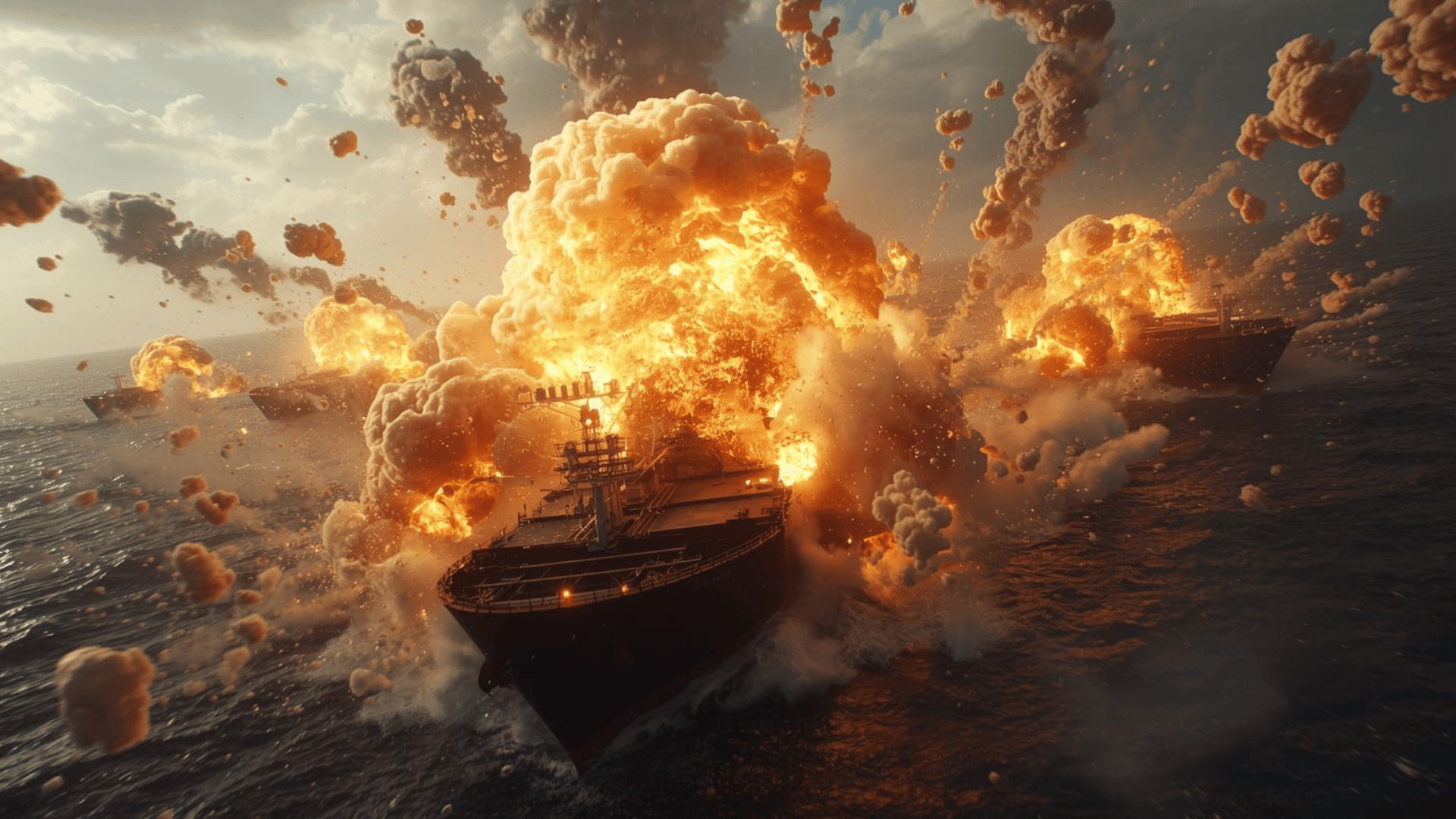
On a gas carrier, cargo tanks are partially filled with liquid and partially with vapour under normal operating conditions. The moment the tank structure fails, this equilibrium collapses. Vapour rushes out through the breach, the internal pressure drops, and the remaining liquid undergoes explosive boiling. The expanding vapour generates a shock wave powerful enough to shatter the tank, hurl fragments hundreds of metres, and — if the cargo is flammable — ignite into a massive fireball.
It is important to understand that BLEVE does not require a flammable substance. Even liquid nitrogen or liquid helium can produce a purely physical BLEVE, capable of causing frostbite, asphyxiation from vapor displacement, or structural damage from the blast overpressure. However, when the cargo is flammable — as is almost always the case on LPG carriers — the explosion transforms into a vapour cloud explosion (VCE) accompanied by a rising fireball that can reach hundreds of metres in diameter and cause severe thermal burns at distances of 300–400 metres from the source.
The science behind it: superheat limit theory
For a BLEVE to occur, the liquid must be sufficiently superheated at the moment of containment loss. Researchers have proposed a minimum BLEVE temperature based on a fluid’s critical temperature — the point above which distinct liquid and gas phases cannot coexist. A widely cited formula, proposed by researcher Robert Reid, gives this minimum as approximately 89.5% of the fluid’s critical temperature (in kelvin).
The table below shows minimum BLEVE temperatures for cargoes commonly carried on gas ships:These temperatures represent thresholds, not certainties. In practice, BLEVEs can occur at temperatures lower than those predicted by the formula, particularly when the vessel fails suddenly or when there is temperature stratification within the liquid — localised hot spots that accelerate phase transition before the rest of the cargo has reached the theoretical minimum.
Four conditions that must exist for a BLEVE
A BLEVE does not happen randomly. It requires the simultaneous presence of four specific conditions:
Liquid cargo must be present. Vapour alone cannot produce a BLEVE — there must be a quantity of liquid inside the tank. The liquid is the energy store that drives the explosion. Even a non-flammable liquid like water will cause a BLEVE if the other conditions are met.
The container must be pressurised. The liquid must be enclosed in a vessel capable of maintaining pressure above atmospheric, keeping the boiling point elevated. If the vessel vents freely, pressure cannot build to the required level.
Temperature above atmospheric boiling point. The enclosed liquid must be above its atmospheric boiling point at the time of failure. On gas carriers, this condition is almost always met by design — cargoes like propane have atmospheric boiling points well below ambient temperature, so the pressurised tanks are always holding them in a superheated state relative to what they would experience at sea level pressure.
Structural failure of the tank. The contained liquid requires a path to escape and flash to vapour. That path is created only by a failure of the tank structure — whether from corrosion, fire exposure, mechanical damage, or relief valve malfunction.
Common causes on gas carrier ships
The single most common cause of BLEVE on a gas carrier is an external fire near the cargo tanks. Fire heats the tank wall, which in turn heats the contents. As vapour pressure rises, the installed pressure relief valve should activate and release excess vapour. However, if the rate of heating is extreme — such as from a jet fire from a ruptured adjacent tank or pipeline — pressure can build faster than the relief valve can discharge it. The tank then fails at its weakest structural point, exposing pressurised flammable vapour directly to the ignition source.
Other causes of tank structural failure include: improper or neglected maintenance allowing corrosion to weaken the shell; a relief valve that is stuck closed or incorrectly sized for the cargo and tank capacity; mechanical impact during cargo operations or collision; and material fatigue from repeated thermal cycling over the vessel’s service life.
The danger is compounded on ships by proximity. A BLEVE on one tank can project fragments with enough energy to rupture adjacent tanks, creating a chain reaction. At the 1966 Feyzin disaster on shore, three propelled fragments each weighed over 100 tonnes and were thrown 150–350 metres from the explosion. One tank at the 1984 San Juanico disaster travelled 1,200 metres through the air — possibly the farthest recorded BLEVE missile. The maritime environment provides no comparable open space to absorb such projectiles.
Phases of a BLEVE in sequence
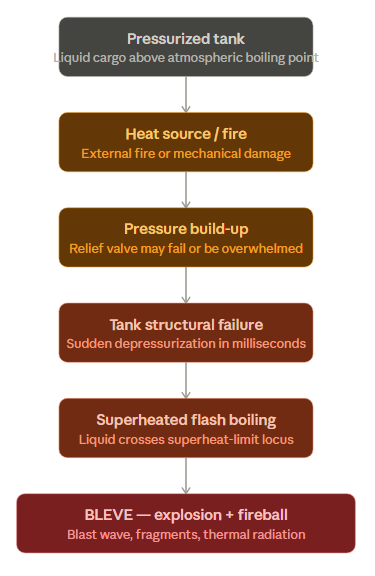
The process unfolds in four distinct phases, each feeding the next:
Phase 1 — Tank failure. Whether from fire exposure, corrosion, or impact, the tank loses structural integrity. Internal pressure has no means of controlled release. The weakest point of the shell gives way.
Phase 2 — Phase transition. In milliseconds, the internal pressure drops from operating pressure to atmospheric. The liquid-vapour mixture, which was thermodynamically stable at elevated pressure, is now superheated. Its temperature is far above the new, lower boiling point at atmospheric pressure.
Phase 3 — Violent flash boiling. Because the temperature of the liquid exceeds the superheat limit, homogeneous bubble nucleation occurs throughout the bulk of the liquid simultaneously — not just at the surface. This produces a violent, explosive outward splashing of the liquid-vapour mixture rather than a controlled boil.
Phase 4 — Explosion and fireball. The combination of instantaneous phase change, rapid vapour expansion, and — for flammable cargoes — ignition produces the BLEVE proper: a blast overpressure wave, high-velocity tank fragments, and a rising fireball. The fireball is not an incidental effect. For flammable BLEVEs, thermal radiation from the fireball typically causes more casualties than the blast itself.
Warning signs crew must recognise
A BLEVE almost always gives warnings before it occurs. Any of the following should trigger immediate evacuation and emergency response:
A ringing or pinging sound emanating from the tank shell indicates the metal is under extreme thermal or mechanical stress. Visible discolouration of the tank surface — particularly a reddish or bluish hue — indicates the steel is being overheated. Flaking of small metal pieces from the shell surface is a sign of material degradation. A visible bulge or bubble on the tank surface means the internal pressure has deformed the shell and failure is imminent. A sudden, unexplained rise in tank pressure — particularly one that does not respond to relief valve operation — is the most urgent warning of all.
Hazards when a BLEVE occurs
Three distinct hazard zones exist around a BLEVE event. The blast wave travels outward at near-sonic speed and can collapse structures, shatter windows, and cause fatal barotrauma in personnel. Fragment projection — sometimes described as “rocketing” for cylindrical tanks that rupture longitudinally — can throw heavy pieces of steel hundreds of metres in unpredictable directions; horizontal cylindrical tanks behave like rockets when they fail at the end caps. Thermal radiation from the fireball is the dominant cause of fatalities in flammable BLEVEs; the fireball rises rapidly into a mushroom shape, and exposed personnel can sustain fatal burns hundreds of metres away.
For toxic cargoes that do not ignite — chlorine, ammonia, phosgene — the BLEVE produces a dense toxic gas cloud rather than a fireball. This cloud disperses downwind and can cause mass casualties at concentrations well below what produces visible effects, making it potentially more dangerous than a fireball in terms of total area affected.
Prevention and safety measures on gas carriers
Prevention centres on eliminating the conditions required for BLEVE, and on ensuring the systems designed to control pressure actually function. Cargo tanks must be inspected at regular intervals for corrosion, weld cracking, and shell deformation. Pressure relief valves must be tested and confirmed operational at all times, and must be sized in accordance with the International Gas Code (IGC Code) requirements for the specific cargo carried. A valve that is undersized for the flow rate required will not prevent over-pressurisation even if it is functioning correctly.
During cargo transfer operations, no bunkering, compressed gas work, or general stores movements should occur in the vicinity of the cargo manifold. Mooring lines must be kept tight and in good condition to prevent surge loads on the cargo arms. An LP-Gas detector must be available and deployed at the berth throughout operations. All connection areas, stop valves, and emergency shut-down points must be clearly marked and accessible without obstruction.
Fire-fighting equipment — water spray monitors, dry powder systems, and foam applicators appropriate for the cargo — must be positioned and ready for immediate deployment. In the event of an external fire near a cargo tank, water spray cooling of the tank shell is one of the most effective measures available to buy time before failure occurs, since cooling prevents the metal from losing structural integrity and slows the rate of pressure increase.
Crew emergency preparedness must be maintained through drills that specifically simulate cargo tank fire and over-pressure scenarios. All personnel — both ship and shore — must know the locations of emergency shut-down valves and the procedures for activating them. The most critical time window between warning signs and catastrophic failure may be minutes or less; a crew that has rehearsed the response saves lives.
Why BLEVE matters for gas carrier design
Gas carrier cargo tanks are built from high-strength, low-thermal-coefficient steel alloys specifically chosen to maintain structural integrity at cryogenic temperatures, and insulated to minimise heat ingress from the marine environment. These design choices directly address the BLEVE risk. A tank that fails to absorb heat slowly stays closer to its design temperature and further from the superheat threshold. A tank built to higher tensile standards fails at a higher pressure, giving relief valves more time to function. The IGC Code mandates these design standards precisely because the consequences of their absence — as demonstrated in numerous shore-based and marine BLEVE accidents — are catastrophic and irreversible.
Understanding the mechanism, the warning signs, and the conditions that produce a BLEVE is not academic for gas carrier officers. It is operational knowledge that sits at the foundation of safe cargo management at sea.
Happy Boating!
Share What is Boiling Liquid Expanding Vapour Explosion (BLEVE) on Gas Carrier Ships? with your friends and leave a comment below with your thoughts.
Read 10 Important Tests for Major Overhauling of Ship’s Generator until we meet in the next article.