Vibration sensor data can help prevent major equipment problems at sea
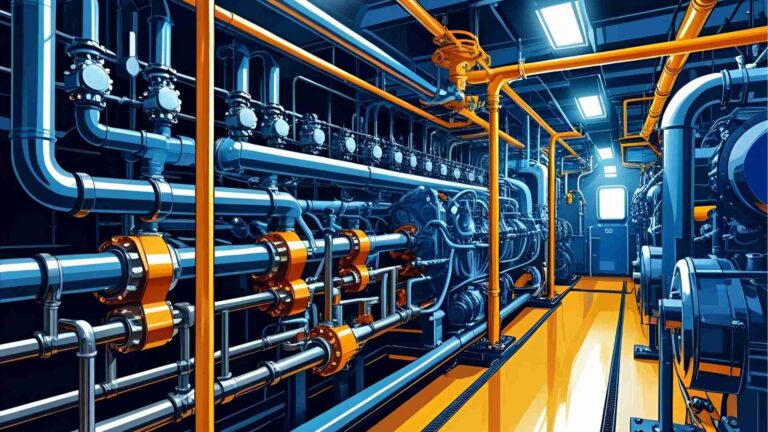
In the vast expanse of global maritime operations, where vessels traverse unpredictable waters carrying billions of tons of cargo, the integrity of onboard machinery stands as a critical pillar. Engines, pumps, generators, and other rotating equipment face relentless stress from waves, loads, and corrosive environments.
A single failure can lead to catastrophic downtime, endangering crews and disrupting supply chains. This is where vibration sensor data emerges as a game-changer, offering real-time insights to detect and mitigate issues before they escalate into major problems.
Maritime transportation underpins approximately 80% of international trade, with seaborne volumes reaching around 11 billion tons annually. This scale demands unwavering reliability, as even minor disruptions ripple through global logistics.
Vibration monitoring systems have become indispensable, shifting the industry from reactive fixes to predictive strategies. By capturing subtle shifts in frequency, amplitude, and phase, these systems flag anomalies like shaft misalignment, bearing wear, or structural looseness in marine assets. This proactive approach not only averts breakdowns but also optimizes operations in one of the world’s most challenging sectors.
The Critical Role of Vibration Monitoring in Maritime Operations
Marine vessels operate in harsh conditions, exposed to constant motion, saltwater corrosion, and variable loads. Traditional maintenance relies on scheduled inspections, but these often miss emerging faults until damage is irreversible. Vibration sensor data fills this gap by providing continuous, data-driven oversight of key machinery.
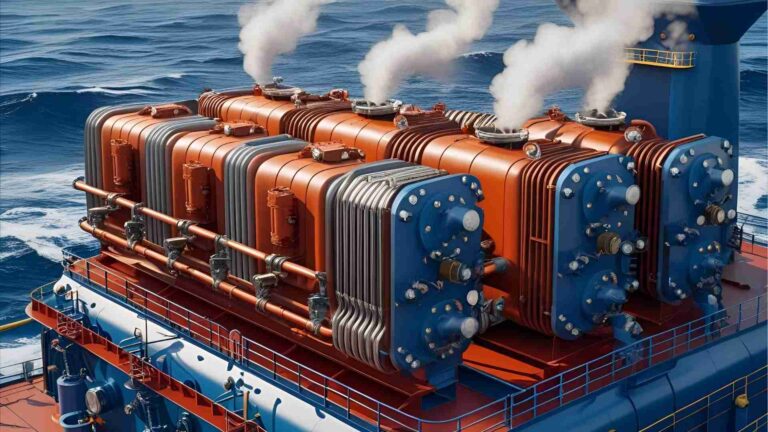
Consider the core components of a marine vessel: main propulsion engines, auxiliary generators, centrifugal pumps for ballast and fuel systems, compressors for air conditioning and refrigeration, and gearboxes linking power sources. Each generates unique vibration signatures under normal operation. Deviations—such as increased amplitude from imbalance or frequency spikes from bearing defects—signal impending issues.
Predictive monitoring through vibration sensors allows operators to intervene early. For instance, a slight misalignment in a propeller shaft might start as a minor hum but could lead to seal failures or hull damage if unchecked. By analyzing data in real-time, crews can adjust operations or schedule repairs during port calls, minimizing at-sea risks.
This technology aligns with the industry’s resilience, as trade volumes continue to grow by around 3% annually. With containerization streamlining ports and supply chains, vessels must maintain peak efficiency. Vibration data ensures that, preventing the kind of failures that could strand a ship mid-voyage or compromise cargo integrity.
Understanding Vibration Monitoring Systems: How They Work
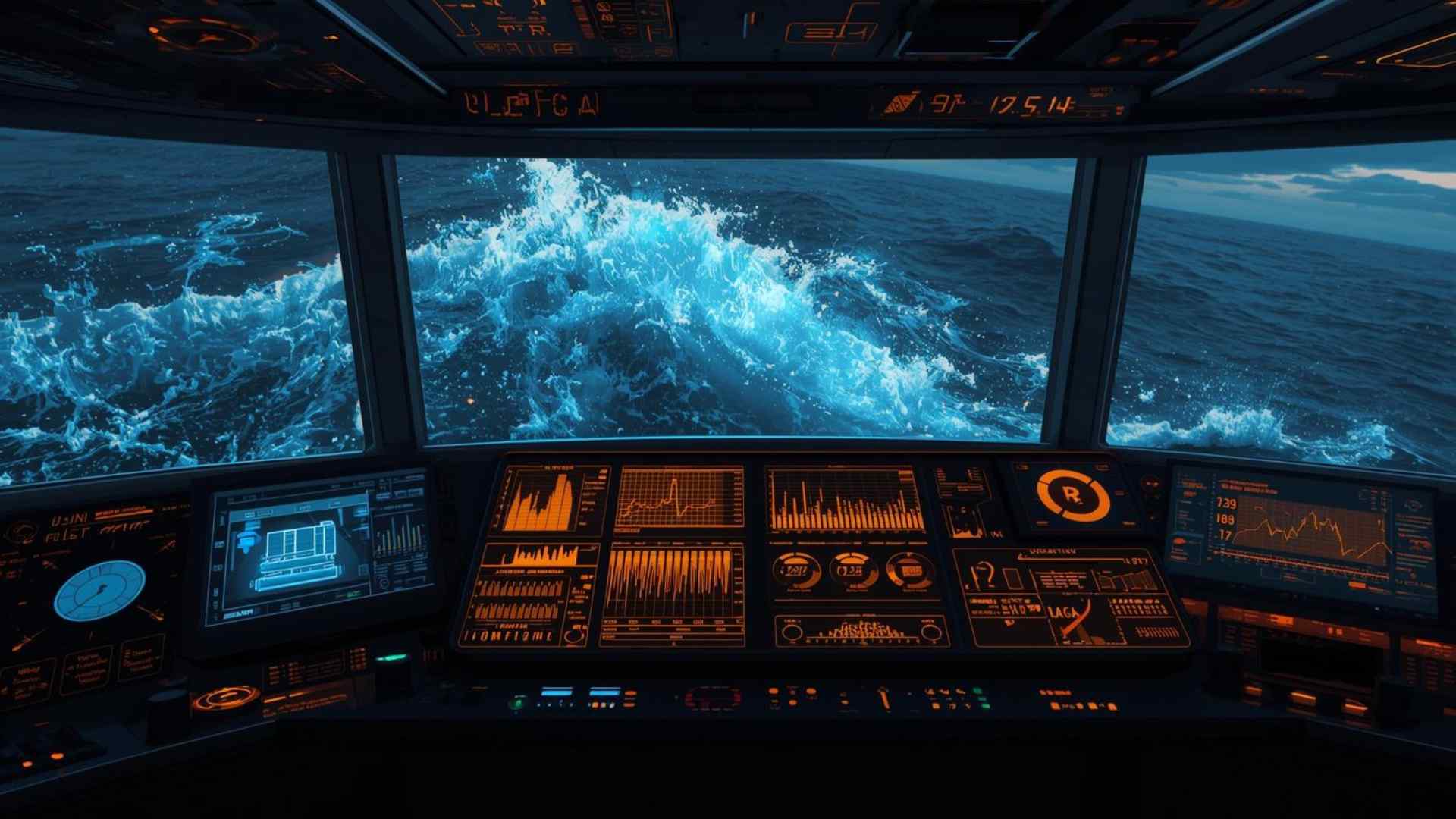
Vibration monitoring systems are engineered to detect, measure, and analyze mechanical oscillations in equipment. At their core, they use sensors to capture vibration data, which is then processed to reveal equipment health.
The process begins with sensors mounted on machinery. These devices measure parameters like acceleration, velocity, or displacement. Accelerometers, the most common type, convert mechanical motion into electrical signals, sensitive to frequencies from 0.1 Hz to 10 kHz or higher, depending on the model.
Data flows to a acquisition unit, which samples signals at rates up to 100 kHz for high-resolution analysis. Software algorithms apply techniques like Fast Fourier Transform (FFT) to break down vibrations into frequency components, identifying patterns linked to specific faults:
- Imbalance: Dominant at rotational speed (1x RPM).
- Misalignment: Peaks at 2x RPM.
- Bearing wear: High-frequency broadband noise.
- Looseness: Subharmonics or multiples below RPM.
If anomalies exceed thresholds—say, amplitude over 5 mm/s RMS for a pump—alerts trigger via dashboards or mobile apps. This enables immediate action, such as lubricating bearings or realigning shafts.
In maritime settings, systems must withstand IP67-rated enclosures for water and dust resistance, operating in temperatures from -40°C to 85°C. Wireless IoT integration allows data transmission via satellite, enabling remote oversight from shore-based teams.
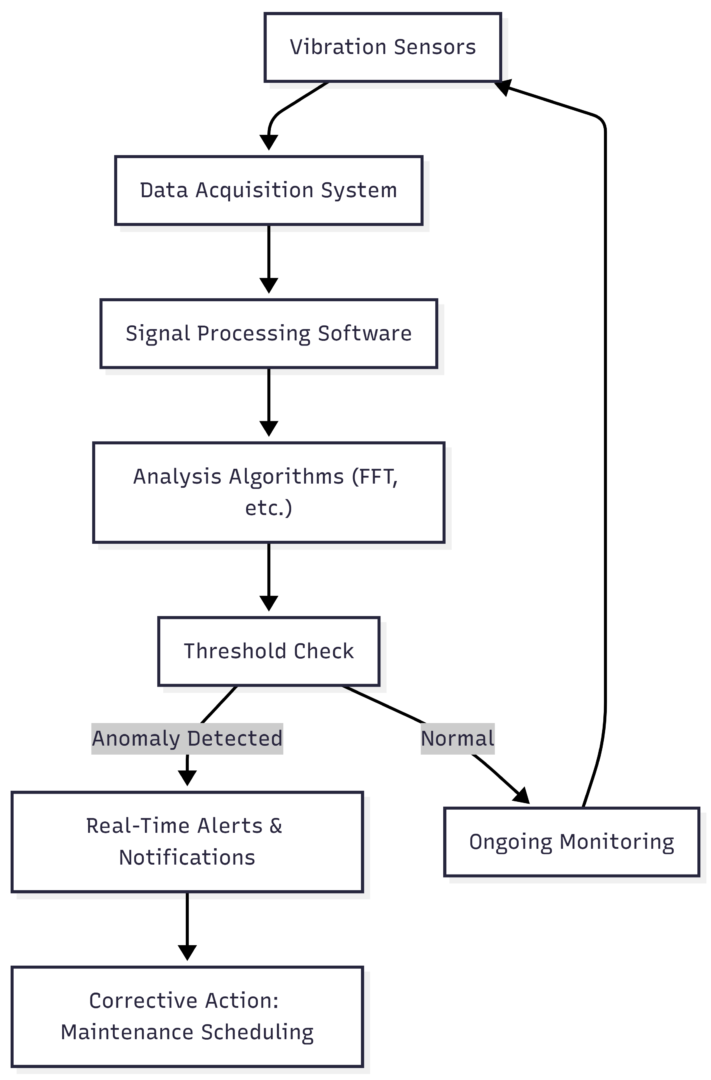
This Mermaid flowchart illustrates the workflow: sensors feed data through processing to alerts, looping back for continuous monitoring.
Key Components of Vibration Monitoring Systems
Effective systems comprise several integrated elements, each tailored for marine durability.
- Vibration Sensors: Piezoelectric accelerometers or velocity transducers mounted on equipment housings. Specifications include sensitivity (100 mV/g typical), frequency range (2-10,000 Hz), and shock resistance (up to 5,000 g). Submersible models, like those from Monitran, feature stainless steel casings for underwater applications.
- Data Acquisition System (DAQ): Multi-channel units sampling at 24-bit resolution. They handle inputs from 4-32 sensors, with onboard storage for offline analysis. Marine-grade DAQs are compact, vibration-resistant, and powered by 12-24V DC.
- Signal Processing and Analysis Software: Cloud-based or onboard platforms using AI for pattern recognition. They generate spectrograms, trend plots, and fault diagnostics. Integration with SCADA systems allows vessel-wide oversight.
- Display and Notification Interface: Touchscreen HMIs or apps providing visualizations like waterfall plots. Alerts via SMS, email, or sirens ensure rapid response.
A sample table of component specifications:
| Component | Key Specifications | Typical Price Range (USD) |
|---|---|---|
| Accelerometer Sensor | Sensitivity: 100 mV/g; Freq: 0.5-15k Hz; IP68 rating | 200-500 per unit |
| DAQ Unit | Channels: 8-16; Sampling: 50 kHz; Ethernet/Wi-Fi | 1,000-3,000 |
| Analysis Software | AI fault detection; Cloud integration | 500-2,000 annual license |
| Notification System | Mobile app; Custom thresholds | Included in software |
Prices vary by supplier and scale; bulk purchases for fleets reduce costs.
Benefits of Implementing Vibration Monitoring at Sea
The advantages extend across operations, safety, and economics.
Predictive Maintenance: By spotting issues early, systems shift from time-based to condition-based schedules. This reduces unnecessary overhauls, extending asset life by 20-30%.
Enhanced Safety: Real-time detection prevents failures like engine seizures, which could cause fires or loss of propulsion in rough seas. For oil tankers, this mitigates explosion risks from pump leaks.
Reduced Operational Costs: Early interventions avoid major repairs. One case saw savings of over $100,000 in parts and downtime by catching looseness in components.
Real-Time Alerts: Threshold breaches trigger immediate notifications, allowing crews to isolate faulty equipment without halting voyages.
Remote Monitoring: IoT-enabled sensors transmit data to shore, ideal for inaccessible areas like engine rooms. This supports Reliability-Centered Maintenance (RCM), prioritizing critical assets.
Efficiency Gains: Optimized machinery reduces fuel consumption by 5-10% through balanced operation, lowering emissions.
Data-Driven Insights: Long-term trends inform fleet-wide decisions, such as upgrading bearings or redesigning mounts.
In a table format for clarity:
| Benefit | Description | Impact on Operations |
|---|---|---|
| Predictive Maintenance | Identifies faults early for scheduled fixes | Reduces downtime by 50% |
| Safety Enhancement | Prevents catastrophic failures | Lowers accident risk |
| Cost Reduction | Avoids expensive breakdowns; extends life | Savings up to 30% on maintenance |
| Real-Time Alerts | Instant notifications for quick action | Minimizes voyage disruptions |
| Remote Monitoring | Oversees from shore in harsh environments | Enables global fleet management |
| Efficiency Improvement | Smoother operation cuts fuel and emissions | Boosts sustainability |
These benefits compound in large fleets, where a single prevented failure justifies the investment.
Advanced Technologies and Integration
Modern systems leverage accelerometers for tri-axial measurement (x, y, z axes), capturing directional data for precise diagnostics. Phase analysis reveals coupling issues between components.
Wireless sensors, using Bluetooth or LoRaWAN, eliminate cabling in confined spaces. Battery life extends to 5 years with low-power designs.
Integration with AI enhances accuracy. Machine learning models train on historical data to predict failures with 95% precision, adapting to vessel-specific patterns.
For example, partnerships like ioCurrents and ifm combine sensitive sensors with analytics. ifm’s devices detect micro-vibrations, while ioCurrents’ platform generates reports on looseness, friction, and impact. Custom thresholds alert crews, enabling RCM plans.
In one deployment, high-frequency data prevented two failures, saving over $100,000. This underscores how vibration analytics transform raw data into actionable intelligence.
Case Studies and Real-World Applications
Real-world examples highlight the transformative impact.
A cargo ship operator faced recurring generator failures from bearing wear, costing $40,000-$80,000 per incident plus downtime. Installing ifm sensors and ioCurrents analytics set thresholds for friction and impact. Within 90 days, alerts caught issues, averting major costs.
Sensonics, with expertise in turbine protection, equips oil tankers with API 670-compliant systems. Their sensors monitor engines and pumps, detecting misalignment early to prevent hull vibrations.
Monitran’s submersible sensors suit hovercraft and ferries, tracking fan and motor health in wet environments. Continuous data supports proactive swaps, reducing off-hire periods.
These cases show vibration data’s role in averting disruptions in container ships, where timely maintenance keeps supply chains flowing.
Leading Suppliers and Solutions
Several companies specialize in marine vibration monitoring.
Sensonics: Offers sensors and protection equipment for turbines and rotating machinery. Their systems include eddy current probes for shaft vibration, with ranges up to 10 mm and linearity better than 1%.
Monitran: Provides robust accelerometers for marine use, with models like MTN/2200 (general purpose) featuring 100 mV/g sensitivity and -25°C to 120°C operation.
ioCurrents and ifm: Their collaboration delivers end-to-end solutions. ifm’s VVB sensors offer frequency ranges to 6 kHz, integrated with ioCurrents’ cloud platform for vessel-wide reports.
When selecting, consider compatibility with existing PLCs and scalability for fleets. Initial costs range from $5,000 for basic setups to $50,000 for comprehensive systems, with ROI in 6-12 months through savings.
Challenges and Best Practices
Despite benefits, implementation faces hurdles like sensor placement in vibrating hulls or data overload. Best practices include:
- Strategic mounting: Near bearings or shafts for optimal signal.
- Calibration: Regular checks against ISO 10816 standards.
- Training: Crew education on interpreting alerts.
- Integration: With vessel management systems for holistic views.
Overcoming these ensures maximum value from vibration data.
Future Trends in Marine Vibration Monitoring
Emerging trends include edge computing for onboard AI analysis, reducing latency. 5G connectivity enhances remote diagnostics, while blockchain secures data for insurance claims.
Sustainability drives adoption, as efficient machinery cuts emissions aligned with IMO regulations.
In summary, vibration sensor data revolutionizes marine maintenance, preventing major problems through insight and action. By embracing these systems, operators safeguard assets, crews, and the global trade they enable.
Happy Boating!
Share Vibration sensor data can help prevent major equipment problems at sea
with your friends and leave a comment below with your thoughts.
Read Training Generation “Z” in the Marine Industry until we meet in the next article.