Sewage Treatment Plant on Ships Explained
Every ship generates sewage — from toilets, urinals, and washrooms — and discharging it untreated into the ocean is both illegal and environmentally damaging. A Sewage Treatment Plant (STP) is the system onboard that processes this waste to meet international discharge standards before it reaches the sea. Understanding how it works, what regulations govern it, and what technologies are used is essential knowledge for anyone working in or studying the maritime industry.
What Is a Marine Sewage Treatment Plant?
A marine STP is an onboard system that collects, treats, and safely discharges sewage generated by the crew and passengers. It handles two categories of waste:
- Blackwater — waste from toilets and urinals
- Greywater — waste from sinks, showers, and galleys (handled by some systems)
The treatment process converts raw sewage into an effluent that is safe for discharge into the sea, meeting the strict standards set by MARPOL Annex IV under the International Maritime Organization (IMO).
MARPOL Annex IV — Discharge Regulations
MARPOL Annex IV governs the discharge of sewage from ships. The key rules are:
| Condition | Treated Sewage | Untreated Sewage |
|---|---|---|
| Distance from nearest land | Permitted beyond 3 nautical miles | Not permitted |
| Untreated discharge | Not applicable | Only beyond 12 nautical miles |
| Speed requirement | Not applicable | Ship must be proceeding at ≥4 knots |
| Visibility requirement | No visible solids or discoloration | No visible solids or discoloration |
| Special Areas (e.g., Baltic Sea) | Must meet enhanced N/P removal standards | Prohibited for passenger ships |
Ships operating in Special Areas — currently the Baltic Sea is the only designated special area under Annex IV — face stricter rules. Passenger ships operating in the Baltic Sea must use an approved STP that also meets nitrogen and phosphorus removal standards before discharging.
The preferred solution onboard most vessels is a biological sewage treatment plant, which produces effluent clean enough for near-shore discharge while occupying minimal space compared to large holding tanks.
Types of Sewage Treatment Systems
Three main technologies are used aboard ships:
1. Biological (Extended Aeration) Method
This is the most widely used method. It relies on aerobic bacteria — oxygen-loving microorganisms — to break down organic matter in sewage. The bacteria digest waste and convert it into carbon dioxide, water, and inorganic matter. The result is a clean effluent suitable for discharge.
Why aerobic and not anaerobic? Anaerobic bacteria can also break down sewage, but they produce toxic gases like hydrogen sulfide (H₂S) and methane in the process — hazardous to both the crew and aquatic ecosystems. The effluent from anaerobic processes also produces dark discoloration, which is prohibited for discharge.
2. Membrane Bio-Reactor (MBR)
A more advanced system that combines biological treatment with membrane filtration. The membranes filter out particles at a microscopic level, producing higher-quality effluent. MBR systems are becoming increasingly popular on newer vessels, especially passenger ships operating in sensitive maritime zones.
3. Chemical / Electrolytic Method
Uses chemical dosing or electrolysis to break down waste and kill bacteria. Often used as a supplementary disinfection stage rather than the primary treatment method. Chemical systems use sodium hypochlorite (NaOCl) or chlorine tablets to sterilize the effluent.
Key Components of a Ship STP
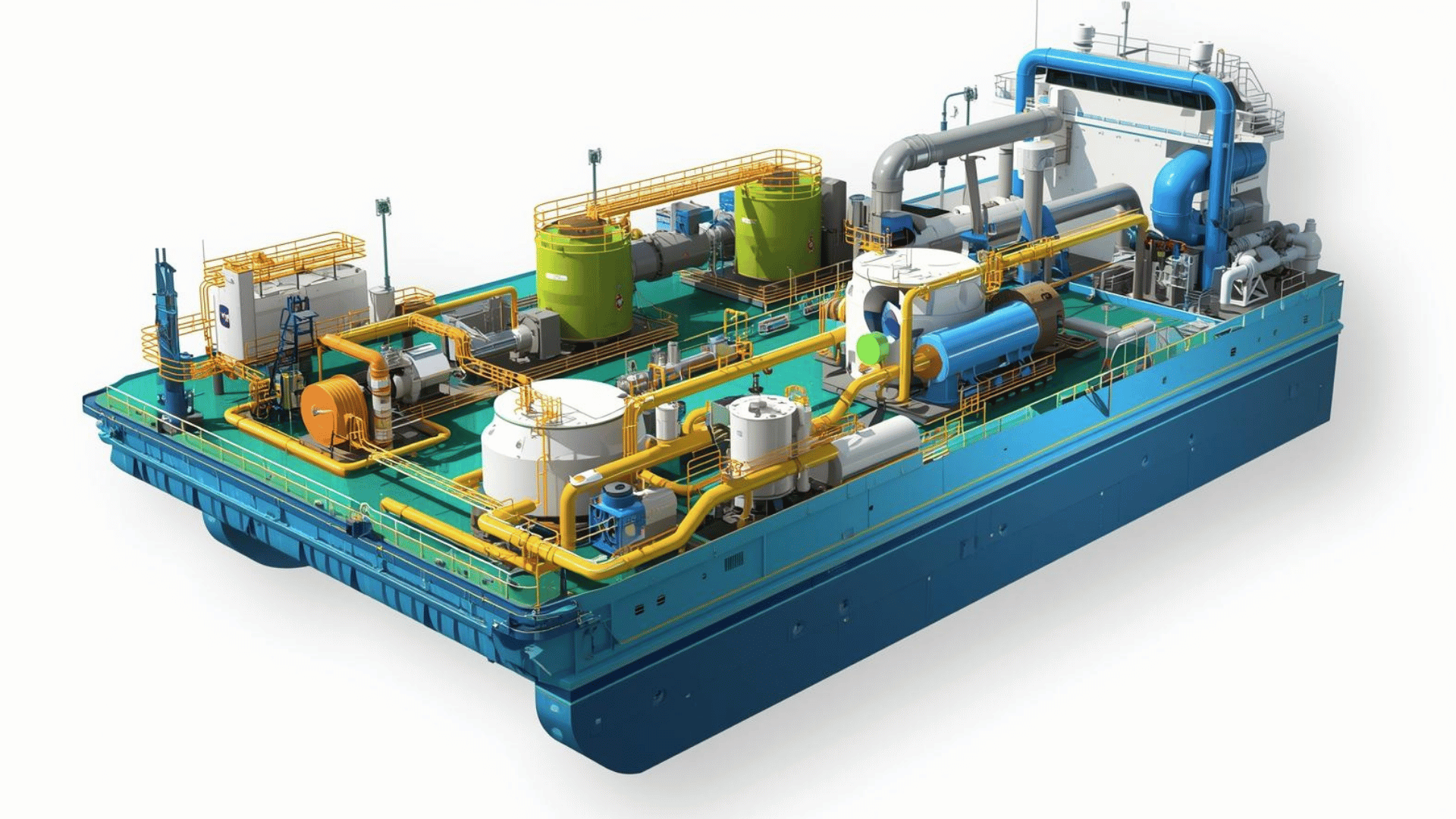
A standard biological STP has the following chambers and components working in sequence:
Screen Filter
Fitted at the inlet of the STP, the screen filter removes large non-biodegradable solids — toilet paper, plastics, rags — that would otherwise clog or damage the system. This is the first line of protection for the entire plant.
Aeration / Biofilter Chamber
The core of the biological treatment process. Air blowers force fine bubbles through diffusers submerged in the sewage. These bubbles supply oxygen, allowing aerobic bacteria and microorganisms to thrive and break down organic matter. The fine bubble diffusion increases the oxygen transfer rate, maximizing bacterial activity. Air pressure inside this chamber is typically maintained at 0.3 to 0.4 bar to ensure proper mixing without the air escaping without doing useful work.
Settling / Sedimentation Chamber
After biological treatment, the effluent flows into the settling chamber. Here, gravity separates the treated liquid from suspended solids (sludge). The chamber walls are typically hopper-shaped with sloping sides to prevent sludge from sticking and accumulating — the sludge slides down toward an air lift tube and is returned to the aeration chamber for further breakdown. This recycled sludge also carries active bacteria back into the process, maintaining treatment efficiency.
Activated Carbon Filter
Positioned after the settling chamber, the activated carbon unit removes residual Chemical Oxygen Demand (COD) through adsorption and filtration. It also treats remaining Biological Oxygen Demand (BOD) and suspended solids, polishing the effluent before disinfection.
Chlorination / Sterilization Tank
The final treatment stage. The clarified liquid is disinfected here using one of two methods:
- Tablet dosing — clean water contacts chlorine tablets directly, forming a chlorine solution
- Chemical injection — a diaphragm-type reciprocating pump injects a measured dose of sodium hypochlorite (NaOCl) into the tank
Some systems use UV radiation instead of or alongside chemical dosing. The treated liquid is retained in the sterilization tank for a minimum of 60 minutes to ensure E. coli and other bacteria are reduced to acceptable discharge levels. Float switches in this chamber control the discharge pump automatically.
Air Blowers
Usually installed in pairs (one duty, one standby), the blowers run continuously. They supply air to the biofilter, assist in sludge transfer from the sedimentation tank, supply air to the activated carbon tank, and perform back-flushing of sludge. Shutting down the blowers — even temporarily — kills the aerobic bacteria, and it can take days to re-establish the bacterial colony and restore treatment efficiency.
Discharge Pump
A duplex centrifugal non-clog pump mounted on the sterilization chamber. It runs in automatic mode, controlled by level switches in the sterilization tank. When a high-level is reached, the pump starts and discharges treated effluent overboard — stopping automatically when the low-level switch activates. Manual mode is used during tank cleaning and sludge removal.
Effluent Quality Standards
The treated effluent must meet strict quality parameters before discharge:
| Parameter | Acceptable Range / Limit |
|---|---|
| pH | 6.0 – 8.5 |
| Nitrite content | ≤ 10 mg/L (NO₂) |
| E. coli | Reduced to acceptable IMO levels |
| Suspended solids | No visible floating solids |
| Discoloration | No visible discoloration of surrounding water |
| BOD (Biological Oxygen Demand) | Minimized via biological + carbon treatment |
How the Biological Process Works — Step by Step
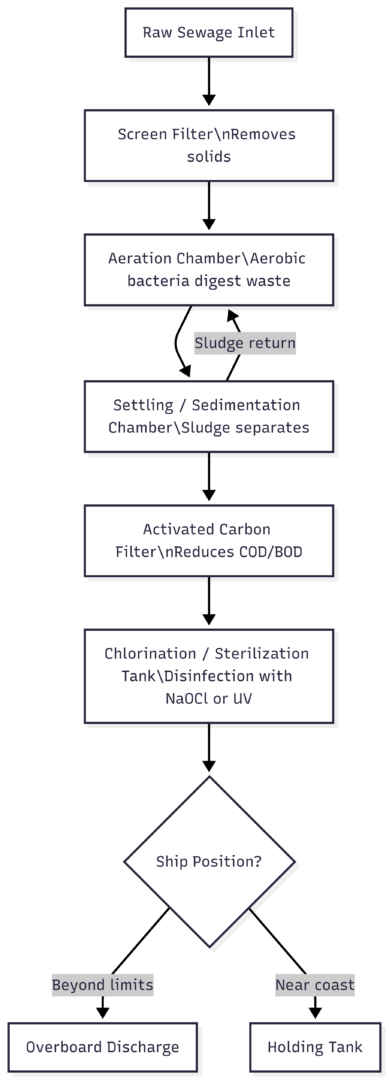
- Raw sewage enters through the screen filter, where large solids are broken down into smaller particles. Smaller particle size increases surface area, allowing more bacteria to simultaneously attack and decompose the waste.
- Aeration begins in the biofilter chamber. Blowers force air through diffusers at controlled pressure. Aerobic bacteria multiply rapidly in the oxygen-rich environment and digest organic matter, converting sewage into carbon dioxide, water, and inorganic compounds.
- Settling separates the liquid from the sludge. Clear treated water rises to the top; sludge settles to the bottom and is returned to the aeration chamber. This prevents anaerobic conditions from developing in the settled sludge, which would generate toxic gases and foul-smelling compounds.
- Activated carbon polishes the effluent by adsorbing residual organic compounds and reducing COD and BOD levels.
- Chlorination disinfects the final effluent. The liquid is held for at least 60 minutes before the discharge pump activates, ensuring complete sterilization.
- Discharge or holding — the system automatically checks the ship’s position relative to discharge limits. If the ship is near the coast or in a restricted zone, flow is directed to the holding tank. Otherwise, the treated effluent is discharged overboard via a non-return valve.
Special Area: Baltic Sea
The Baltic Sea is the only designated Special Area under MARPOL Annex IV. Passenger ships operating in this zone must have a certified STP that additionally removes nitrogen and phosphorus — nutrients that contribute to eutrophication (algal blooms) in the Baltic’s enclosed waters. Ships found discharging non-compliant effluent in Special Areas face severe port state control penalties.
Operating Precautions and Best Practices
For an STP to function effectively and remain compliant, the following practices must be followed:
- Never switch off the air blowers. The aerobic bacteria require continuous oxygen. A blower shutdown causes bacterial die-off, and recovery takes several days.
- Do not flush foreign materials — cigarette butts, plastics, rags, or non-biodegradable items will clog filters and pipework.
- Use only approved toilet tissue free of vinyl components, which inhibit bacterial growth.
- Do not use unauthorized cleaning chemicals or strong disinfectants in toilets. These chemicals kill the aerobic bacteria in the aeration chamber, destroying the plant’s treatment capacity.
- Grey water inlet pipes must be positioned below the internal water level of the STP to minimize foam generation.
- Monitor effluent pH regularly — it must remain between 6.0 and 8.5.
- Keep nitrite levels below 10 mg/L.
Maintenance Requirements
| Maintenance Task | Frequency |
|---|---|
| Clean screen filter | Weekly / as needed |
| Inspect air diffusers | Monthly |
| Check chlorine tablet/chemical levels | Daily |
| Test effluent pH and nitrite | Regular sampling |
| Inspect discharge pump and seals | Monthly |
| Back-flush activated carbon filter | Per manufacturer schedule |
| Full tank internal inspection and cleaning | Annually or per class requirements |
Comparison of STP Technologies
| Feature | Biological (Extended Aeration) | Membrane Bio-Reactor (MBR) | Chemical / Electrolytic |
|---|---|---|---|
| Primary treatment method | Aerobic bacteria | Bacteria + membrane filtration | Chemical dosing / electrolysis |
| Effluent quality | Good | Excellent | Moderate to Good |
| Space requirement | Moderate | Moderate to High | Low to Moderate |
| Maintenance complexity | Moderate | Higher | Moderate |
| Suitable for Special Areas | With N/P upgrade | Yes | With modifications |
| Common application | General cargo, tankers | Passenger ships, cruise ships | Supplementary disinfection |
Why the Biological Method Is Preferred
The biological STP remains the standard choice across most vessel types for several reasons. It produces eco-friendly effluent from natural bacterial action rather than heavy chemical inputs. It requires a relatively compact holding tank compared to chemical storage alternatives. It is certified by major classification societies and recognized under MARPOL Annex IV. And with proper maintenance — particularly keeping the blowers running — it reliably delivers compliant effluent even during extended voyages.
Modern biological STPs are increasingly integrated with automated monitoring systems that track pH, turbidity, and chemical dosing levels in real time, alerting the engineering team to deviations before they affect discharge compliance.
Conclusion
A ship’s Sewage Treatment Plant is not optional equipment — it is a regulatory requirement and an environmental responsibility. From the initial screen filter through aeration, settling, carbon filtration, and chlorination, each stage plays a specific role in converting raw sewage into clean, compliant effluent. Operators must understand both the engineering and the regulations: MARPOL Annex IV discharge limits, Special Area requirements, and the day-to-day operational precautions that keep the aerobic bacterial culture alive and effective.
As environmental regulations tighten — particularly in sensitive zones like the Baltic Sea — the industry is moving toward higher-performance systems like MBR, but the biological extended aeration plant remains the reliable workhorse of marine sewage management across the global fleet.
Happy Boating!
Share What are SSB Radios? with your friends and leave a comment below with your thoughts.
Read 10 Biggest Ship Propellers in the World? until we meet in the next article.