The international convention for the safety of life at sea
The International Convention for the Safety of Life at Sea (SOLAS) is the most important international treaty on maritime safety. Developed by the International Maritime Organization (IMO), SOLAS sets minimum standards for ship construction, equipment, and operation to protect human life at sea.
SOLAS is often called the “constitution” of maritime safety because it addresses the most critical risks — structural failure, fire, and navigational accidents — which have historically caused the majority of maritime casualties.
This comprehensive guide explains everything you need to know about SOLAS 1974 (as amended), its structure, major chapters, risk mitigation strategies, and why it remains the cornerstone of global shipping safety.
History and Evolution of SOLAS
Shipping has always been vital to global trade, but as ships grew larger and more complex, the need for uniform international safety standards became clear. The sinking of the RMS Titanic in 1912, which claimed over 1,500 lives, triggered the first version of SOLAS in 1914.
The current version, SOLAS 1974, was adopted to replace older versions and introduced the tacit acceptance procedure, which allows faster updates to the convention. This mechanism has enabled SOLAS to evolve continuously with new technologies and emerging risks.
Today, SOLAS has 165 contracting states and covers over 99% of the world’s merchant fleet by gross tonnage, making it one of the most widely ratified maritime conventions.
Structure of the SOLAS Convention
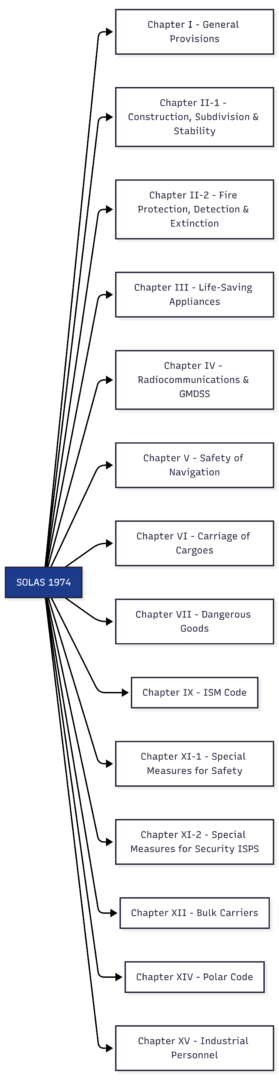
SOLAS 1974 consists of Articles (general obligations) and an Annex divided into 15 Chapters. The most important technical requirements are found in Chapters II-1 to XIV.
Here is a clear overview of the current SOLAS chapters:
Chart: SOLAS 1974 Structure Overview
SOLAS Amendment Procedure
SOLAS uses two main methods for amendments:
- Expanded Maritime Safety Committee (MSC) – Most common method
- International Conference – Used for major changes
The tacit acceptance procedure is one of SOLAS’s biggest strengths. Amendments are automatically accepted after a set period (usually 2 years) unless a sufficient number of countries formally object. This has allowed rapid updates in response to new risks like cybersecurity, autonomous ships, and climate-related challenges.
Risk Management in SOLAS: Formal Safety Assessment (FSA)
SOLAS moved from a purely reactive to a proactive approach in the 1990s with the introduction of Formal Safety Assessment (FSA).
FSA is a structured risk assessment methodology that helps IMO identify hazards, evaluate risks, and develop cost-effective mitigation measures.
Chart: Formal Safety Assessment (FSA) Process
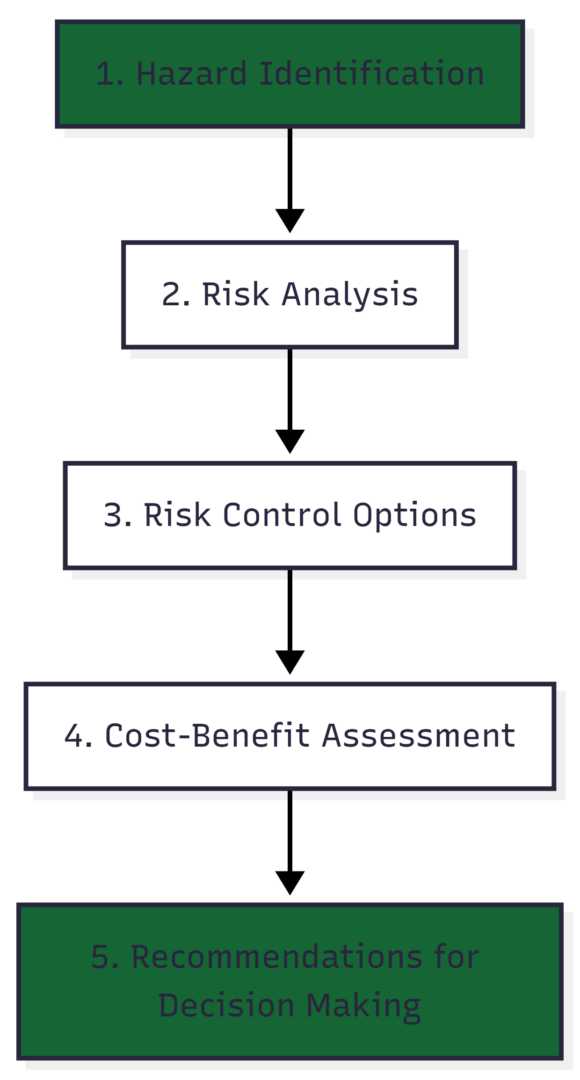
The goal of FSA is to reduce risks to As Low As Reasonably Practicable (ALARP).
Major Risks Addressed by SOLAS
Analysis of global maritime casualty databases consistently shows three dominant risks:
- Navigational Risks (Collisions, Groundings, Contact) → ~54%
- Fire & Explosion
- Structural Failure & Stability Issues
1. Structural Integrity and Stability (Chapter II-1)
Chapter II-1 is one of the most important parts of SOLAS. It covers:
- Subdivision and damage stability
- Watertight integrity
- Bilge pumping systems
- Intact stability criteria
- Goal-Based Ship Construction Standards (GBS)
Goal-Based Standards (GBS) require ships (especially bulk carriers and oil tankers) to be designed for a 25-year safe life, considering structural strength, fatigue, and residual strength after damage.
Key requirements include double-bottom protection, strengthened bulkheads, and specific damage stability calculations to ensure the ship remains afloat even if one or two compartments are flooded.
2. Fire Protection, Detection and Extinction (Chapter II-2)
Fire is one of the most frequent and dangerous risks at sea. Chapter II-2 follows three core principles:
- Prevention – Minimize ignition sources
- Detection & Alarm – Early detection
- Containment & Extinction – Stop fire from spreading
Major requirements include:
- Fire-resistant bulkheads and divisions
- Automatic fire detection systems
- Fixed fire extinguishing systems (CO₂, water mist, foam)
- Restricted use of combustible materials
- Safe means of escape
For large passenger ships, the Safe Return to Port (SRtP) concept requires that after a major fire or flooding, the ship must still reach a safe port under its own power.
3. Safety of Navigation (Chapter V)
Chapter V is unique because it applies to all ships on all voyages (not just international voyages).
Key provisions include:
- Carriage of AIS, VDR (Voyage Data Recorder), and ECDIS
- Bridge navigation equipment standards
- Voyage planning requirements
- Mandatory reporting systems
- Meteorological services and ice patrol
Chapter V also makes the International Safety Management (ISM) Code mandatory, which significantly improves bridge team management, watchkeeping standards, and human factors.
Key Supporting Codes under SOLAS
SOLAS is supported by several mandatory codes:
- ISM Code – Safety Management Systems
- ISPS Code – Ship & Port Security
- Polar Code – Ships in Polar Waters
- IGC Code – Gas Carriers
- IBC Code – Chemical Tankers
- LSA Code – Life-Saving Appliances
- IMDG Code – Dangerous Goods
Recent Developments and Future Challenges
SOLAS continues to evolve. Recent priorities include:
- Integration of cybersecurity requirements
- Regulatory framework for Maritime Autonomous Surface Ships (MASS)
- Improved standards for ships carrying industrial personnel (Chapter XV)
- Climate resilience and energy-efficient design
Conclusion
The SOLAS Convention has dramatically improved maritime safety since its modern version was adopted in 1974. Through detailed technical standards, mandatory codes, continuous updates, and a risk-based approach, SOLAS has significantly reduced loss of life, ship casualties, and environmental damage.
While risks can never be completely eliminated, SOLAS has successfully driven them down to levels that are As Low As Reasonably Practicable. Its success is evident in the high ratification rate and the steady decline in serious maritime accidents over the past decades.
As shipping faces new challenges — digitalization, automation, decarbonization, and larger vessels — SOLAS remains the primary global framework ensuring that safety stays at the heart of maritime operations.
Happy Boating!
Share The international convention for the safety of life at sea with your friends and leave a comment below with your thoughts.
Read Marine Engineering until we meet in the next article.