How Are Cruise Ships Powered?
Modern cruise ships are floating cities. A single vessel may carry 3,000 passengers and 1,000 crew members, maintain dozens of restaurants, run multiple entertainment venues, power air-conditioning across hundreds of cabins, and simultaneously push through open ocean at 20+ knots. All of this demands an extraordinary amount of energy — and engineering. Here is a complete breakdown of how cruise ships produce, distribute, and manage power.
The Engine Room: Where Everything Begins
The engine room is the nerve center of any cruise ship. On a modern vessel, this space spans at least three decks and is divided into watertight compartments — one for main engines, another for air conditioning systems, others for pumps and auxiliary machinery. This compartmentalization is a safety requirement, not just an organizational preference.
Most modern cruise ships use diesel-electric propulsion, a system fundamentally different from the direct-drive diesel engines used on cargo ships. Rather than connecting an engine directly to a propeller shaft, the diesel engines on a cruise ship act as generators. They produce electricity, which is then used to power everything from propulsion motors to galley equipment.
Main Generator Sets
Cruise ships typically carry 5 to 6 diesel generator (DG) sets, each rated between 9 and 15 megawatts (MW). For comparison, a cargo ship’s generators typically produce 1–2 MW each. Total installed power on a large cruise ship can reach 100 MW or more.
| Feature | Cruise Ship DG Sets | Cargo Ship DG Sets |
|---|---|---|
| Number of sets | 5–6 | 2–3 |
| Power per unit | 9–15 MW | 1–2 MW |
| Voltage output | 6.6 kV or 11 kV | 440 V – 6.6 kV |
| Engine room layout | Separate DG rooms (Fwd & Aft) | Single engine room |
| Fuel options | Diesel, LNG, dual-fuel | Diesel (HFO/MGO) |
Most modern passenger ships have two separate DG rooms — one forward, one aft — divided by a watertight bulkhead. Each room has its own independent air, fuel, lubrication, and cooling water systems. This redundancy is designed specifically for fire and flooding emergencies: if one DG room is compromised, the other can sustain essential operations.
Power Distribution: From Generators to Every Corner of the Ship
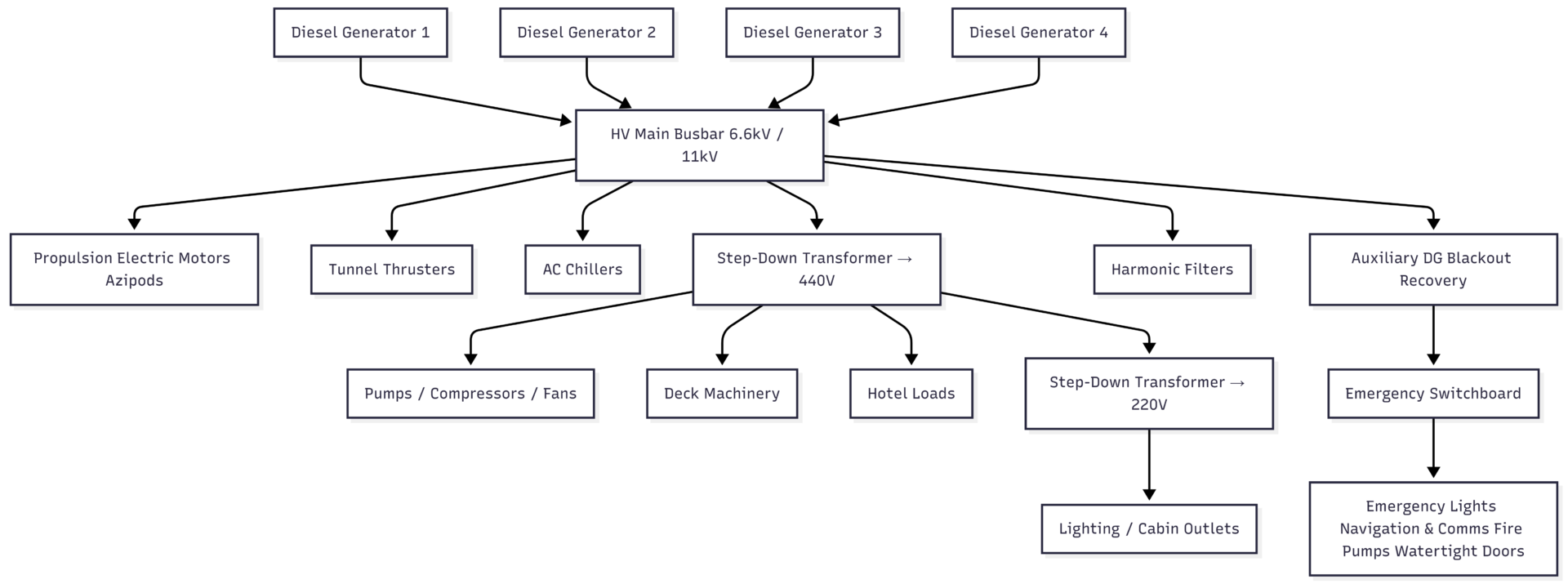
The electricity produced by the diesel generators flows to a high-voltage (HV) main busbar, rated at either 6.6 kV or 11 kV. From there, power is distributed to different systems at appropriate voltages.
Voltage Levels and Their Loads
- High Voltage (6.6 kV / 11 kV): Propulsion motors, azipods, tunnel thrusters, large AC chillers
- 440 V: Engine room pumps, compressors, fans, deck machinery, hotel services
- 220 V: Cabin outlets, public area lighting, general accommodation
Propulsion Electric Motors (PEMs) require variable speed and torque. This is achieved using frequency converters (thyristors or Silicon Controlled Rectifiers), which convert the fixed voltage and frequency from the generators into the variable supply the motors need. Direction control — ahead or astern — is achieved by changing the phase sequence of the supply.
Each PEM has two separate stator windings (called half-drives). If one fails, the other can still operate the motor at reduced power, allowing the ship to safely reach port.
Three Methods of Ship Propulsion
While diesel-electric is now dominant on cruise ships, it is worth understanding all three methods:
1. Direct Drive (Conventional Diesel)
The oldest and simplest method. Combustion drives pistons, which turn a crankshaft, which connects via a long shaft and gearing to the propeller. A shaft generator can capture rotational energy from the shaft to produce electricity — but only while the ship is moving. This method is rarely used on modern cruise ships due to its limitations in layout flexibility and efficiency.
2. Diesel-Electric
The standard for modern cruise ships. Main diesel engines run generators at constant speed. The generated electricity powers electric propulsion motors. This eliminates the need for long shaft lines, allows engines to be positioned anywhere in the hull, and enables variable-speed propulsion without changing engine RPM. Approximately 85% of generated power goes to propulsion; the rest powers all onboard services.
3. Gas Turbine
Gas turbines burn cleaner than diesel and produce less vibration, making them attractive for passenger ships. They drive generators, and exhaust heat can be recovered via steam turbines to generate additional electricity. Royal Caribbean was the first cruise line to fit gas turbines on its ships. The trade-off is higher fuel cost compared to diesel.
Azipod Propulsion: The Most Advanced System
The most significant advancement in cruise ship propulsion is the Azimuth Podded Drive, widely known as the Azipod — a trademark of ABB, which pioneered the technology in the late 1980s.
An Azipod is a self-contained propulsion unit mounted externally beneath the stern of the ship. It houses a synchronous electric motor directly connected to a propeller, and the entire unit can rotate 360 degrees — eliminating the need for a rudder, stern thruster, long shaft line, or conventional steering gear.
What Azipods Replace
| Traditional Component | Azipod Equivalent |
|---|---|
| Main propulsion motor | Built into pod |
| Shaft line & bearings | Eliminated |
| Stern tube | Eliminated |
| Rudder & steering gear | Pod rotation |
| Stern thrusters | Pod rotation capability |
How Azipod Power Transfer Works
High-voltage power cables run from the HV switchboard to a pod room at the stern. There, transformers and converters adjust the voltage and frequency, which is then fed through a slip-ring unit into the rotating pod. The slip-ring allows electrical connection while the pod rotates. Inside the pod, the synchronous motor drives the propeller directly.
Azipod Performance Specifications
| Specification | Typical Range |
|---|---|
| Power per unit | 7–20 MW |
| Rotation | 360 degrees |
| Propulsion efficiency gain | 18–20% vs conventional |
| Ships fitted (approximate) | 100+ cruise ships |
| Notable operators | Royal Caribbean, MSC, Carnival, Norwegian |
Notable ships using Azipods include Royal Caribbean’s Oasis of the Seas, Harmony of the Seas, Symphony of the Seas, and Allure of the Seas — all among the largest cruise ships ever built.
Advantages of Azipod Propulsion
- 18–20% improvement in energy efficiency with lower fuel consumption
- Exceptional maneuverability — large ships can dock without tug assistance in many ports
- Reduced maintenance (no shaft lines, rudder systems, or stern thrusters)
- Faster and quieter crash-stop response
- Smaller engine rooms, freeing space for passenger amenities
- Reduced propeller size, lowering cavitation risk and maintenance costs
- Ideal for ice navigation
Fuel Sources: Diesel, LNG, and Dual-Fuel
Traditional cruise ships run on Marine Diesel Oil (MDO) or Heavy Fuel Oil (HFO). However, environmental regulations — particularly IMO 2020 sulfur caps and emissions restrictions in Emission Control Areas (ECAs) — have pushed the industry toward cleaner fuels.
Liquefied Natural Gas (LNG) is now the leading alternative. LNG burns significantly cleaner than diesel: approximately 20% less CO₂, near-zero sulfur emissions, and significantly reduced NOx and particulate matter.
| Fuel Type | CO₂ Reduction vs HFO | SOx Emissions | NOx Reduction | Cost (Approx.) |
|---|---|---|---|---|
| Heavy Fuel Oil (HFO) | Baseline | High | Baseline | Low |
| Marine Diesel Oil (MDO) | ~5% | Low | ~5% | Moderate |
| LNG | ~20% | Near-zero | ~85% | Moderate–High |
| Methanol (emerging) | ~10–15% | Near-zero | ~60% | High |
| Hydrogen (future) | ~100% (if green) | Zero | Zero | Very High |
Dual-fuel engines can switch between LNG and diesel, offering flexibility depending on fuel availability at each port. Ships like MSC World Europa and AIDAnova are LNG-powered from the outset.
Emergency and Backup Power Systems
Auxiliary Generator
Each cruise ship has an auxiliary diesel generator specifically for blackout recovery. This unit can power the 440V busbar independently of the main generators, allowing operators to restart the main plant after a total power failure.
Emergency Generator
Per SOLAS (Safety of Life at Sea) regulations, every passenger ship must have an emergency generator located above the uppermost continuous deck, outside all machinery spaces. It must:
- Start automatically within 45 seconds of main power failure
- Power the emergency switchboard independently
- Supply essential services for at least 36 hours on passenger vessels
Emergency switchboard loads include:
- Emergency lighting throughout the ship
- Navigation and communication systems
- Fire detection and alarm systems
- One steering gear motor
- Fire and sprinkler pumps
- Bilge and ballast pumps
- Watertight door controls
- Alarm and control systems
Battery Backup
Beyond the emergency generator, ships carry battery systems capable of supplying at least 24 hours of power to critical systems in the event the emergency generator also fails. As battery technology improves, some newbuilds are integrating large-scale battery banks for peak shaving, harbor maneuvering, and emissions reduction in port.
Cold Ironing: Shore Power at Port
When a cruise ship is docked, its main propulsion load disappears, but hotel, air conditioning, and service loads remain. Rather than running diesel generators in port — creating local air pollution — ships increasingly use cold ironing (also called shore power or alternative maritime power).
Cold ironing allows a ship to connect to the local electrical grid while docked, shutting down its onboard generators entirely. This can cut port-side emissions by up to 95%. Ports including Los Angeles, Seattle, and several European terminals have invested in high-voltage shore connection infrastructure to support this.
Why Diesel-Electric Beats Conventional Propulsion on Cruise Ships
The shift to diesel-electric propulsion was not arbitrary. The advantages over a traditional centralized 2-stroke main engine are decisive for passenger ships:
| Factor | Conventional Propulsion | Diesel-Electric |
|---|---|---|
| Engine room flexibility | Low — centralized shaft required | High — generators placed anywhere |
| Noise & vibration | High | Low |
| Part-load efficiency | Poor (SFOC rises steeply) | Good (generators optimized at constant speed) |
| Propulsion redundancy | Single engine failure = serious problem | Dual motors + dual half-drives |
| Speed control method | Mechanical (slower, less precise) | Electronic (fast, smooth) |
| Emissions at part load | High | Lower |
| Space for passenger areas | Limited | Significant gains |
The Future: Greener Cruise Ship Power
Cruise lines are under increasing regulatory and consumer pressure to reduce emissions. Key technologies shaping the next generation of cruise ship power include:
- LNG and dual-fuel engines — already entering service across major fleets
- Battery hybrid systems — used for peak shaving and zero-emission port operations
- Fuel cells — hydrogen and methanol fuel cells being tested on smaller vessels
- Wind-assisted propulsion — rotor sails and rigid sail systems being retrofitted
- Shore power (cold ironing) — expanding to more ports globally
- Waste heat recovery — using exhaust heat from engines to generate additional steam or electricity
Each ship built today is measurably more efficient than its predecessor from a decade ago, driven by both regulation and the commercial value of fuel savings at scale.
Summary
A modern cruise ship is powered by a diesel-electric system in which multiple large diesel generators produce high-voltage electricity distributed across the entire vessel. Propulsion is handled by electric motors — increasingly in the form of rotating Azipods that replace shaft lines, rudders, and stern thrusters. Emergency and backup power systems ensure continuous safety-critical operation even in worst-case scenarios. Fuel is shifting from heavy fuel oil toward LNG and eventually hydrogen and fuel cells. The result is a power plant that is quieter, more efficient, more maneuverable, and progressively cleaner than anything that came before it — all while keeping thousands of people comfortable and entertained in the middle of the ocean.
Happy Boating!
Share How Are Cruise Ships Powered? with your friends and leave a comment below with your thoughts.
Read Properties Of Membrane Tanks For Transportation Of LNG Cargo On Ships until we meet in the next article.