Blackwater Treatment Onboard Cruise Ships Explained
Modern cruise ships are essentially floating cities. A large vessel can carry 5,000 or more passengers and crew, generating up to 1,000 cubic metres of wastewater every single day. Managing that wastewater — especially blackwater — is one of the most technically demanding and environmentally critical responsibilities in cruise ship operations.
This article explains what blackwater is, how it is collected, treated, and discharged, what systems are used onboard, and what international regulations govern the entire process.
What Is Blackwater?
Blackwater is wastewater generated from toilets, urinals, medical facility drains, and waste disposal units. Because it contains human waste, pathogens, bacteria, and organic matter, it is classified as highly contaminated and poses a serious environmental and public health risk if discharged without treatment.
Blackwater is distinct from greywater, which comes from showers, sinks, bathrooms, and laundry. While greywater also requires treatment, it carries far fewer pathogens. On cruise ships, these two streams are kept completely separate in collection, storage, and treatment to maintain system efficiency and comply with regulations.
| Wastewater Type | Source | Contamination Level | Treatment Required |
|---|---|---|---|
| Blackwater | Toilets, urinals, medical waste | High – pathogens, human waste | Advanced biological + membrane filtration |
| Accommodation Greywater | Showers, sinks, bathrooms | Moderate – soaps, oils | Biological + filtration |
| Galley/Laundry Greywater | Kitchen, laundry | Moderate – detergents, oils | Separate treatment (not suitable for MBR) |
Why Blackwater Treatment Matters
Untreated or poorly treated blackwater discharged into the sea can:
- Introduce harmful bacteria and viruses into marine ecosystems
- Damage coral reefs and contaminate fish breeding grounds
- Spread waterborne diseases in coastal communities
- Violate international maritime environmental law and attract heavy penalties
For cruise lines, non-compliance is not just an environmental issue — it is a commercial and reputational liability. This is why modern cruise ships invest heavily in advanced onboard treatment systems that often exceed the standards of land-based municipal sewage plants.
Collection and Pre-Treatment
Ring-Main Collection System
Blackwater from all decks is collected through a ring-main piping system, divided by deck zones, and fed into blackwater collecting units — typically 4 to 10 units depending on ship size. These are installed in technical spaces throughout the vessel for easy monitoring and maintenance.
Collection happens either by gravity or vacuum. In vacuum systems, pumps maintain negative pressure in the collection tank and its suction lines, triggered automatically by pressure sensors. This allows toilets to flush with minimal water — an important conservation advantage on a vessel at sea.
Coarse Straining
Before blackwater enters the collecting tanks, it passes through coarse strainers that trap large solid objects — paper, plastics, grit, and other debris. These strainers must be cleaned daily or more frequently under high load. Neglecting them leads to clogging in downstream pumps and pipework.
Screen Presses
From the collecting tanks, sewage discharge pumps transfer the blackwater to screen presses. These devices perform two stages of solid separation:
- A mesh screen removes larger solids such as toilet paper, fibres, and rags
- A motor-driven screw shaft grinds and expels finer suspended solids
The solids separated here are collected in a bio-sludge tank for separate disposal — typically via onboard incinerators. Only liquid passes forward to the biological treatment stage.
The Treatment Process: Membrane Bio-Reactor (MBR)
The core of blackwater treatment on modern cruise ships is the Membrane Bio-Reactor (MBR) system. As the name indicates, it combines biological breakdown with membrane filtration to produce high-quality treated water. MBR systems on cruise ships are capable of producing effluent that meets or exceeds standards required for coastal and even port-area discharge.
MBR Process Flow
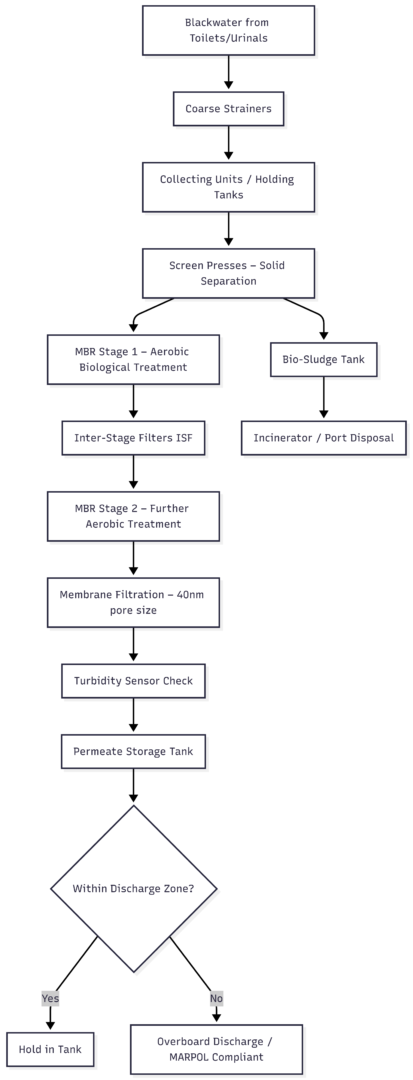
Stage 1: Aerobic Biological Treatment
Screened blackwater enters the first bioreactor chamber, where aerobic bacteria break down organic matter. Air is continuously supplied through blowers and diffusers, creating fine air bubbles that distribute oxygen evenly through the biomass. This aerobic environment accelerates bacterial decomposition, dramatically reducing Biological Oxygen Demand (BOD) — the key measure of organic contamination in wastewater.
Inter-Stage Filters (ISFs)
Before passing to Stage 2, the partially treated water moves through Inter-Stage Filters (ISFs), which remove fine particles generated in Stage 1. The filtrate is pumped to Stage 2, while separated screenings are returned either to the screen press or Stage 1.
The filtrate-to-screenings ratio is a key health indicator for ISF performance. A ratio between 1 and 5 is normal. Readings outside this range indicate clogging or filter degradation requiring immediate attention.
Stage 2: Secondary Aerobic Treatment
Stage 2 mirrors Stage 1, with further aerobic bacterial activity. Its role is to ensure that sludge separation is as complete as possible before the liquid reaches the membranes. Carrying over sludge into the membrane stage is a primary cause of clogging, membrane damage, and costly downtime.
Sludge from both stages is removed daily via dedicated sludge pumps to separate tanks. Chemical dosing is applied in both stages to assist sludge conditioning.
Membrane Filtration
Treated water from Stage 2 is pumped through multiple banks of tubular ultrafiltration membranes — typically 3 to 4 parallel banks, each independently isolatable for maintenance. Key membrane specifications:
| Specification | Detail |
|---|---|
| Tube bore diameter | 8 mm nominal |
| Casing diameter | 200 mm nominal, fibre-reinforced |
| Filtration type | Ultra-filtration |
| Nominal pore size | 40 nanometres |
| Barrier capability | Bacteria, viruses, protozoa |
Billions of microscopic pores on each membrane fibre allow pure water molecules to pass through while blocking all microbial contaminants. Water that fails to pass through is recirculated back to Stage 2.
Membranes must be backflushed with clean freshwater daily and chemically cleaned weekly to prevent fouling. Membrane replacement — when neglected maintenance leads to failure — is expensive and labour-intensive.
Disinfection and Storage
The filtered permeate may undergo chlorine disinfection for additional safety before entering the permeate storage tanks. However, when the bioreactor and membranes are functioning correctly, chlorination is often unnecessary — the membrane itself acts as a sufficient barrier to pathogens.
A turbidity sensor is installed on the permeate line. If turbidity readings exceed acceptable limits (indicating membrane leakage or failure), the permeate pump shuts down automatically, preventing substandard water from entering storage.
Weekly Testing Parameters
Engineers must conduct weekly performance tests on the MBR system, sampling from both bioreactor stages and the permeate output:
| Test Parameter | Purpose |
|---|---|
| Biological Oxygen Demand (BOD) | Measures organic contamination |
| Chemical Oxygen Demand (COD) | Measures chemical pollutant load |
| E-Coli count | Confirms pathogen elimination |
| Colour and smell | Basic quality indicators |
| Turbidity | Checks membrane integrity |
Greywater and MBR Integration
Accommodation greywater can be fed into the MBR alongside blackwater, controlled automatically via a 3-way valve at the screen press inlet. This is particularly useful during periods of low blackwater generation — typically at night — to maintain liquid levels in the bioreactor stages and prevent the biomass from drying out.
However, galley and laundry greywater should never be fed into the MBR. The detergents and oils present in these streams are toxic to aerobic bacteria, disrupting biomass function and degrading treatment performance. These streams are stored separately and managed independently.
Discharge Regulations: MARPOL Annex IV
All blackwater treatment and discharge on cruise ships is governed internationally by MARPOL Annex IV — the Prevention of Pollution by Sewage from Ships, enforced by the International Maritime Organization (IMO).
Key regulatory requirements include:
- Treated blackwater may only be discharged outside restricted zones — generally at least 3–4 nautical miles from the nearest land
- Ships must have an approved sewage treatment system or holding tank capacity
- Stricter rules apply in Special Areas (such as the Baltic Sea and Caribbean), where discharge is either prohibited or requires higher treatment standards
- Ships must maintain a sewage record book documenting all discharges
Some coastal nations and port states enforce requirements that go significantly beyond MARPOL minimums, requiring ships to hold all wastewater and discharge it at port reception facilities.
Advanced Wastewater Treatment System (AWTS) Overview
Modern cruise ships deploy full Advanced Wastewater Treatment Systems (AWTS) that integrate blackwater and greywater treatment into a unified, largely automated operation. These systems are designed to:
- Process high volumes continuously (up to 1,000 m³/day on large vessels)
- Achieve effluent quality comparable to or better than municipal sewage plants
- Operate with minimal manual intervention
- Alert crew automatically to deviations in key parameters
- Comply with the most stringent discharge standards globally
The shift from simple holding tanks and basic treatment units to full MBR-based AWTS represents a generational leap in the environmental performance of the cruise industry.
Operational Challenges
Despite the sophistication of these systems, operators face real-world challenges:
- Membrane Fouling — High passenger loads accelerate membrane clogging. Consistent backflushing and chemical cleaning schedules are non-negotiable.
- Sludge Management — Sludge volumes can be substantial on large ships. Onboard incinerators handle much of it, but port disposal is required for excess.
- Biomass Maintenance — Aerobic bacteria in the bioreactor are living organisms. Disruptions from incompatible chemicals (detergents, disinfectants entering the stream) or extended low-load periods can degrade bacterial populations, reducing treatment effectiveness.
- Sensor Reliability — Turbidity sensors, float switches, and level sensors are critical to automated operation. Regular calibration and cleaning prevent false shutdowns or undetected failures.
- Space Constraints — On cruise ships, machinery space is always at a premium. AWTS installations must be compact without sacrificing treatment capacity.
Summary
Blackwater treatment onboard cruise ships is a highly engineered, multi-stage process that transforms one of the most hazardous waste streams generated at sea into water that meets international environmental discharge standards. From collection through screening, biological treatment, membrane filtration, and disinfection, every stage plays a critical role in protecting marine ecosystems and ensuring regulatory compliance.
The Membrane Bio-Reactor has become the industry standard for good reason — it delivers consistently high effluent quality, operates automatically at scale, and provides the documentation trail needed to demonstrate MARPOL compliance. As environmental scrutiny of the cruise industry intensifies, investment in these systems will only increase.
For engineers, officers, and maritime students, understanding the full blackwater treatment chain — not just its stages but its failure modes, maintenance requirements, and regulatory context — is fundamental to responsible ship operation.
Related reading: Sewage Treatment Plant on Ships Explained | MARPOL Annex IV: What You Need to Know
Happy Boating!
Share Blackwater Treatment Onboard Cruise Ships Explained with your friends and leave a comment below with your thoughts.
Read Interpreting an Oil Analysis Report – The Top 10 Tips until we meet in the next article.