Applications of Water Mist Systems on Passenger Ships
Fire at sea is among the most catastrophic events a vessel can face. With thousands of lives aboard a modern cruise ship and no shore-based assistance within reach, the onboard fire suppression system is the only line of defence between a manageable incident and a disaster.
Over the past two decades, the industry has moved decisively from traditional sprinkler and CO2 systems toward high-pressure water-mist technology. Understanding how both systems work, where each is applied, and why one is rapidly superseding the other is essential knowledge for anyone involved in passenger ship design, operations, or safety management.
Why Fire Suppression Matters More on Passenger Ships
Cargo vessels carry goods; passenger ships carry people — often in their thousands — many of whom have no maritime training and cannot respond effectively to an emergency. The layout of a large cruise ship compounds this: hundreds of identical cabins, long internal corridors, deep machinery spaces, and galleys running around the clock. Any one of these environments can ignite a fire that, without immediate suppression, spreads rapidly.
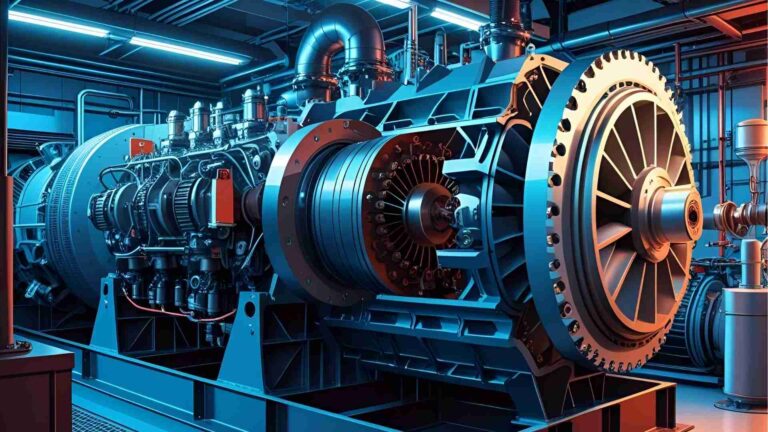
The engine room remains statistically the most dangerous space. Running machinery generates continuous heat, exhaust gases, oily residues, and abundant forced air — an almost ideal combination for fire initiation and spread. If a machinery space fire is not controlled in its first minutes, it can compromise propulsion, flood the ship’s electrical systems, and release toxic gases into adjacent spaces.
Traditional fixed CO2 systems can extinguish such fires but come with a significant cost: the space must be evacuated and perfectly sealed before release, the gas itself is lethal to anyone present, and the delay from detection to effective discharge can allow a fire to grow substantially. Water-mist systems have changed this calculus significantly.
How Water-Mist Systems Work
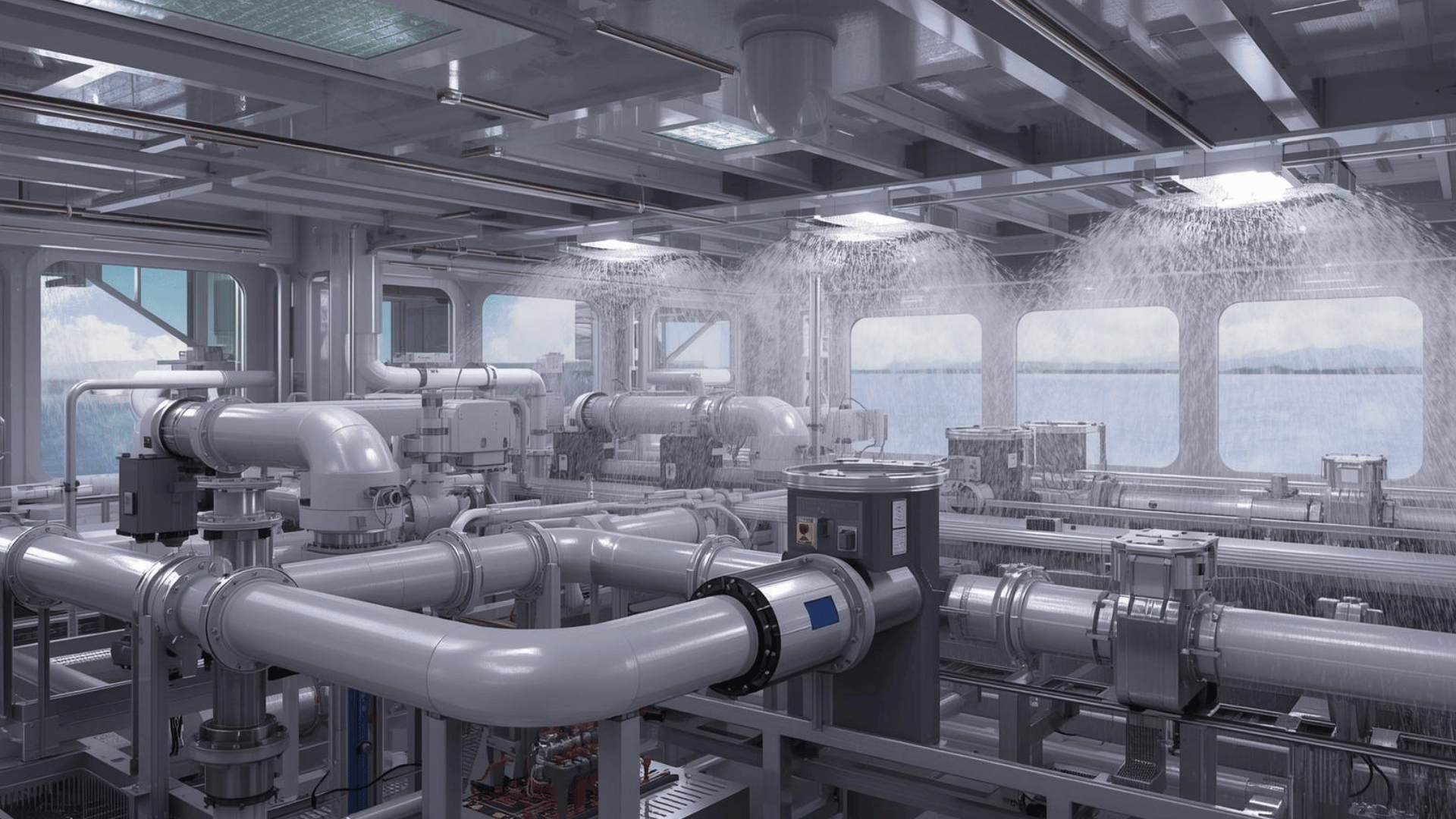
A water-mist system delivers water in the form of extremely fine droplets — typically between 10 and 1,000 microns in diameter — at high pressure through specially designed nozzles. The physics of fire suppression at this droplet scale are markedly different from conventional sprinklers.
Cooling: The enormous surface area of the mist relative to its volume accelerates heat absorption from the surrounding air and the fire itself. The seat of the fire and surrounding surfaces are cooled rapidly, slowing the spread of combustion.
Oxygen displacement: As fine droplets evaporate instantly to steam, they expand dramatically and displace oxygen in the immediate vicinity of the fire. This smothering effect — oxygen starvation — is particularly effective in confined spaces like generator rooms and purifier spaces.
Pre-wetting: Surfaces around the fire perimeter are coated with fine moisture, retarding the spread of flames to adjacent materials.
Penetration: High-pressure mist penetrates shielded fires — flames sheltered behind equipment or within enclosed casings — more effectively than conventional water spray, which simply bounces off surfaces.
The combined result is faster knockdown with dramatically less water. High-pressure water-mist systems consume up to 90% less water than conventional sprinkler systems for equivalent fire control — a critical advantage on a vessel where every tonne of water affects stability.
System Pressure Classifications
Water-mist systems are classified by the maximum working pressure in their distribution piping. This classification determines droplet size, penetration ability, and the complexity of the pump and pipe specification.
| Classification | Pressure Range (Metric) | Pressure Range (Imperial) | Typical Application |
|---|---|---|---|
| Low pressure | Under 12.1 bar | Under 175 psi | Accommodation corridors, public spaces |
| Intermediate pressure | 12.1 – 34.5 bar | 175 – 500 psi | Galley hoods, certain machinery areas |
| High pressure | Over 34.5 bar (up to 140 bar) | Over 500 psi | Machinery spaces, DG rooms, boiler rooms |
High-pressure systems produce the finest droplets and the most effective oxygen displacement, making them the preferred choice for machinery spaces on modern passenger vessels. The Marioff HI-FOG system — one of the most widely installed on cruise ships — operates in this range, with pumps capable of raising system pressure to 140–150 bar under fire conditions.
The HI-FOG System: Architecture and Operation
The HI-FOG system, developed by Marioff Corporation, is a good representative of modern high-pressure water-mist technology as installed on passenger vessels. Its architecture illustrates the redundancy and automatic operation demanded by SOLAS regulations.
The system is typically split into two independent units: a forward (Master) unit and an aft (Slave) unit. Each maintains its own freshwater tank, high-pressure pump bank, and control logic.
Normal standby condition: The distribution network is pressurised to 18–24 bar by a low-capacity air-operated diaphragm pump, which compensates for minor leaks and pressure losses without starting the main pumps. This ensures the system is always ready for immediate activation.
Fire condition: When a section valve opens in response to fire detection or manual activation, pressure in the main line drops below 18 bar. This triggers the automatic start of the high-pressure positive-displacement pumps (typically 8–10 per unit), which rapidly raise system pressure to 140–150 bar and sustain flow to the nozzles in the affected zone.
Sectional control: The system is divided into individually controlled zones, each protected by a section valve. In machinery spaces these are normally closed (NC); in accommodation areas they are normally open (NO). This distinction has important consequences for nozzle design:
- Machinery space nozzles are open-type, with no thermal element. The line is dry until the section valve opens. This avoids false activations in the hot ambient conditions of the engine room.
- Accommodation nozzles are bulb-type — sealed with a heat-sensitive glass bulb that shatters at a set temperature and releases water automatically, without any manual or remote activation required.
Redundancy and backup: If the Master unit cannot control the fire, it signals the Slave unit to activate. Beyond both units, some vessels carry pressurised water cylinders (typically 10 × 50 litres each) actuated by nitrogen pilot charges as a tertiary reserve. A seawater supply connection from the ship’s fire main provides a final backup in a prolonged event, though any seawater use requires thorough freshwater flushing afterwards to prevent corrosion.
Nozzle Types and Application Modes
Water-mist systems can be deployed in several configurations depending on the hazard being protected.
Total compartment application floods an entire enclosed space with mist, providing uniform protection throughout the volume. This is standard for machinery spaces, generator rooms, and purifier rooms.
Local application directs mist onto a specific piece of equipment — a diesel generator set, a purifier, an incinerator — without treating the entire compartment. Useful where the hazard is highly localised.
Zoned application divides a large space into segments and activates only the zone where detection confirms a fire, reducing water consumption and limiting the operational disruption to the rest of the space.
Occupancy protection uses automatic nozzles throughout accommodation areas — the equivalent function to a traditional sprinkler system, but with finer droplets and lower water demand.
Nozzle types reflect these applications:
| Nozzle Type | Activation Method | Typical Use |
|---|---|---|
| Automatic (bulb) | Heat-responsive glass element | Accommodation cabins, corridors |
| Non-automatic (open) | Section valve or deluge valve | Machinery spaces, DG rooms |
| Electronically operated | Fire detection and control panel | High-risk automated spaces |
| Multifunctional | Built-in element plus remote signal | Hybrid spaces |
Traditional Sprinkler Systems on Older Passenger Vessels
Before water-mist technology became widely available and cost-effective, passenger ship accommodation areas were protected by wet-pipe sprinkler systems pressurised to approximately 10–12 bar. Many older vessels still carry these systems, and some ships operate them alongside a retrofitted water-mist system in the machinery spaces.
A typical sprinkler installation for accommodation areas comprises:
Surge tank: A pressurised vessel maintaining system pressure at 10–12 bar. Contains both water and a compressed air column, which must be maintained at the correct level to prevent pressure spikes and waterlogging.
Booster and topping-up pumps: Supply freshwater from the ship’s technical water system to maintain the surge tank level. Both run in automatic mode under normal conditions.
Sprinkler seawater pump: Activates automatically via a pressure switch when system pressure drops below 5 bar, supplying seawater as an emergency backup if all freshwater sources are exhausted.
Section valves: Butterfly valves with limit switches that allow remote monitoring of open/closed position from the bridge or fire control station.
In normal operation, the freshwater lines are always wet up to each sprinkler head. The heads themselves are bulb-type with thermal fuses calibrated to the expected ambient temperature of the protected space. When a bulb breaks, water flows immediately to that head only, limiting water damage to the area of the fire.
Sprinkler testing follows a defined protocol: the seawater pump is tested separately from the freshwater pumps by closing the freshwater supply valves, opening a drain valve to drop system pressure, and confirming that the pump cuts in automatically at the 5 bar threshold. After testing, the system is restored to the normal freshwater configuration.
Water Mist vs. Sprinkler vs. CO2: A Direct Comparison
| Factor | High-pressure water mist | Traditional sprinkler | Fixed CO2 |
|---|---|---|---|
| Water consumption | Very low (up to 90% less than sprinklers) | High | None |
| Personnel risk on release | None | None | Lethal |
| Pre-release evacuation | Not required | Not required | Required |
| Machinery space suitability | Excellent | Limited | Good (but delayed) |
| Accommodation suitability | Excellent | Excellent | Not applicable |
| Re-charge complexity | Low (freshwater, in-house) | Low | High (specialist, shore-based) |
| Equipment damage risk | Very low | Moderate | None (but sealing required) |
| Post-fire re-entry | Immediate | Immediate | Delayed (gas clearance) |
| Retrofit complexity | Moderate–High | Low | Low |
| System cost (approximate) | High ($500K–$2M+ per vessel) | Moderate | Moderate |
CO2 systems remain valuable as a last resort for large, uncontrolled machinery space fires. However, their operational limitations — mandatory evacuation, sealing, long delays, specialist recharge — mean that water-mist has taken over as the primary suppression method on modern passenger ships, with CO2 retained only as a backup.
System Configuration: Dry Pipe vs. Wet Pipe
The choice between dry-pipe and wet-pipe configuration is driven by the ambient temperature and risk profile of the protected space.
Wet-pipe systems keep the distribution lines flooded with water at all times. Activation is immediate when a nozzle bulb breaks. Standard for accommodation spaces, where ambient temperatures are controlled and false activation from heat is unlikely.
Dry-pipe systems keep the lines filled with air or inert gas under pressure. Water only enters when a valve opens — either automatically on detection or manually. Used in machinery spaces where high ambient temperatures would cause premature activation of bulb-type nozzles, and where the slower response is acceptable because the space is continuously manned.
Pre-action systems use automatic nozzles on dry piping with a separate detection system. The detection system opens a control valve, flooding the lines with water. Water only discharges through nozzles that have individually activated. Used where accidental activation would cause significant damage — computer rooms, sensitive electrical spaces.
Deluge systems use open nozzles on dry piping. All nozzles in a zone discharge simultaneously when the detection system activates the deluge valve. Used for high-hazard areas requiring rapid total coverage, such as over large diesel generators.
SOLAS Compliance and Regulatory Framework
All fire suppression systems on passenger vessels must comply with SOLAS Chapter II-2, which sets requirements for the number, placement, type, and performance of fire extinguishing arrangements. Water-mist systems specifically must meet IMO Resolution MSC.265(84) and the associated MSC/Circ.1165 guidelines for alternative design and arrangements.
For new passenger ships, SOLAS Regulation II-2/10.5.6 addresses fixed pressure water-spraying systems and allows water-mist systems as equivalents when their performance has been demonstrated through testing. Classification societies including Lloyd’s Register, DNV, and Bureau Veritas publish their own type-approval requirements for water-mist systems, and IMO Circular MSC/Circ.913 provides specific guidance on approval of water-mist fixed fire-fighting systems.
Key compliance parameters typically specified include:
- Minimum nozzle operating pressure
- Minimum flow rate per nozzle
- Maximum nozzle spacing and area coverage
- Activation time from detection to full discharge
- Duration of water supply (typically 20–30 minutes minimum)
- Compatibility with ship stability calculations
Water Quality Management
Both water-mist and sprinkler systems require routine water quality monitoring to remain serviceable. The fine orifices of water-mist nozzles are particularly vulnerable to blockage from scale, corrosion products, and biological growth.
Samples are drawn from test/drain valves (water-mist) or sprinkler stations (sprinkler systems) and tested for:
- pH: Should remain near neutral (7–8). Values outside this range indicate corrosion or contamination.
- Conductivity: A proxy for dissolved solids. High conductivity suggests mineral loading that can cause scale on nozzle orifices.
- Chloride content: Elevated chlorides — from seawater intrusion or impure supply — accelerate corrosion of stainless steel components and pipework. If found high, the system must be drained, flushed, and refilled with technical water.
Monthly inspection routines also include visual checks of nozzle condition, test activation of supply pumps in manual mode, operation of section valves with blocking valves closed, and confirmation of pressure gauge readings across all zones.
Retrofitting Water-Mist on Older Passenger Ships
The superior performance of water-mist systems has driven widespread retrofitting on older vessels that were built with sprinkler-only or CO2-primary arrangements. However, retrofit projects on existing ships present engineering challenges that are less significant on new builds:
- Existing pipe routes, cable runs, and structural members complicate new pipework installation
- High-pressure systems (above 35 bar) require thicker-walled stainless steel pipework that is heavier and more expensive than sprinkler pipework
- The pump units require dedicated spaces with appropriate access for maintenance
- The higher system pressure requires upgraded fittings and more careful sealing throughout
For these reasons, full-ship water-mist retrofits on older vessels are generally limited to newbuilds and major refurbishments. Partial retrofits — covering high-risk machinery spaces such as diesel generator rooms, boiler rooms, purifier spaces, and incinerators — are more common and deliver the highest safety return on investment. Accommodation areas on older ships typically retain their original sprinkler systems, which remain SOLAS-compliant.
Conclusion
Water-mist technology represents a fundamental improvement in shipboard fire protection. Its combination of rapid activation, effective suppression across both machinery and accommodation spaces, negligible risk to personnel, and dramatically lower water consumption addresses the limitations of every system it has displaced. High-pressure systems like the Marioff HI-FOG now serve as the primary fire suppression method on most new passenger vessels, with CO2 retained purely as a last-resort backup for uncontrolled machinery space fires.
Sprinkler systems are not yet obsolete — they remain on hundreds of older passenger vessels and continue to meet SOLAS requirements for accommodation protection — but their phaseout on new ships is effectively complete. Understanding both technologies, their operational logic, maintenance demands, and regulatory standing is essential for the safe and compliant operation of any passenger vessel.
Happy Boating!
Share Water-Mist And Sprinkler Systems On Passenger Ships with your friends and leave a comment below with your thoughts.
Read What is Remotely Operated Underwater Vehicle (ROV)? until we meet in the next article.