10 Biggest Ship Propellers in the World
Ship propellers are among the most impressive feats of mechanical engineering ever produced. Weighing over 100 tons, spanning more than 10 meters in diameter, and machined to tolerances of fractions of a millimeter, the world’s largest propellers are what make global maritime trade possible. These rotating giants convert engine power into thrust, moving vessels that carry millions of tons of cargo across oceans every year.
This article ranks the 10 biggest ship propellers ever built or installed, based on diameter, weight, and engineering significance.
How Ship Propellers Work
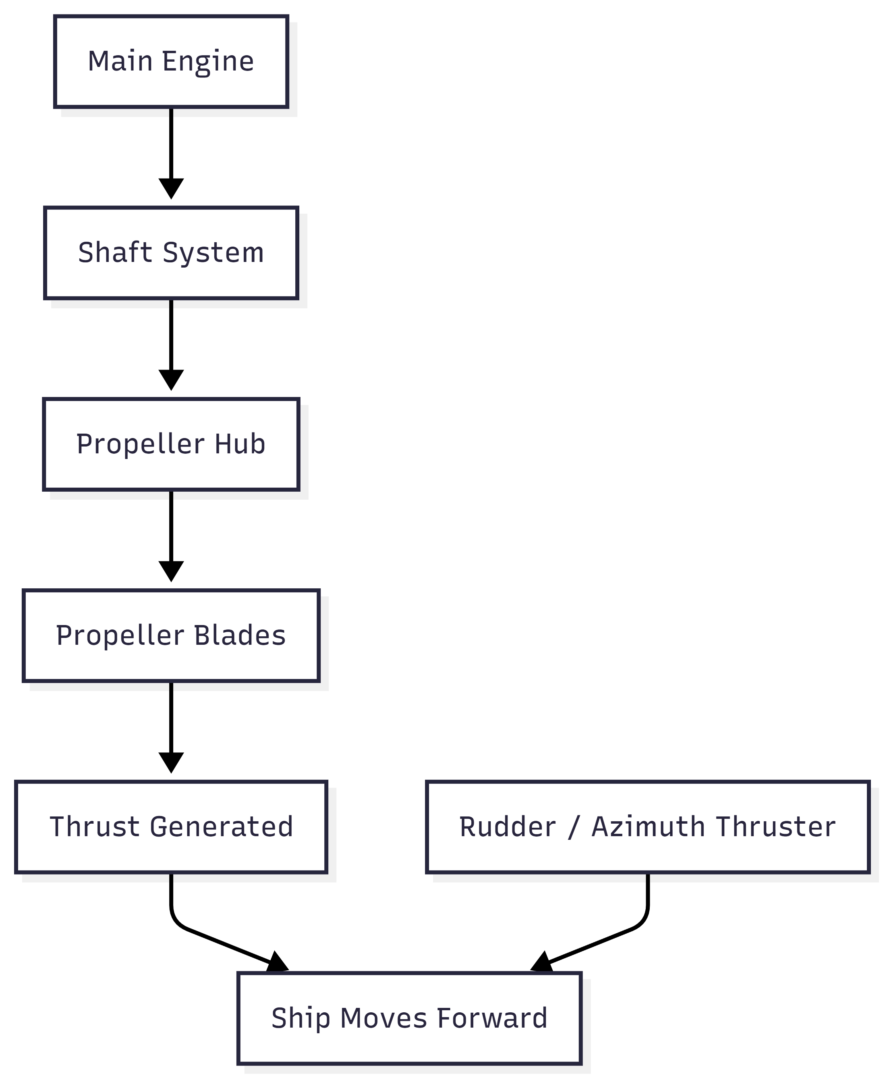
A ship propeller is a rotating fan-like device mounted at the stern of a vessel. Connected to the main engine via a shaft, it spins at controlled revolutions per minute (RPM) to generate thrust by displacing water. The blade geometry — pitch, rake, and skew — determines efficiency, cavitation resistance, and speed output.
Modern large propellers are cast from nickel-aluminum-bronze (NAB) alloys, chosen for their resistance to corrosion, high tensile strength, and anti-fouling properties. Manufacturing a single large propeller can take months and requires precision casting in specialized foundries.
Comparison Table: 10 Biggest Ship Propellers
| Rank | Vessel | Diameter | Weight | Blades | Type | Vessel Class |
|---|---|---|---|---|---|---|
| 1 | Emma Maersk | 10.3 m | 113 tons | 5 | Fixed-pitch | Container Ship |
| 2 | Hamburg Express | 9.1 m | 101.5 tons | 6 | Fixed-pitch | Container Ship |
| 3 | Palmer (Icebreaker) | ~4 m (twin 13 ft) | N/A | 4 | Fixed-pitch | Icebreaker |
| 4 | Titanic | 7.16 m (23.5 ft) | 38 tons | 3 | Fixed-pitch | Ocean Liner |
| 5 | Oasis of the Seas | 6.1 m | N/A | N/A | Azimuth thruster | Cruise Ship |
| 6 | Queen Elizabeth 2 | 6.7 m (22 ft) | 43 tons | N/A | Fixed-pitch | Ocean Liner |
| 7 | OOCL Hong Kong | ~9 m (est.) | N/A | N/A | Fixed-pitch | Container Ship |
| 8 | Norwegian Epic | N/A | N/A | N/A | Fixed-pitch | Cruise Ship |
| 9 | Elation (Carnival) | 5.6 m | 14 tons | 4 | Fixed-pitch | Cruise Ship |
| 10 | Bismarck | 4.7 m | ~3 tons | 3 | Fixed-pitch | Battleship |
1. Emma Maersk — The World’s Largest Ship Propeller
Diameter: 10.3 m | Weight: 113 tons | Blades: 5 | Manufacturer: Mecklenburger Metallguss GmbH (Germany)
The propeller fitted to Emma Maersk holds the undisputed title of the largest ship propeller ever made. Cast by Mecklenburger Metallguss GmbH in Waren, Germany, this single five-bladed propeller measures 10.3 meters in diameter and weighs 113 tons. Transporting the propeller overland to Hamburg before installation was itself a logistical feat requiring special road permits and custom transport vehicles.
Emma Maersk is one of the world’s largest container ships at 397 meters long, with a beam of 56 meters and a cargo capacity of 15,000 TEUs. The propeller drives the vessel to a maximum speed of 27 knots — extraordinarily fast for a ship of its size. The engine powering it is a Wärtsilä-Sulzer 14RT-flex96C, one of the most powerful two-stroke diesel engines ever produced.
Key Specs:
- Ship length: 397 m
- Cargo capacity: 15,000 TEUs
- Max speed: 27 knots
- Engine: Wärtsilä-Sulzer 14RT-flex96C (~109,000 hp)
2. Hamburg Express — Precision-Built by Hyundai Heavy Industries
Diameter: 9.1 m | Weight: 101.5 tons | Blades: 6 | Manufacturer: Hyundai Heavy Industries (HHI)
Manufactured by Hyundai Heavy Industries for Hapag-Lloyd’s 7,200 TEU container fleet — including the Hamburg Express — this six-bladed propeller is comparable in scale to a three-storey building. It was built alongside what was then the world’s most powerful diesel engine, producing 93,360 brake horsepower, with a crankshaft alone weighing 420 tons.
The Hamburg Express propeller stands as a testament to South Korean shipbuilding expertise and remains one of the heaviest marine propellers ever manufactured.
3. Palmer Antarctic Icebreaker — Brute Force Engineering
Diameter: Twin 13 ft (~4 m each) | Blades: 4 | Engine Power: 12,000+ HP
The RVIB Nathaniel B. Palmer, operated for polar research in Antarctica, is equipped with twin propellers engineered for one of the harshest environments on the planet — thick polar ice. Each propeller has four blades and is built from a reinforced alloy to withstand repeated impacts with ice sheets. The vessel can maintain a speed of three knots through solid ice coverage, an extraordinary capability that demands extreme propeller strength and precise shaft engineering.
4. Titanic — The Giants of a Bygone Era
Diameter: 7.16 m (23 ft 6 in) | Weight: 38 tons each | Material: Solid Bronze | Total Power: 30,000 HP
The RMS Titanic carried three propellers. The two outer propellers each measured 23 feet 6 inches (approximately 7.16 m) in diameter and weighed 38 tons, while the central propeller was slightly smaller. All three were cast in solid bronze, a material chosen for its strength and machinability in the era before modern alloys.
Each propeller was driven by a separate engine: the outer two by reciprocating triple-expansion steam engines producing 15,000 HP each, and the central one by a low-pressure steam turbine generating an additional 16,000 HP. At the time of construction, these were among the largest propellers ever built, and they remain iconic symbols of maritime history.
5. Oasis of the Seas — Propulsion Without a Rudder
Diameter: 6.1 m | Manufacturer: ABB | Propulsion Type: Electric Azimuth Thrusters (3 × 20,000 kW)
When Oasis of the Seas was launched, she was the largest passenger ship in the world. Her propulsion system is fundamentally different from traditional vessels — instead of conventional fixed propellers and a rudder, she uses three electric azimuth thrusters manufactured by ABB, each housing a 6.1-meter propeller. These units can rotate 360 degrees, eliminating the need for a separate rudder and providing exceptional maneuverability in port.
Additional bow thrusters (4 × 7,500 HP) assist with docking. The combined propulsion output allows Oasis of the Seas to carry over 6,000 passengers with remarkable stability.
6. Queen Elizabeth 2 — Built to Last
Diameter: 6.7 m (22 ft) | Weight: 43 tons each | Count: 2 propellers
The QE2 was equipped with two massive propellers, each approximately 22 feet (6.7 m) in diameter and weighing 43 tons. The blades were designed with a specialized geometry to maximize operational lifespan across decades of transatlantic crossings. The design philosophy prioritized durability and reliability over outright speed — a fitting approach for a ship that needed to operate continuously and dependably across some of the world’s most challenging waters.
7. OOCL Hong Kong — Engineering for 21,000 TEUs
Vessel Length: 399.8 m | Capacity: 21,000+ TEUs | Engine: MAN Diesel G-type 11G95ME-C9 (62,382 kW) | Max Speed: 21 knots
The OOCL Hong Kong was the largest container ship in the world upon delivery, measuring 399.8 meters in length and 58.8 meters in breadth. Its fixed-pitch propeller is engineered to handle the enormous torque produced by its MAN Diesel & Turbo G-type engine producing 62,382 kW of power. The vessel achieves a top speed of 21 knots and a cruising speed of around 14.6 knots, managing over 21,000 TEUs of cargo — a milestone for the industry.
8. Norwegian Epic — Advanced Propulsion Technology
Vessel Length: 329.4 m | Propellers: 2 × Wärtsilä fixed-pitch, 24 MW each at 135 RPM | Capacity: 4,200 guests
The Norwegian Epic represented a leap forward in cruise ship technology when launched. She is powered by two Wärtsilä fixed-pitch propellers, each rated at 24 MW and spinning at 135 RPM, driven by electric motors on conventional shafts. Additional thrusters provide maneuverability in port. A major refit added Becker rudders and propeller caps to improve fuel efficiency, representing how propeller technology continues to evolve even on existing vessels.
9. Elation (Carnival Cruise) — Efficient Mid-Size Propulsion
Diameter: 5.6 m | Weight: 14 tons | Blades: 4 | Type: Fixed-Pitch
Carnival’s Elation uses two four-bladed fixed-pitch propellers, each 5.6 meters in diameter and weighing 14 tons. While smaller than the other propellers on this list, they represent the standard for reliable, efficient propulsion in the mid-size cruise ship segment. Their fixed-pitch design is straightforward to maintain and provides consistent performance across varied sea states.
10. Bismarck — Battleship Precision
Diameter: 4.7 m | Weight: ~3 tons | Blades: 3 | Material: Manganese Bronze | RPM: 270
The German battleship Bismarck carried three propellers, each 4.7 meters in diameter and weighing approximately 3 tons. Manufactured from manganese bronze alloy — chosen for its hardness and corrosion resistance — these propellers operated at up to 270 RPM and displaced 2.4 cubic meters of water per revolution. Their design reflected military priorities: maximum speed and rapid acceleration under combat conditions rather than fuel economy.
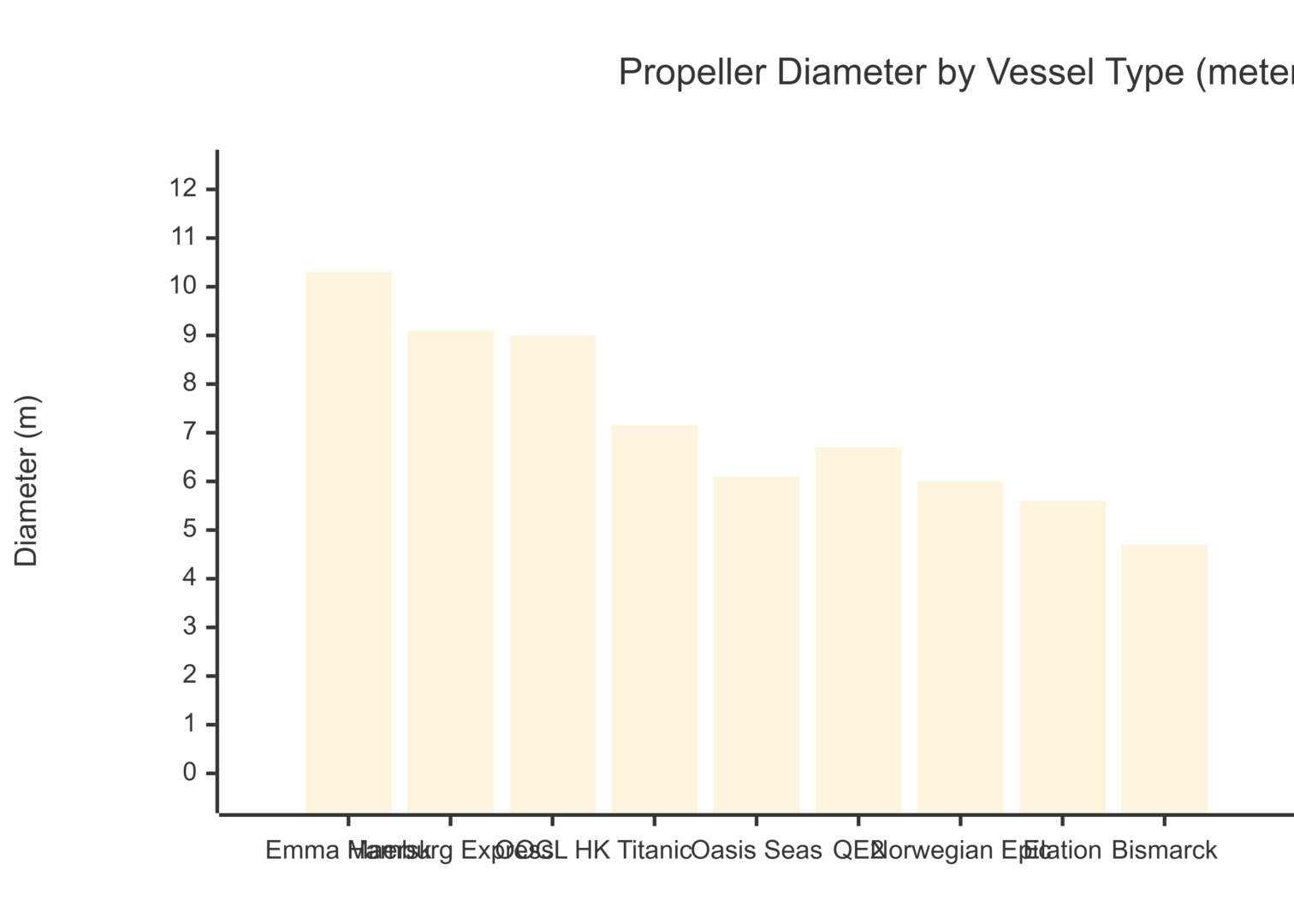
Propeller Size vs. Vessel Type
Key Materials Used in Large Marine Propellers
| Material | Properties | Typical Use |
|---|---|---|
| Nickel-Aluminum-Bronze (NAB) | Corrosion-resistant, high strength | Modern large propellers |
| Manganese Bronze | Hard, wear-resistant | Historic warships |
| Solid Bronze | Machinable, reliable | Early ocean liners (Titanic era) |
| Stainless Steel | High tensile strength | Some naval applications |
Manufacturing Process of a Large Marine Propeller

Manufacturing the Emma Maersk propeller, for example, required a single continuous pour of molten alloy into a precision sand mold, followed by days of controlled cooling to prevent structural stress fractures. The finished propeller then underwent CNC machining to achieve exact blade profiles before being transported overland by special convoy.
Propeller Pricing — How Much Do the Largest Cost?
Large ship propellers are custom-engineered components. Pricing varies significantly by size, alloy, and complexity:
| Propeller Size | Estimated Cost |
|---|---|
| Small vessel (under 3 m) | $50,000 – $200,000 |
| Mid-size cargo (3–6 m) | $500,000 – $1.5 million |
| Large container ship (7–9 m) | $2 million – $5 million |
| Ultra-large (10 m+, e.g., Emma Maersk) | $5 million – $10 million+ |
These figures reflect raw material costs (NAB alloy alone is expensive at scale), precision machining, quality certification, and logistics for oversized transport.
Why Propeller Size Matters
Larger propellers are not simply about raw size — they operate at lower RPMs, which reduces cavitation (the formation of vapor bubbles that erode blades), improves fuel efficiency, and extends operational lifespan. A 10-meter propeller spinning at 90–100 RPM moves the same or more water as a smaller propeller at 300 RPM, but with significantly less cavitation damage and energy loss.
This is why ultra-large container ships favor massive, slow-turning propellers paired with high-torque, low-speed engines — the combination delivers the best efficiency across long ocean transits.
Conclusion
The world’s biggest ship propellers are more than oversized mechanical components — they are precision-engineered systems that make global maritime trade possible. From the 113-ton giant on the Emma Maersk to the historically significant bronze propellers of the Titanic, each represents the pinnacle of engineering capability at the time of its construction.
As vessels continue to grow larger and environmental regulations demand greater efficiency, propeller design will keep evolving — with advances in blade geometry, materials science, and hybrid propulsion systems pushing the limits of what these maritime giants can achieve.
Happy Boating!
Share 10 Biggest Ship Propellers in the World with your friends and leave a comment below with your thoughts.
Read What are SSB Radios? until we meet in the next article.